A trustworthy gazebo builder quote should never be just a price. It should assign scope, materials, site work, permits, schedule, payment terms, warranty boundaries, and post-installation service in writing, so you know exactly who is responsible for what before you sign anything. If a proposal is missing any of these pieces, that is your cue to ask for a revision, not to assume the gap works in your favor.

Use the checklist below to compare gazebo builders on the same terms, spot the quotes that leave responsibilities open, and decide with confidence whether a custom build, professional kit assembly, or DIY installation fits your project.
Use This Gazebo Builder Vetting Checklist Before You Compare Quotes
Send every builder the same short project brief, then require written answers to each item below. Use those answers to compare the proposals on matching terms.

- Project basics: State dimensions, intended location, surface type (lawn, patio, deck), design requirements, and materials. Ask whether the proposal is labor-only or supply-and-installation.
- Design and permits: Get a written yes, no, or not-applicable for design work, permit applications, and inspections.
- Site and structure: Confirm site preparation, foundation work, and anchoring responsibility in writing.
- Logistics: Clarify delivery, assembly, cleanup, and disposal.
- Timing and money: Record the proposed schedule, payment structure, and how change orders are priced and approved.
- Coverage: Ask for warranty terms and who handles service after installation.
- Exclusions: Request named exclusions, allowances, subcontractors, and any homeowner-provided items.
- Gate rule: Only advance a proposal once it assigns each item above or tells you the next step to confirm it.
The FTC says a written estimate should describe the work, materials, completion date, and price. Use those fields as a baseline, then ask separately about permits, change orders, warranties, and contractor responsibilities. Our own gazebo buying checklist covers similar ground for shoppers comparing a catalog structure instead of a custom build.
Verify the Builder's Qualifications and Project Experience
A builder who can document relevant experience, insurance, and past client results is easier to trust than one who relies on a verbal pitch. Screen for this before you request a final number.
Check Relevant Experience and Credentials
- Ask for: photos or references from gazebo, pergola, or comparable outdoor-structure projects, plus proof of insurance and any license or registration required in your area.
- If subcontractors will be involved: request each subcontractor's name, role, and applicable license or insurance documentation before work begins.
- If the answer is vague: treat it as a reason to keep comparing rather than assume the builder or subcontractors are qualified.
Use References to Test Follow-Through
Call at least two former customers and ask three things: did the final scope match what was quoted, how were change orders handled, and did the builder respond after installation was complete? An unverifiable or reluctant reference is a signal to look elsewhere.
Notice How the Builder Handles Questions
A builder who explains assumptions and puts exclusions in writing is simpler to compare than one who answers only in generalities. Responsiveness is a useful screening signal, but it does not replace a license check, insurance proof, real references, or a signed contract. Consumer guidance from the New York Attorney General recommends comparing contractors, checking insurance and licenses where applicable, and reviewing references before work begins.
Assign Permits, Site Work, and Anchoring Before Work Starts
Local approval and construction responsibility are two different things, and your contract should name the party for each. A builder can help coordinate permits, but the contract should assign who researches, applies, pays, schedules, and closes out each item. Local law or the permitting authority may assign responsibilities differently, so confirm the applicable rule for your property.
Confirm the Local Approval Path
Rules vary by city, county, and HOA. Montgomery County, Maryland, for example, includes gazebos in its accessory-structure permit process, with plan review and inspections required before and after construction. This is one local example, not a nationwide rule, so ask your builder to identify the applications, drawings, fees, inspections, and closeout documents your specific property needs.
Define Site Preparation and Foundation Work
Ask what the builder will inspect and price for grading, surface condition, access, drainage, and base or foundation preparation. Require a stated exclusion and change-order trigger for any condition that turns out to be different once work starts, such as an uneven grade or a hidden utility line.
Put Anchoring and Inspection Responsibility in Writing
Confirm who selects the anchoring method for your actual surface. Confirm who installs it. Confirm who signs off that it is complete. State each role in the contract. A generic anchor instruction or a builder's verbal reassurance is not a substitute for a property-specific answer. Before construction or modification begins, confirm the applicable local approval path and the named party responsible for applications, inspections, and closeout. Ask a qualified professional to address foundation and anchoring suitability.
| Responsibility | Named Party | Included or Excluded | Proof or Open Question |
|---|---|---|---|
| Permit application | ? | ? | Approved plans; who submits and pays? |
| Site grading | ? | ? | Site assessment; what if the surface is uneven? |
| Foundation/anchoring | ? | ? | Final inspection; who confirms it's done? |
| Delivery staging | ? | ? | Delivery note; who receives materials? |
| Cleanup and disposal | ? | ? | Walkthrough; what counts as complete? |
If you already have a deck or patio in mind, our deck anchoring checks walk through the framing, clearance, and drainage questions that belong in this same conversation.
Compare the Quote Line by Line
Two builder quotes are only comparable when they use the same scope brief. Normalize every proposal against the checklist categories above before you look at the bottom-line price.
Match the Scope Across Proposals
| Line Item | Builder A | Builder B | Status or Follow-Up |
|---|---|---|---|
| Materials | Included, excluded, allowance, or homeowner-provided? | ||
| Delivery and unloading | Included or excluded? | ||
| Assembly | Included or excluded? | ||
| Site preparation | Included, excluded, or allowance? | ||
| Foundation or anchoring | Who performs and verifies it? | ||
| Permits and inspections | Who applies, pays, schedules, and closes out? | ||
| Cleanup and disposal | Included or excluded? |
Mark each row as included, excluded, an allowance, homeowner-provided, or pending verification.
Expose Allowances, Exclusions, and Change Orders
- What triggers a price change, and who has to approve it in writing before work continues?
- What is listed as an allowance rather than a fixed cost, and what happens if the actual cost is higher?
- What conditions are excluded outright, such as rock removal or utility relocation?
- Is there a written authorization step for any change, or only a verbal one?
Use the comparison sheet to record payment schedules, permits, change orders, materials, warranties, cleanup, and contractor responsibilities. Ask the builder to complete any field that affects the total or your obligations.
Compare the Deliverable and Completion Standard
Define what counts as substantially complete, what cleanup is included, and what documents or walkthroughs you receive at the end. Keep exact prices and timelines specific to each proposal rather than assuming one builder's numbers apply to another's scope.
Lock in Schedule, Payments, Change Orders, and Warranty
Before you sign, the contract should name a completion standard, a payment schedule, a change-order process, cleanup terms, a warranty issuer, and a service contact. If the builder will not define one of these terms, request a revision before signing.
Tie Payments to Defined Milestones
- Ask what each payment releases: deposit, delivery, assembly start, or final completion.
- Confirm what deliverable proves each milestone was reached.
- Ask how an approved change order affects the remaining balance.
Avoid treating any single state's payment guidance as a universal rule; instead, use it as a baseline for what to ask.
Define Schedule, Delays, and Change Orders
- What are the estimated start and completion dates?
- What access, weather, or approval dependencies could delay the project?
- How will the builder notify you of a delay?
- Is written approval required before any scope or price change takes effect?
Separate Warranty and Service Responsibilities
Name the warranty issuer, the covered component or labor, the term, exclusions, claim process, and response contact. State who is responsible for damage that occurs during assembly and how that damage will be corrected or reported. If you are buying a catalog kit and hiring separate assembly help, keep the product warranty distinct from installer labor, anchoring, and site work.
Our patio gazebo has separate limited warranty periods. The hardtop roof is covered for five years, curtains and netting for two years, and frame construction for one year. These listed periods do not extend to a third party's installation labor or site conditions. Put labor, site work, anchoring, assembly damage, and post-installation service in separate written terms with the installer.
Custom Build vs. Kit Assembly: Which Route Fits?
Custom construction fits a project with design changes, an unusual site, or multiple trades to coordinate. A defined catalog kit fits when the structure you want already exists as a product and the remaining work is delivery, assembly, and site-specific preparation you can assign separately.
| Comparison Axis | Custom Build | Kit Assembly | Best-Fit Signal |
|---|---|---|---|
| Project scope and flexibility | Designed around your site and specs | Fixed catalog configuration | Choose custom if the design must change |
| Permit and site-work responsibility | Builder may coordinate, but must be named in contract | Homeowner or installer confirms locally; the kit does not settle it | Confirm local approval before either route |
| Installer responsibilities | Broad: design, materials, labor, cleanup | Narrower: delivery, assembly, anchoring | Match the scope to what you're actually paying for |
| Warranty and service | Set by builder contract | Limited to listed product components | Do not assume one warranty covers the other |
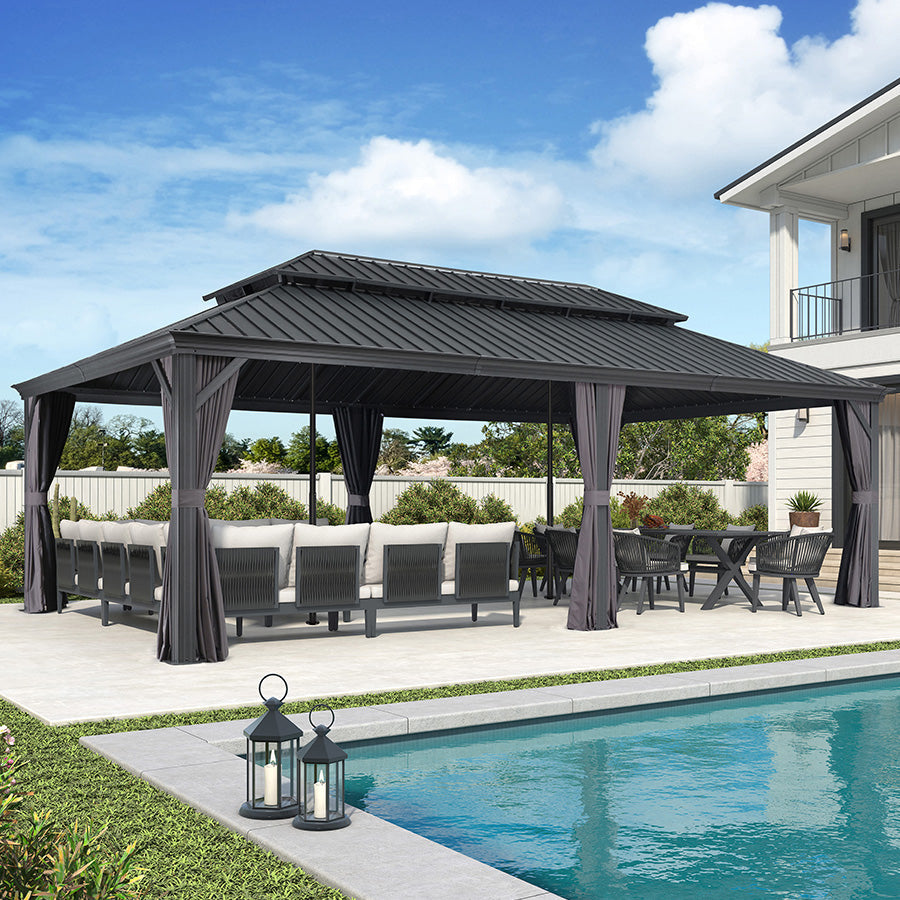
Our PURPLE LEAF Patio Gazebo for Backyard Grey Hardtop Galvanized Steel Roof Awning with Reinforcement Support Rod is a defined aluminum gazebo. It has a powder-coated aluminum frame, a galvanized hardtop roof, curtains, and netting. Its sloped roof is listed as a drainage feature.
The product listing says two to three people are required to assist with installation. Plan for that labor before choosing DIY or hiring an installer. The listing also advises purchasers to check their local city, municipality, and applicable HOA guidance for building-code and zoning requirements before purchase.
The product listing does not assign your permit, site-preparation, anchoring, or installer-labor responsibilities. Put those tasks in a separate written scope with whoever assembles it. If an open, beam-style structure fits your yard better than a roofed gazebo, cedar pergola kits and a wood pergola kit serve a different design goal. Compare them on their own terms rather than treating them as interchangeable with a gazebo. If your search includes a lightweight gazebo, compare the listed materials and installation requirements rather than relying on that label alone.
Choose the kit route only after confirming that the catalog configuration fits your project. Confirm local approval separately. Assign site preparation, anchoring, and assembly responsibilities in writing. The kit route can then avoid custom design coordination when a defined product meets your needs.
Make the Final Hire, Revise, or Walk-Away Decision
Use a three-way rule: hire when the builder has assigned every responsibility in writing, revise when the builder is responsive but the proposal still needs a clear term, and walk away when key duties remain vague after you ask for clarification. If the documented project fits a defined catalog kit instead, compare kit assembly only after its separate site, approval, anchoring, and labor responsibilities are clear.
- Recheck the five gates: scope, local approval, site work, contract terms, and warranty or service ownership.
- Send one written clarification request for anything still unresolved.
- Require the builder to send a revised, written proposal, not a verbal update.
- Verify any open local-authority question before signing or before work starts.
- Before signing, compare the final proposal with your clarification request and keep the approved version with the contract.
FAQ
What Should I Ask a Gazebo Builder?
Ask about comparable project experience, insurance and any applicable license, full scope, permit and inspection responsibility, site preparation, schedule, payment structure, change-order process, warranty terms, and who handles service after installation. Get every answer in writing so you can compare it against another bid later.
What Should a Gazebo Quote Include?
A complete quote should list labor, materials, delivery, assembly, site work, foundation or anchoring, permits and inspections where applicable, cleanup, named exclusions, a schedule, a payment structure, and warranty terms. If any of these fields is missing, ask the builder to fill it in before you compare totals.
When Is Professional Gazebo Work Necessary?
Professional help tends to fit custom design work, complex site conditions, coordination with a local approval process, or projects involving multiple trades. It can also fit if you would rather not manage delivery, anchoring, and assembly yourself. None of that makes DIY installation universally unsuitable; it depends on your site and your comfort with the work involved.
Does a Gazebo Need a Permit?
That depends on your location and your specific project. Some jurisdictions, including Montgomery County, Maryland, include gazebos in their accessory-structure permit process, but that is a local example rather than a nationwide rule. Confirm requirements with your local building department and put permit responsibility in writing before work begins.