An aluminum gazebo can be a strong candidate for a coastal property, but the frame material alone does not prove it. Before you compare models, verify five things in order: the finish documentation, the hardware and drainage design, the anchoring plan for your actual site, your ability to reach and clean it, and whether replacement parts are documented. Depending on what you find, you land on one of three outcomes: proceed with the order, request more documentation, or choose a different structure. That workflow, not the word "aluminum" on a spec sheet, is what determines coastal fit.
Coastal Environment Reality: Identify the Exposure Before Comparing Gazebos
Coastal buying decisions are exposure-specific. Wind, flooding, corrosion, and material decay do not affect every coastal lot the same way, so your site's conditions decide what you need to verify before you compare gazebo listings.

Start With the Site's Exposure Profile
Before you shop, write down these conditions for your property:
- Marine moisture or salt exposure: routine salt spray changes what finish and hardware questions matter.
- Shelter versus open exposure: a covered patio behaves differently than an open, wind-exposed yard.
- Storm and wind exposure: a location that regularly sees high wind needs a documented anchor plan, not a general one.
- Foundation or installation surface: a poured slab, deck, or paver base each changes the anchoring options.
- Drainage and flood context: standing water or floodplain status affects both structure and site prep.
- Local permitting, HOA rules, and the manufacturer's own installation instructions: these govern what you're allowed to install and how.
Coastal construction guidance from the Federal Emergency Management Agency and Pacific Northwest National Laboratory supports checking wind, flooding, corrosion, and decay resistance along with local rules and manufacturer instructions through this coastal exposure guidance. This guidance does not certify a product as coastal-rated. Use your recorded site conditions to decide which product documents you still need.
Turn Exposure Into a Buying Decision
Once you have your exposure profile, use it as a filter. Proceed toward a purchase only when the documentation you can get for a specific model addresses your exposure and you can realistically maintain it long-term. Move to verification when the finish, hardware, anchor, or support facts you need are missing.
| Outcome | Required finding | Next action |
|---|---|---|
| Proceed | Your exposure is recorded, and the finish, hardware and drainage, model-specific anchor path, and maintenance access are documented and fit the site. | Proceed with the order. |
| Verify | One or more required details are missing or unclear. | Request the missing documents or contact support before ordering or installing. |
| Choose another | A documented site requirement cannot be met, or the installation path does not match the surface or exposure. | Choose another structure with a documented path that fits the site. |
Evaluate the Finish and Corrosion Resistance
A finish label tells you what the frame is coated with, not how well that coating holds up in salt air. Ask for the documentation behind the label before you order.
What the Finish Label Tells You and What It Does Not
A listing might state a bronze or gray powder-coated aluminum frame. That tells you the base material and coating type. It does not tell you the pretreatment step, the coating thickness, whether the system was tested for salt-spray performance, what's excluded from coverage, or how to touch up a scratch. Treat those gaps as open questions, not disqualifiers.
Ask for the Finish Documentation Before Ordering
Before you buy, request the named finish system, the pretreatment process, the number of coating layers, the repair or touch-up procedure, and any stated exclusions. If a seller can't provide that, treat the purchase as a "verify" step rather than a pass or fail.
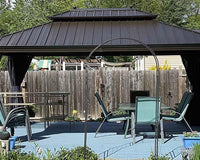
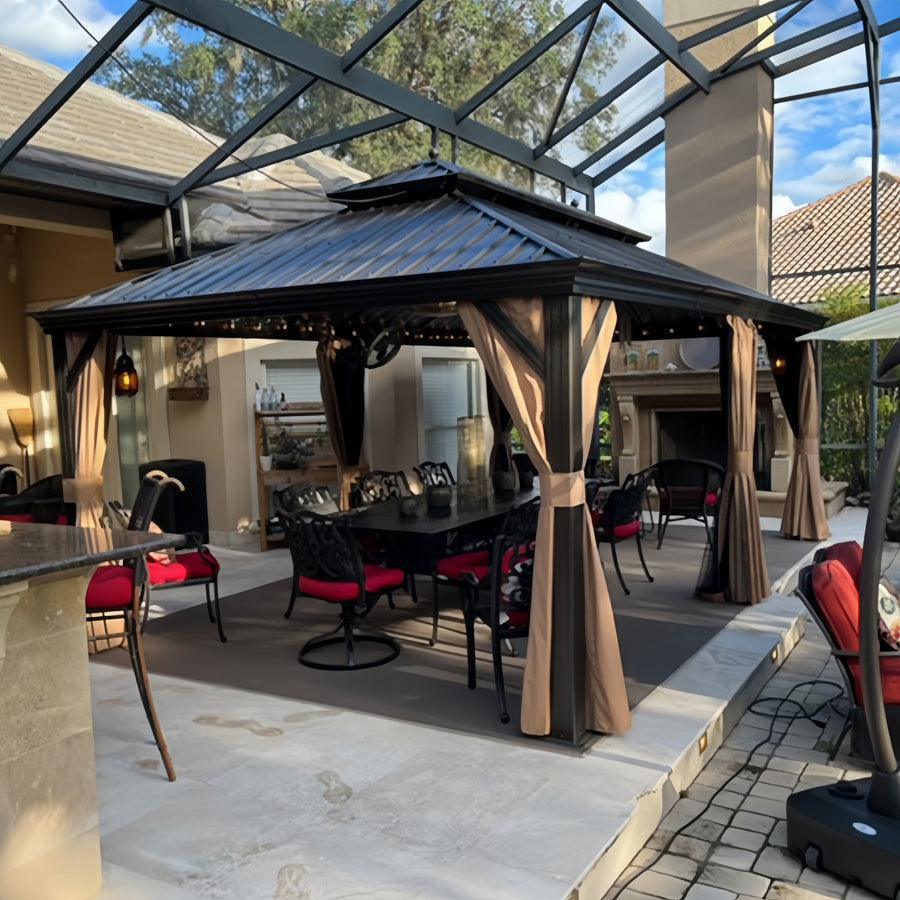
Our bronze frame specifications page lists a bronze powder-coated aluminum frame, a galvanized hardtop roof, and a sloped roof with gutter drainage. These are listed construction details. They are not an independent coastal-performance certification, so ask about pretreatment, repair, and applicable finish-system documentation before ordering for a high-salt site.

Check Hardware, Drainage, and Fastener Integrity
Hardware compatibility, not a general "rust-resistant" phrase, is the real purchase question for a coastal gazebo. Run through this checklist before you order.
Hardware Inspection Checklist
- Fastener material and coating: ask what the screws, bolts, and brackets are made of and how they're coated.
- Dissimilar-metal isolation: confirm how the design protects aluminum from contact with other metals in wet conditions.
- Aluminum-to-masonry or concrete interfaces: ask how the base is isolated where it meets a slab or paver surface.
- Drainage outlets, gutters, seams, and cleanout access: confirm you can reach and clear these points, since trapped moisture accelerates corrosion.
- Replacement hardware and parts documentation: ask whether individual fasteners, brackets, or drainage parts can be ordered separately later.
An unanswered question on any of these points means you should request clarification before ordering for a salt-exposed site, not assume the part is fine.
Read Rust-Resistant Claims Carefully
A broad "rust-resistant" description on a product page does not identify the specific fastener alloy, coating, or isolation method used at each joint. Guidance from the Aluminum Association notes that moist aluminum connections need compatibility controls, including protective coatings where aluminum contacts other metals and limits on certain high-strength steel fasteners in contact with aluminum. That's a reason to request the specific compatibility details for your model, not a fastener recommendation for any single product.
Confirm Anchoring for Coastal Wind Loads
Anchoring has to match your actual foundation and wind exposure, not a generic base design. Confirm this before you install, and before you order if your site is exposed.
Match the Anchor Plan to the Actual Site
- Identify your foundation or surface: note whether you have a poured slab, wood deck, pavers, or bare soil.
- Get the model-specific anchor and foundation instructions: request the manufacturer's documented anchoring method for that exact model.
- Check local wind, flood, permitting, and professional requirements: confirm what your jurisdiction requires for a structure your size in your wind zone.
FEMA's National Flood Insurance technical-bulletin material provides background on corrosion-resistant coastal connectors and jurisdiction-specific coastal requirements. It does not prescribe one anchor size or embedment depth for every structure. Our gazebo anchoring guide covers general assembly and site-preparation steps, but it does not replace the exact model's anchor documentation for a coastal wind zone.
Know When to Pause the Purchase
Some listings note that a gazebo should be anchored soon after the frame and finish are installed. That's a sequencing instruction, not evidence the anchor method meets your wind or flood conditions. A heavy base, wide footprint, or pre-drilled holes are not a substitute for a documented anchor path that matches your surface and exposure. If you can't get that documentation for your site, pause the order and ask the manufacturer directly, or consult a qualified local contractor before installing in an open or storm-exposed location.
Plan Coastal Gazebo Maintenance Around Cleaning Access
Coastal gazebo maintenance depends on what you can reach, not a fixed calendar. Build your plan around triggers instead of a single universal interval.
Maintenance Schedule for Coastal Environments
- Routine: inspect reachable frame joints, fasteners, gutters, and roof edges for early signs of buildup or wear.
- When deposits or debris appear: clean the affected surfaces using the manufacturer's approved cleaning products and method.
- After severe weather: check drainage paths, hardware, curtains, netting, and any visible movement or damage.
- Periodically: confirm that replacement-part and warranty information is still available for your model.
Check Cleaning Access Before You Buy
A maintenance plan only works if you can physically reach the parts that need it. Confirm whether roof channels, hidden joints, and drainage outlets are reachable, and whether curtains and netting are removable for washing.
Our gray aluminum gazebo details page lists removable curtains and netting, a sloped roof with gutter drainage, and component-specific limited warranties covering the hardtop roof, curtains, netting, and frame separately. Use these listed details to judge access and documented coverage. Then confirm the cleaning frequency and any coastal-specific finish care for your site with the seller before you order.
Use the Buyer's Proceed, Verify, or Choose-Another Checklist
Run this four-step sequence with the findings from the sections above, then take one action.
- Classify your exposure: sheltered, routine salt-air, or open and storm-exposed, based on the profile you built earlier.
- List what's missing: mark any gap in finish, hardware, anchoring, or replacement-parts documentation for your chosen model.
- Confirm your installation and maintenance path: verify you can anchor to your actual surface and reach the parts you'll need to clean.
- Choose your outcome: proceed if every check is documented and maintainable, request documentation or contact support if one or two items are missing, or choose another structure if your site's requirements can't be met.
If you have questions about a specific model's coastal fit, we're glad to help. Check the product specifications on the page you're considering, or contact our support team about site-specific installation questions before you order.
FAQ
What Is the Best Material for Coastal Gazebos?
No single material is universally best for every coastal site. An aluminum gazebo can be a reasonable choice when its finish system, hardware compatibility, drainage design, anchoring documentation, and maintenance access all match your exposure. The material label alone doesn't answer that; the verification steps above do.
How Often Should I Clean My Gazebo in a Salt-Air Environment?
There isn't one universal interval. Follow the manufacturer's approved cleaning method, inspect after storms or whenever you notice visible salt deposits or debris, and set your routine cleaning frequency based on how exposed and how reachable your structure is.
Can I Use a Lightweight Gazebo Near the Coast?
Weight alone doesn't decide fit. A lightweight structure can be workable or unworkable depending on whether you can verify a site-specific anchor and foundation plan that matches your wind exposure, flood context, and local requirements. Confirm that documentation before ordering or installing.