
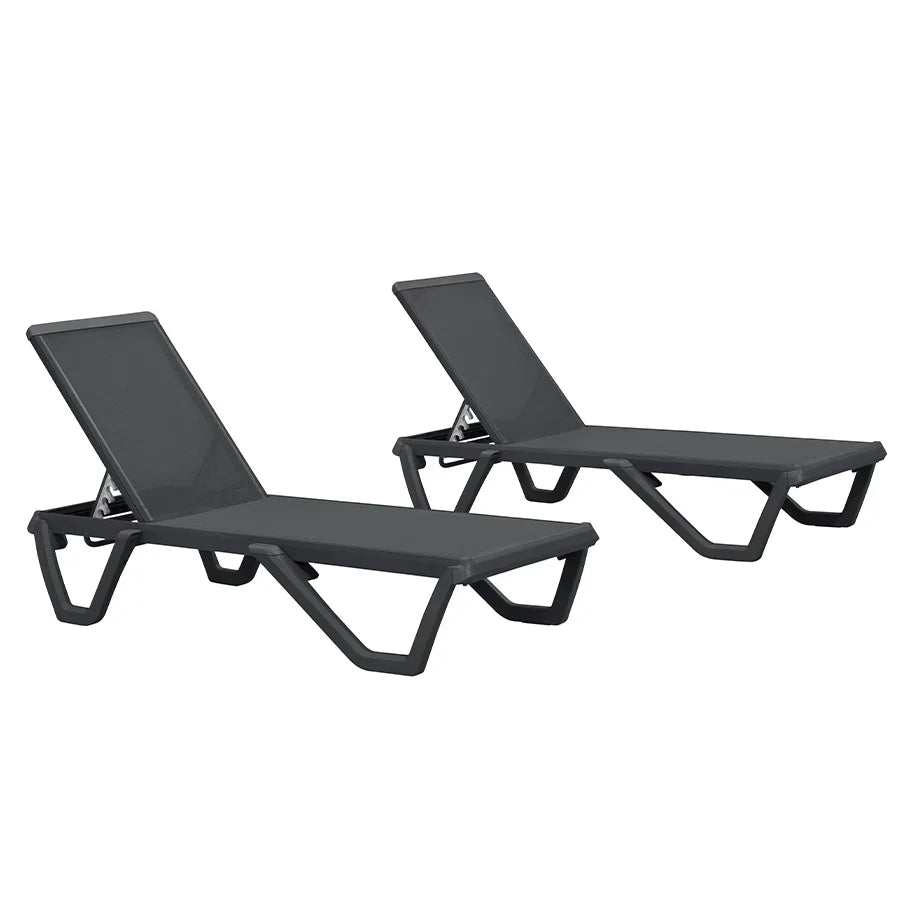
To choose a cover for an outdoor chaise lounge, measure the whole chaise in the exact position it will sit under the cover. The seat alone won't tell you enough. Then compare that full outline with the cover maker's own dimensions and measuring instructions.
If you have a reclining chaise, set the backrest where it will stay while covered before you measure. Buy a cover only when its listed sizing clearly fits that outline. Check its fit and ventilation details too.
Measure the chaise in its covered position
The size that matters is the chaise's outer outline in the position it will stay in all season, not the cushion or the seat. A fixed chaise has only one shape, so measure it as it stands. An adjustable model has a different outline for each recline setting, so pick your covered position first.

- Set the position. Move the backrest to the setting it will hold under the cover, whether that's flat, upright, or somewhere in between. Leave in place any cushions or accessories that will stay underneath.
- Measure the widest width. Go from outside edge to outside edge at the widest point. That point may be at the armrests or the frame, not the seat.
- Measure the full length. Run the tape from the very front of the chaise to the very back, following the frame and not just the sitting surface.
- Measure the height. Measure from the ground to the highest point, which on a raised backrest is usually the top of the back.
- Note projecting parts. Write down anything that sticks out beyond the main frame and will stay under the cover, such as armrests, wheels, or a headrest.
Write each number down in inches, along with the backrest setting you used. If you later cover the chaise in a different position, measure again. For more on how chaise styles and features vary, our chaise lounge buying guide covers the main designs. If your chaise rolls into place, models like those in our wheeled chaise lounge collection have wheels that sit in the outline, so measure from the outside edges of those parts too.
Match the full outline to the cover's sizing guide
A cover is a match only when its documented sizing fits every dimension you recorded and the chaise's shape. The "chaise cover" label on a product doesn't prove that.
Start by reading how the maker measures. Some size charts list the furniture a cover fits. Others list the cover's own finished dimensions. Those two numbers mean different things, so find out which one you're looking at before you compare. Then match like with like: your width against the listed width, your front-to-back length against the listed length, and your height against the listed height.
Check all three numbers. A cover that matches your length but falls short on height won't fit an upright backrest. Shape matters too. A cover cut for a flat lounger may not suit a chaise you plan to cover with the back raised. A cover designed for a raised back may leave extra fabric on a flat one.
Don't guess at a standard amount of extra room, and don't assume the next size up is safe. The maker's guidance should settle the question. If the listing doesn't say how its dimensions were measured or what shape it fits, contact the maker before you buy. Treat the fit as unconfirmed until you get an answer.
Check fit and ventilation without assuming a guarantee
After the size checks out, read the cover's own fit, vent, and fastening details. Designs differ, so one cover's method doesn't carry over to another. For outdoor furniture in general, published expert advice in Better Homes & Gardens recommends resting the cover on the frame rather than letting it drape loosely to reduce pooling, noting that vents and a slight bottom gap help airflow without guaranteeing results for every piece.
Use it as a checklist:
- Frame support: Does the cover sit on the chaise's frame in your covered position, or will large areas sag?
- Vents: Does the maker describe vents or another airflow feature?
- Bottom edge: Do the instructions say how the hem should sit, and is some airflow at the bottom possible?
- Closures: Does it have straps, buckles, drawstrings, or an elastic hem, and where do they attach?
- Instructions: Follow the maker's fitting steps. Don't cut or alter the cover in ways its instructions don't allow.
If the cover would sag badly on your chaise, or the maker gives no ventilation details, ask before buying. Cushions need their own care too. Our guide on how to store cushions after rain walks through drying them before they go back under a cover.
FAQs
Should I cover the chaise flat or with the backrest up?
Either can work. Choose the position you'll actually use for storage and buy for that shape. A flat position usually gives a lower, longer outline. A raised back makes the chaise taller. Our article on where to place a chaise lounge can help you decide where it will sit while covered.

Is a custom cover better than a universal one?
The expert quoted in Better Homes & Gardens says custom covers give the best fit for a specific piece of furniture. Thicker universal covers can also protect furniture when they're sized carefully. Either way, your measurements decide whether a cover works.
What if a cover is too small or too loose?
Both cause problems. The same article notes that a cover that's too small can strain seams or materials, and one that's too loose can blow away or let debris in. If no listed size fits your outline, ask the maker about other options rather than settling for a poor fit.
How do I keep a chaise cover from blowing off?
Look for straps, clips, or buckles that attach to the legs or frame. The expert also mentions weighted systems for windy spots. Check the fasteners from time to time and adjust them through the season.


