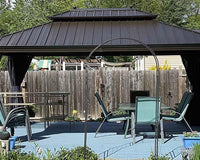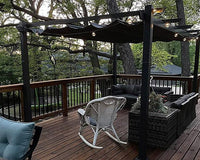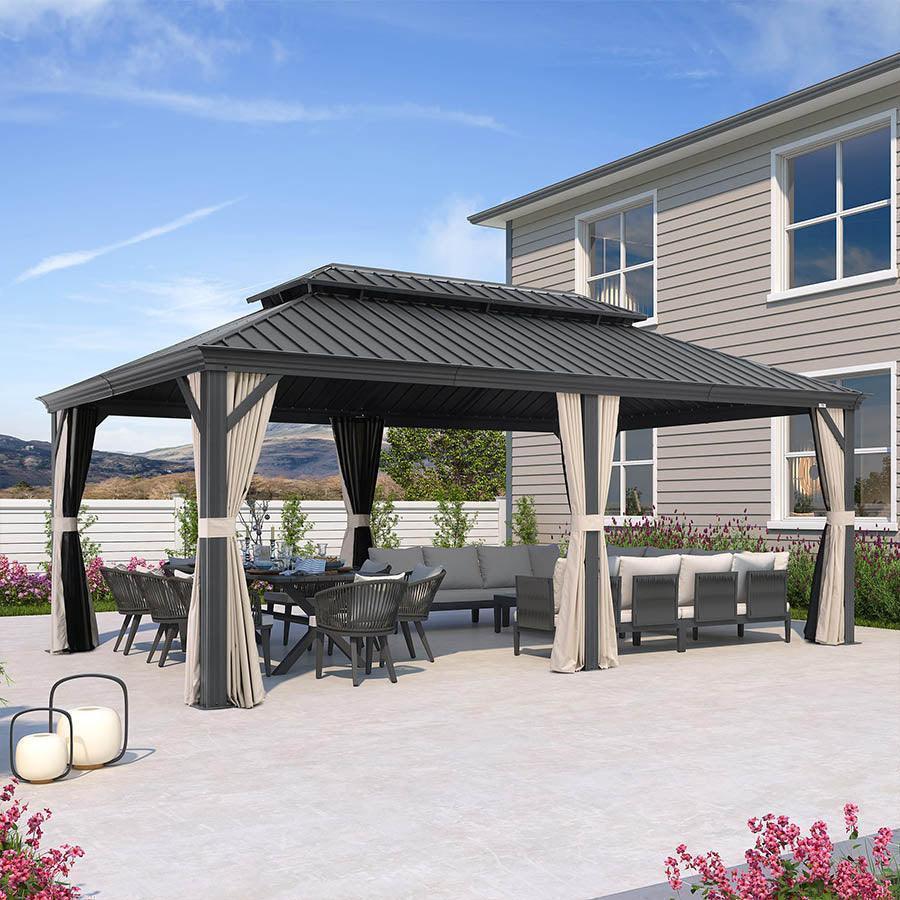
A gazebo on a deck can work, but an existing deck is not automatically a suitable base. Treat it as a candidate for detailed checks only when the exact gazebo footprint and base locations can plausibly align with sound deck support, the model's instructions allow the planned attachment, and the deck has no obvious condition or placement problems. If the framing or anchoring is uncertain, pause for a qualified review. If the footprint conflicts with the deck's edges, access, drainage, waterproofing, or construction, choose another location or redesign before buying.

Can a Gazebo Go on a Deck? Make This Three-Way Decision First
A gazebo on a deck is a project-specific compatibility question, not a universal yes-or-no decision. Compare the exact structure you plan to install with the deck's framing, condition, attachment route, and surroundings before placing an order.
- Candidate for detailed checks: The gazebo's footprint and base locations are known, those locations appear able to connect to sound deck support, the deck is visibly serviceable, and the manufacturer's instructions fit the planned installation. This does not automatically apply to every soft-top or hardtop model. Keep the purchase on hold until the support and anchoring route is documented.
- Pause for qualified review: The deck is elevated, older, moving, damaged, unfamiliar, or partly concealed; posts, footings, framing, or connections are unknown; or the attachment route is unclear. Gather the project details and have a qualified contractor, carpenter, structural professional, or appropriate local official review the conditions before buying or installing.
- Redesign or choose another location: The full footprint conflicts with an edge, railing, stairs, gate, door, maintenance access, drainage path, waterproofing, or the deck's construction. Do not solve that conflict by casually moving base plates or improvising an attachment.
This is screening guidance, not structural approval. Local building department and HOA requirements vary by property and project. For a plain-language starting point, see our local gazebo permit guidance, then confirm the requirements for your property. A local deck construction guide provides context for why project requirements should be checked rather than treated as universal (local deck construction guidance).

Check the Deck's Framing and Load Path
The key deck support for a gazebo is the deck's primary structural system, not the walking surface alone. Identify the gazebo's exact base or post locations, then trace how those concentrated attachment points would transfer loads through the deck.
- Identify the structural layout. Compare the base locations with accessible joists, beams, ledger boards, posts, and footings. These are the primary elements to document when evaluating a support path, as described in the deck framing guide.
- Map every base location. A deck can feel solid under normal walking use while its surface boards reveal little about the framing below. Mark each gazebo post or base plate and determine what structural member lies beneath or supports that area.
- Inspect accessible condition. Look for rot, splitting, corrosion, loose connections, sagging, unusual bounce, movement, standing water, or questionable repairs. These observations do not prove capacity, but they do change the next action: visible problems call for review before installation.
- Trace elevated support. On an elevated deck, follow the load path beyond the surface framing to beams, posts, and footings. If those elements or their connections are concealed or unknown, record what you can observe instead of assuming the hidden construction is adequate.
A known framing layout does not, by itself, approve a gazebo. It gives a qualified reviewer the information needed to assess whether the exact base locations and structure are a reasonable match.
Match the Gazebo Anchors to Sound Deck Support
To understand how to anchor a gazebo to a deck, start with the chosen model's installation instructions, not a generic fastener suggestion. Each gazebo base or post needs an attachment route that the instructions permit and that reaches an appropriate, sound part of the deck assembly.
The attachment location matters as much as the connector. A plan that relies on deck boards alone, a railing, loose blocks, improvised hardware, or relocated base plates does not establish a reliable support route. Do not bypass, weaken, split, crush, or casually alter structural members to make the footprint fit. Generic deck guidance cannot provide a universal gazebo anchor size, embedment, spacing, edge distance, wind performance, or capacity for every model and deck.
Before installation, place the exact gazebo instructions beside a marked-up deck layout. Show each base location, the accessible framing below it, and any area that cannot be drilled or fastened. If the instructions do not clearly fit the deck assembly, stop. Obtain project-specific input rather than substituting hardware or assuming that a gazebo deck anchoring method will work because it worked elsewhere.
Resolve Edge, Clearance, and Water-Path Conflicts
A structurally plausible gazebo on a deck can still be the wrong placement if the full footprint interferes with movement, drainage, or waterproofing. Check the roof overhangs, curtains, doors, stairs, gates, railings, openings, deck edges, and maintenance access—not just the four post locations.
Inspect above and below the deck before drilling or setting bases. Look for joists, beams, utilities, flashing, membranes, drainage routes, and other concealed constraints. Preserve the existing water-management path. An attachment that punctures a membrane, blocks drainage, traps moisture, or prevents maintenance access may require a different location even when the deck appears strong enough.
Do not apply an invented universal edge setback or clearance number. Use the exact gazebo instructions, the deck assembly, and local requirements for the project. If a base is near an edge or opening, a railing would become the attachment point, access is blocked, or waterproofing cannot be preserved, treat the conflict as a redesign or qualified-review issue rather than adjusting the layout casually.
Pause and Get a Qualified Deck Review When These Checks Fail
Stop before purchase or installation when any of the following conditions prevents you from confirming the support or attachment route:
- The deck moves, sags, bounces unusually, or shows rot, splitting, corrosion, standing water, or questionable repairs.
- The framing, ledger, posts, footings, or connections are unknown, concealed, or difficult to trace, especially on an elevated or older deck.
- The proposed gazebo is a larger or heavier structure than the deck was planned to support, and the project may require reinforcement or a concentrated support review.
- The planned anchors would attach to a railing, deck boards alone, relocated base plates, or hardware not covered by the model's instructions.
- Installation could penetrate a membrane, disrupt drainage, interfere with stairs or access, or leave inadequate room around edges and openings.
- The layout departs from the manufacturer's instructions or local requirements cannot be established.
For a review, bring the exact gazebo instructions, footprint and base dimensions, deck photos, accessible framing information, and proposed anchor locations. A municipal deck guide recommends documenting framing details such as the deck's framing and supports rather than guessing about concealed construction. If a qualified review cannot confirm support, anchoring, clearance, and water management, choose another location or redesign before ordering.
Frequently Asked Questions
These questions address common planning concerns that remain after the initial support, anchoring, and placement checks.
Can You Put a Gazebo on Any Deck?
No. A deck is not automatically suitable; the exact gazebo, base locations, support path, condition, placement, and local requirements all matter. Start by gathering the gazebo footprint and installation instructions.
How Do You Anchor a Gazebo to a Deck?
Use the chosen model's instructions and an attachment route that reaches sound support in the deck assembly. If the plan depends on deck boards alone, a railing, moved base plates, or improvised hardware, stop for a project-specific review.
Can a Deck Support a Hardtop Gazebo?
Possibly, but a hardtop model's footprint, construction, base locations, and exposure can change the review. Do not transfer a lightweight soft-top assumption to a hardtop; confirm the exact model before ordering.
When Should I Ask a Professional Before Putting a Gazebo on a Deck?
Ask before proceeding when the deck is elevated, damaged, moving, unfamiliar, or missing clear framing information, or when the plan requires reinforcement, membrane penetration, railing attachment, relocated bases, or a departure from the manufacturer's instructions.