
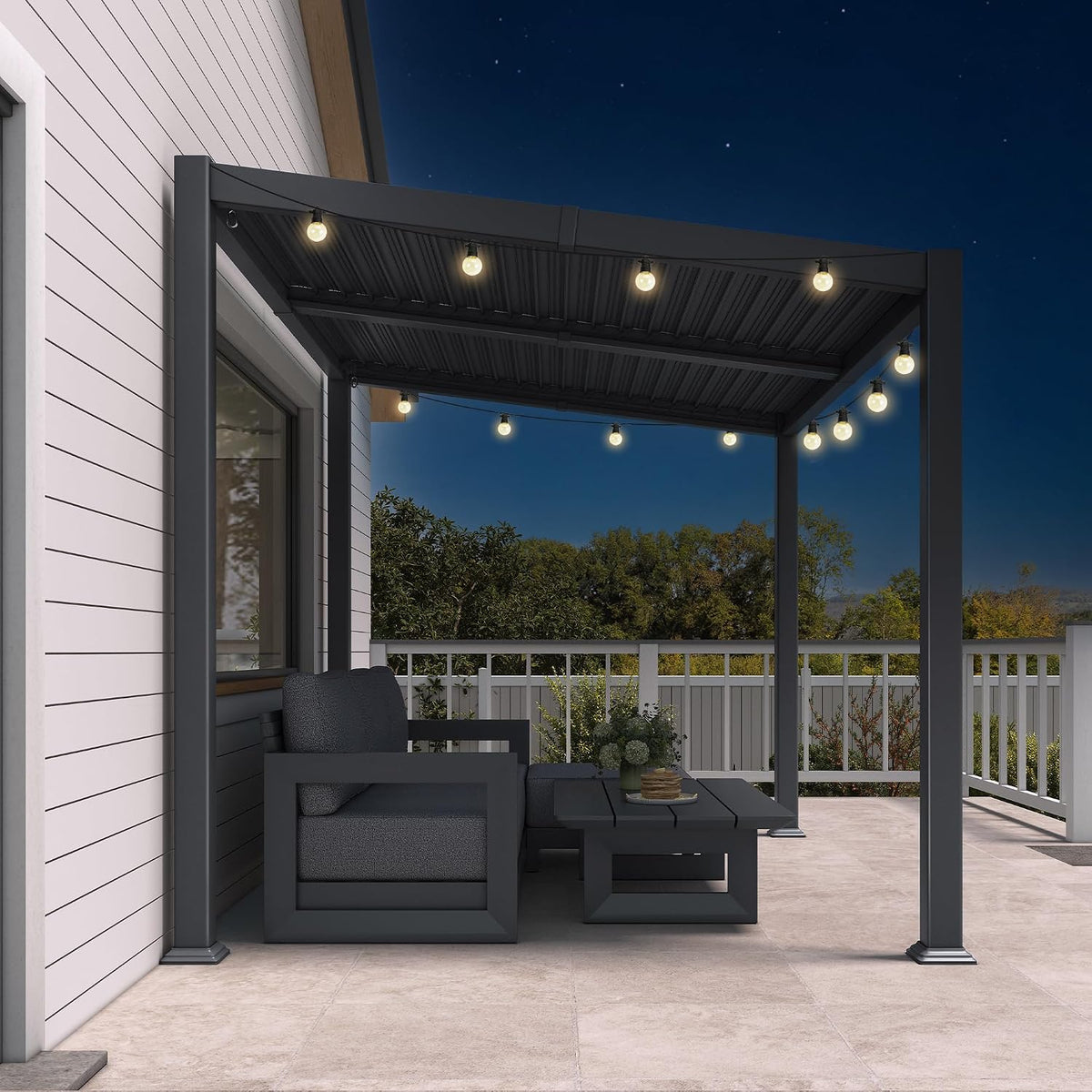
For patio dining, start with the kind of roof you want over your table. A traditional open pergola gives you an airy frame with less overhead coverage. A louvered pergola lets you change how open the roof is. A hardtop gazebo puts a solid roof overhead, but confirm how the exact model's roof works before you count on that.
None of the three automatically protects you in every kind of weather. Our patio pergola comparison below matches each roof to the way you like to eat outdoors. Then it covers the specs to check on any model you're considering.
Compare the Three Roof Experiences
Each structure feels different at mealtime because each one handles the space above you differently. Use this table to match a roof style to how you want dinner outside to feel.

| Option | Roof overhead | Dining experience it suits |
|---|---|---|
| Traditional open pergola | Open frame of beams and rafters | Airy, sky-visible meals with less coverage overhead |
| Louvered pergola | Slats (louvers) you can tilt | Changing openness from meal to meal |
| Hardtop gazebo | Solid hard roof panels | A more continuous roof over the table; confirm operation per model |
A traditional pergola is built around an open roof frame of girders and cross rafters. Sun and sky show through between the pieces, which is why an open pergola feels light and outdoorsy. It also means you get less overhead coverage than you would under a continuous roof. How much shade you actually get depends on the design, any add-ons like fabric or vines, and the time of day.
A louvered pergola has a roof of angled slats called louvers. On our Caesar model, for example, a manual crank tilts the sloped louvers to control sunlight, shade, and airflow. That's the main appeal for dining: you can open the roof for a sunset dinner and close it more for a bright lunch. How the louvers move, and how far, differs from one model to another.
A gazebo is a freestanding roofed structure that's usually open on the sides. A hardtop version uses rigid roof panels instead of fabric. Many shoppers think of the hardtop as a roof that stays put. A product listing that describes the roof material and drainage doesn't tell you whether the roof can move, though. If a fixed roof is the reason you're choosing a hardtop, look for that detail in the specifications or the manual.
Match the Roof to Your Patio Dining Priorities
Answer three questions in order and the right fit gets clearer. This is about what you prefer. It doesn't rank which structure is more comfortable or protects better.
- Do you want sky overhead or a roof overhead? If eating under an open frame sounds best, like a breezy brunch with filtered sunlight, start with an open pergola for patio dining. If you'd rather have something more continuous above the table, move on to the louvered and hardtop options.
- Does the roof need to change? Maybe you host a hot midday lunch one weekend and a stargazing dinner the next. If so, look for a model with documented adjustable louvers, then check how you operate them (crank, motor, or by hand) and how far they open and close.
- Do you want a roof that stays the same every meal? If you never want to think about adjusting it, a hardtop gazebo may suit you. Confirm in the specifications that this exact model's roof is fixed. Don't assume it from the word "hardtop."
If two options still look close, think about how you'll set up the space. Our guide to pergola ideas for outdoor rooms covers dining layouts, lighting, and furniture flow. For cooler-season hosting, our pergola vs. gazebo for fall entertaining guide walks through a weather-first decision.

Check the Exact Model's Specifications
The category name tells you what kind of roof to expect. It doesn't tell you how a specific model handles sun, rain, wind, or snow. Before you plan meals around any structure, check these points in its product details or manual:
- Roof operation. Is the roof fixed or adjustable? If it adjusts, find out how. Our Caesar louvered pergola uses a manual crank. Other louvered models may work differently.
- Rain handling. Look for how water leaves the roof. On the Caesar, the inclined roof sends rainwater into hidden channels that run through the posts and drain out near the base. A drainage feature shows how a roof manages water. It doesn't promise a dry table in every storm. For more on this, see our guides to louvered roof weather limits and hardtop gazebo rain checks.
- Severe-weather instructions. Read what the manufacturer says to do in wind, snow, or other extreme conditions. For the Caesar, the instruction is to open the louvers and raise or remove any shade screen accessories in high winds, snow, or other extreme weather to avoid damaging the pergola. That rule applies to that model. Don't assume it applies to other louvered pergolas.
- Stated coverage. Compare the listed roof and footprint dimensions with your table and chairs, so diners actually sit under the roof.
- Local rules. Some structures may need permission. Check your city and HOA guidelines before you buy.
If anything is missing from a listing, treat it as an open question and ask before you buy. Don't assume the answer is yes.
FAQs
Is a louvered pergola better than a hardtop gazebo for dining?
Neither one wins across the board. A louvered pergola fits diners who want to change how open the roof is. A hardtop gazebo fits diners who want solid panels overhead, as long as the exact model's specs confirm how its roof works.
Does an open pergola provide shade for a dining table?
It gives some shade through its open frame of beams and rafters, but less overhead coverage than a continuous roof. The amount depends on the design, any added cover, and where the sun is.
Will any of these keep my patio table dry in all weather?
Don't assume so. Rain handling and severe-weather limits vary by model. Read the exact product's specifications and manual, including any instructions for high winds or snow.
What should I compare first when shopping?
Start with roof operation (open, adjustable, or fixed), because that shapes the dining experience most. Then check rain handling, coverage dimensions, and weather instructions for the specific model.


