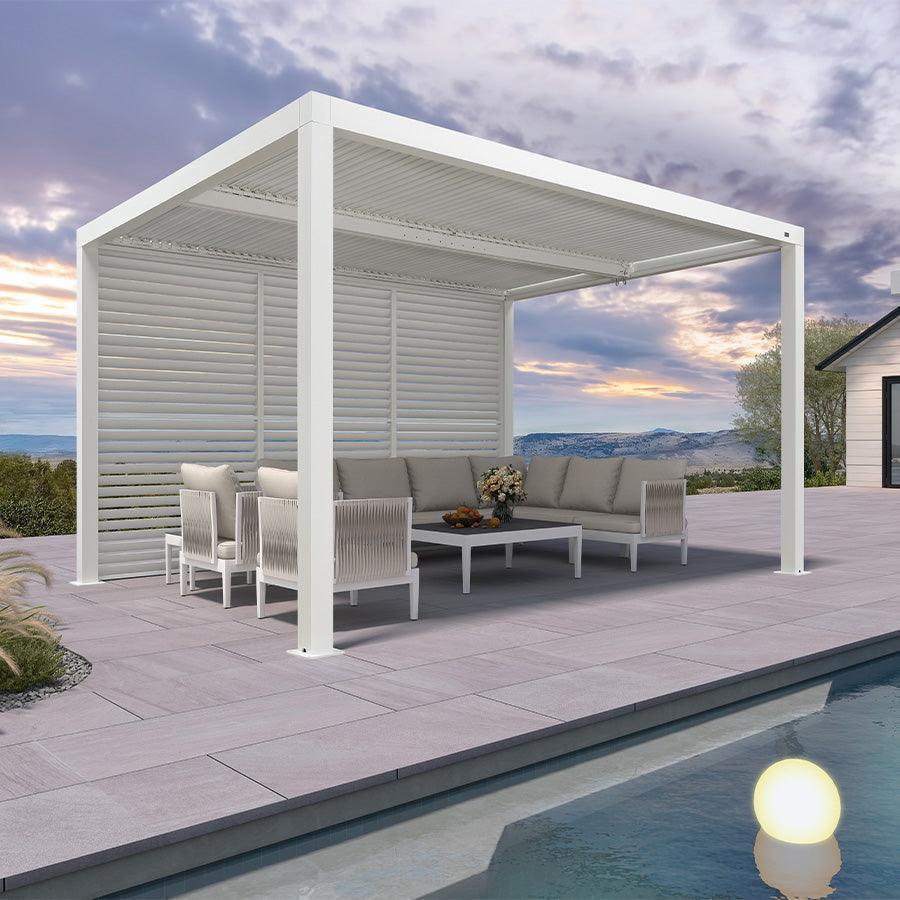
A louvered pergola uses rotating roof slats to control how much sunlight, shade, upward airflow, and rain reach the space below. Open slats create an open-air feel, angled slats offer a middle setting, and closed slats reduce overhead exposure. That control is useful in real weather, but it does not turn an open-sided structure into a sealed room.

How a Louvered Pergola Roof Changes Position
A pergola with a louvered roof uses adjustable slats, also called louvers, set across the top. As the slats rotate between more-open and more-closed positions, they change the paths available to light, air, and water. The exact control method and range of motion depend on the design, so the practical model below focuses on priorities rather than fixed angles or performance percentages.
Open Louvers: More Sky, Light, and Airflow
Open louvers leave more of the sky visible and allow more direct light and upward airflow through the roof. A documented louvered pergola manual describes opening the slats to let sunlight and air pass through, supporting this basic mechanical explanation for the design shown in that manual (Aoxun instruction manual).
The trade-off is straightforward: open slats do not block overhead rain or provide full shade. If the sun becomes too intense or rain starts, you can adjust the roof toward a more closed position, as long as the specific structure allows that operation in those conditions.
Angled Louvers: A Changeable Middle Position
Angled louvers create a middle setting between an open sky and reduced overhead exposure. They can cut some direct overhead sun while retaining some daylight and airflow, but the result changes with the sun’s direction, time of day, roof orientation, nearby walls, and trees.
That is why the roof does not provide one fixed shade percentage. An angle that feels comfortable at midday may still let low morning or afternoon sun in from the side. Treat the angled position as a way to fine-tune comfort during the day, not as a guaranteed level of shade.
Closed Louvers: More Overhead Shade and Rain Routing
Closed louvers reduce direct overhead exposure and can provide more shade from above. In some designs, this position also directs rain toward a built-in drainage path. One documented design describes fully closed louvers as its maximum-shade and rain-protection mode, but that is model-specific operating information—not a category-wide waterproofing promise (MIRADOR instruction manual).
Closing the roof can also reduce upward ventilation because fewer openings remain between the slats. The sides may still be open, however, allowing wind-driven rain and outdoor air to enter around the perimeter. The result is greater overhead control, not automatically a dry, enclosed room.
| Louver position | What it generally prioritizes | What remains conditional |
|---|---|---|
| Open | Sky visibility, daylight, and upward airflow | Overhead rain and direct sun remain exposed |
| Angled | A changing balance of light, shade, and ventilation | Sun angle, orientation, and nearby obstructions change the result |
| Closed | More overhead shade and rain routing where designed | Open sides, drainage design, and operating limits still matter |

How the Roof Behaves in Real Weather
A louvered pergola is most useful for responsive overhead control in full sun and ordinary light rain. Wind direction, heavier rain, open sides, drainage design, assembly, placement, and the structure’s instructions determine how far that control extends.
Sun and Light Rain: Useful Adjustment
In full sun, angling or closing the louvers can reduce direct overhead exposure, while opening them restores more daylight and ventilation. The best position may change as the sun moves, especially on a patio that receives morning or afternoon light from a low angle.
In light or changing rain, closing the roof may help manage water overhead if the design is intended to direct it through a drainage path. That does not guarantee a dry area. For a deeper explanation of this distinction, see how the roof handles rain, which is follow-up reading rather than proof of universal performance.
Drainage is design-specific. One documented manual tells owners to inspect drainage channels in beams and posts and clear leaves or debris. That example supports a practical rule: check the specific structure’s drainage channels and maintenance instructions instead of assuming all designs use the same channel arrangement (MELLCOM user manual).
Wind and Heavier Rain: Conditional Protection
Wind affects both comfort and rain entry. Even with the louvers closed, wind-driven rain can pass through open sides or around roof joints, and heavier weather can create operating conditions that differ from ordinary light rain. No universal wind-speed threshold, storm rule, or rainfall limit applies to every design.
For a purchase decision, the most reliable specific source is the structure’s own documentation. Review its permitted operating positions, anchoring requirements, drainage instructions, and severe-weather directions. If the site is highly exposed or your primary requirement is a consistently dry, room-like space, do not rely on roof adjustment alone.
What a Louvered Pergola Cannot Guarantee
A closed roof can improve overhead shade and rain management, but it cannot guarantee full enclosure or the same shade throughout the day. The roof controls the top of the structure, while the site controls much of what enters from the sides.
Rain Management Is Not Full Enclosure
A closed louvered roof should be understood as overhead rain management, not as a universally sealed or waterproof room. Open sides can admit wind-driven rain and splashing. Closing the roof and directing water to a drain does not close the perimeter.
Blinds, screens, shutter panels, or walls may be separate configuration choices; they are not automatic features of every design. If keeping a seating area consistently dry is the main requirement, evaluate side coverage and the enclosure strategy separately from the roof mechanism. The documentation should also explain how water leaves the roof and what maintenance keeps that path clear.
Adjustable Shade Is Not All-Angle Shade
An adjustable roof can change overhead exposure, but it cannot promise the same shade at every hour or from every direction. As a site-based limitation, low-angle morning and afternoon sun may enter from the sides or beneath the roof even when the louvers are closed or angled.
Orientation, nearby buildings, trees, walls, and the openness of the sides all affect the shaded area. Before choosing this roof type for a sun-sensitive patio, observe where the sun reaches the space at the times you plan to use it. That observation is more useful than relying on a generic shade percentage.
Decide Whether a Louvered Pergola Fits Your Site
A louvered pergola can be a good fit when your priorities shift between open-air airflow, partial shade, and greater overhead rain management. It is a weaker fit when your first requirement is a permanently sealed or fully enclosed space.
Choose Adjustable Comfort When Priorities Can Change
Choose adjustable overhead control when you want to open the roof for ventilation, angle it for a changing balance of light and shade, and close it for greater control over overhead exposure. This flexibility is useful when the same patio serves different activities or receives changing sunlight during the day.
Choose a different enclosure strategy, or investigate additional side coverage, when the space must function like a permanently enclosed room. The question is whether adjustable overhead comfort is sufficient for the site’s exposure, runoff needs, and weather expectations.
Check the Site Before Choosing a Configuration
Use one site review before you shop or request a quote:
- Observe when and where shade matters, including low-angle morning and afternoon sun.
- Identify prevailing wind and the directions from which wind-driven rain reaches the patio or deck.
- Note walls, trees, buildings, and other structures that change shade, airflow, and exposure.
- Identify where roof runoff can go and what support or anchoring conditions the site requires.
- Verify side treatments, dimensions, operating positions and limits, drainage details, maintenance, installation requirements, and applicable local approvals in the product documentation.
After those checks, use louvered pergola options and accessories to review configurations that match the documented site requirements. Then compare those details with your actual sun path, wind exposure, runoff route, and need for side protection.
Frequently Asked Questions
These answers clarify common expectations about the roof and the conditions that can change its behavior.
What Is a Louvered Pergola Roof?
It is a pergola roof made with adjustable slats that rotate between more-open and more-closed positions. This movement changes the balance of sunlight, shade, airflow, and overhead rain management. By definition, it does not enclose the sides or create a sealed outdoor room.
Do Louvered Pergolas Keep Rain Out?
They may manage overhead rain when the louvers are closed and the specific design includes a suitable drainage path. They do not guarantee a fully dry area because wind-driven rain can enter through open sides or joints. Review the structure’s drainage, runoff, maintenance, and weather-operation instructions before relying on it for rain coverage.
How Much Shade Does a Louvered Pergola Provide?
Shade varies with louver position, sun angle, orientation, side exposure, and nearby obstructions. Closing the roof generally reduces direct overhead exposure, but low-angle morning or afternoon sun can still enter from the sides or beneath it. Observe the site during the hours you use the patio instead of expecting one fixed shade percentage.
Can You Use a Louvered Pergola in Windy Weather?
There is no universal wind rule that applies to every design. Wind can affect comfort, rain entry, louver operation, anchoring needs, and when the roof should remain open or closed. At an exposed site, follow the structure’s operating, anchoring, and severe-weather instructions, and treat its documented limits as the deciding information.