A commercial patio shade program is a lifecycle and uptime decision, not a single purchase. Before comparing commercial patio umbrellas or any other shade format, a restaurant, hotel, or club should document its site inventory, choose the shade format that fits each zone, verify durability and weather requirements, define an operating procedure, build a parts and service register, and set replacement triggers. Only then does it make sense to request a supplier quote.

This commercial patio shade buying guide gives you five outputs you can hand to procurement or a commercial supplier: a site-inventory record, a format decision, a verification brief, a daily and seasonal operating procedure, and a replacement-planning rule. Together they turn commercial patio shade from a one-time purchase into a manageable business asset.
Start with a site and operating inventory
Every location needs its own record before you compare products. The goal is a document that procurement, facilities, and a commercial supplier can all use to confirm fit.

Inventory each hospitality area
Start by defining what each patio, terrace, pool deck, courtyard, dining area, or event space is actually used for. A bar patio with quick table turns has different coverage needs than a hotel pool deck used for all-day lounging.
Map seating layout, guest circulation, and service paths so shade units do not block staff movement. Note surface conditions such as concrete, pavers, or decking, sun exposure through the day, and where units will be stored when closed. For restaurant patio shade, also record the base or anchoring constraints that affect each zone. This record becomes your coverage brief, not a canopy-size guess.
Assign ownership before delivery
Name who opens, closes, inspects, stores, and reports damage for each area. Without a named owner, small problems go unreported until they affect service.
For multi-site programs, give every unit a common ID and location record. This lets parts orders, warranty claims, repairs, and replacement budgets stay traceable back to a specific property and zone instead of becoming a generic maintenance backlog.
Choose the shade format that matches the property
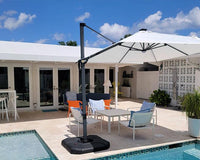
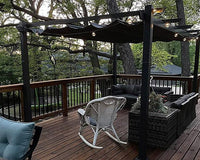
Commercial patio umbrellas fit zones that change or need staff-managed flexibility. Pergolas and other fixed structures fit stable sites that can support a coordinated installation project.
Commercial umbrellas versus pergolas
| Decision axis | Commercial patio umbrellas | Pergolas |
|---|---|---|
| Operational flexibility and serviceability | Modular coverage you can open, close, reposition, or repair unit by unit; supports phased purchases by zone | Fixed system where controls, structure, and service access are coordinated as one project |
| Weather, anchoring, and site verification | Depends on the model's approved base or anchor and a written close-and-store procedure | Requires site-specific structural, drainage, and attachment documentation, plus applicable local review |
| Maintenance, parts, and replacement planning | Repairs and canopy or component swaps can be tracked and prioritized per unit | Failures often need coordinated service across the whole structure rather than a simple swap |
Choose commercial patio umbrellas when seating zones change seasonally, you want to phase purchases, or you need to isolate a failed unit without closing the whole patio. Choose a pergola when the footprint is stable and the property can coordinate structure, drainage, controls, utilities, approvals, and a clear installation handoff before opening.
Where a patio gazebo changes the brief
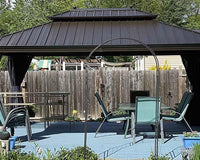
A patio gazebo enters the decision only when an area needs a freestanding or semi-permanent enclosure rather than open-air shade, such as a private event space or a weather-protected lounge. Before approving one, apply the same site, anchoring, drainage, access, maintenance, and ownership questions used for pergola kits. A gazebo is not a smaller pergola substitute; treat it as its own format decision with its own site verification.
Verify durability, weather, and anchoring before approval
Durability and weather resistance are the highest-risk parts of a commercial shade program, so buyers should verify specific product documentation rather than assume a generic rating applies to their site.
Verify construction and serviceability
Ask for the frame material, rib construction, pole or lift mechanism, canopy fabric, and fastener hardware in writing. Confirm which components are field-replaceable, what cleaning methods the canopy tolerates, and what the warranty actually covers.
Also ask whether canopies and individual hardware components can be ordered separately, and how the supplier identifies which parts are compatible with your exact model and pole diameter. A commercial buyer should never assume parts are interchangeable across sizes without confirmation.
Verify exposure, anchoring, and clearances
Match the base or anchor to your surface, exposure level, footprint, guest circulation, and storage plan. A base rated for one surface or wind exposure will not necessarily suit another site, even with the same umbrella model.
Because anchoring choices affect physical safety, require a written close-and-store procedure and name who approves deployment after inspection. Before deployment, use the selected model's written operating and anchoring instructions, confirm the approved base or anchor for the site, and apply the documented close-and-store procedure during inclement or severe weather. Our patio umbrella wind safety guide and our cantilever anchoring guide walk through anchoring options by surface type, but always confirm the specific base and limits documented for your selected model.

Build the daily, severe-weather, and seasonal operating procedure
A commercial shade program needs one repeatable workflow, not a separate rule for every location. The sequence below covers deployment through seasonal reopening.
The operating sequence
- Before opening: inspect the unit's condition, confirm it is properly secured, and clear the surrounding area.
- During service: keep the unit within its approved operating limits and assign a staff member to monitor changing weather.
- At closing or a weather shutdown: the assigned staff member closes and secures the unit, then records the action and any condition issue in the operating log.
- At seasonal reopening: inspect the canopy, frame, operating hardware, and base or anchor interface, and record the results before returning the unit to service.
Seasonal storage and reopening ownership
Name the storage location, any drying requirement before storage, who has access, and who signs off on condition before reopening. For hotels, clubs, and multi-site operators, apply the same procedure template across properties while allowing site-specific conditions like humidity or storage space to adjust the details.

Create the parts, service, and inspection register
Serviceability should be a visible program deliverable, not an afterthought once something breaks.
Build the unit-level maintenance register
Track each unit's identity, location, configuration, condition, warranty status, and inspection and repair history in one record. Use consistent status labels such as in service, monitor, repair pending, isolated, or replacement planned so anyone reviewing the register understands unit status at a glance.
Plan restaurant patio umbrella replacement parts
Before standardizing parts across properties, request a model-specific parts diagram or list from the supplier. Confirm compatibility, expected lead times, storage conditions, and the ordering process for canopies, frame or rib components, operating hardware, fasteners, and base or anchor interfaces. Treat any parts-availability claim as something the supplier confirms in writing, not an assumption you carry between models or sizes.
A hotel patio shade maintenance plan can use the same register to assign inspection ownership, service approval, parts purchasing, and record maintenance across properties.
Set condition-based repair and replacement triggers
Repair or replace decisions should follow the unit's condition and downtime record, not a fixed age.
Repair when the failure is isolated and serviceable
Prioritize repair when the affected component is identifiable, a compatible part is available, and the unit can return to service without repeating the same failure. Record the downtime and the repair outcome so recurring issues become visible across your properties rather than treated as one-off events.
Replace when condition or downtime changes the business case
Move toward replacement when damage affects safe operation or core structure, repairs keep recurring, parts become unavailable, or downtime repeatedly pulls a zone out of service. Warranty status and upcoming budget cycles are also valid inputs. When several units in a group show the same pattern, review them together for phased replacement, without assuming every unit in the group needs the same action.
Turn the framework into a supplier-ready request
Once the framework above is complete, you are ready to request a specific quote instead of a generic catalog.
What to include in the commercial quote request
Ask for a zone-by-zone specification: size, pole or frame configuration, base or anchor, clearances, operating instructions, storage requirements, warranty coverage, a parts list, and a service contact. Have the supplier state clearly what remains your responsibility, including any local review or installation coordination. For multi-site programs, request consistent identifiers and a defined process for ordering replacement canopies and components across properties.
A supported commercial umbrella candidate
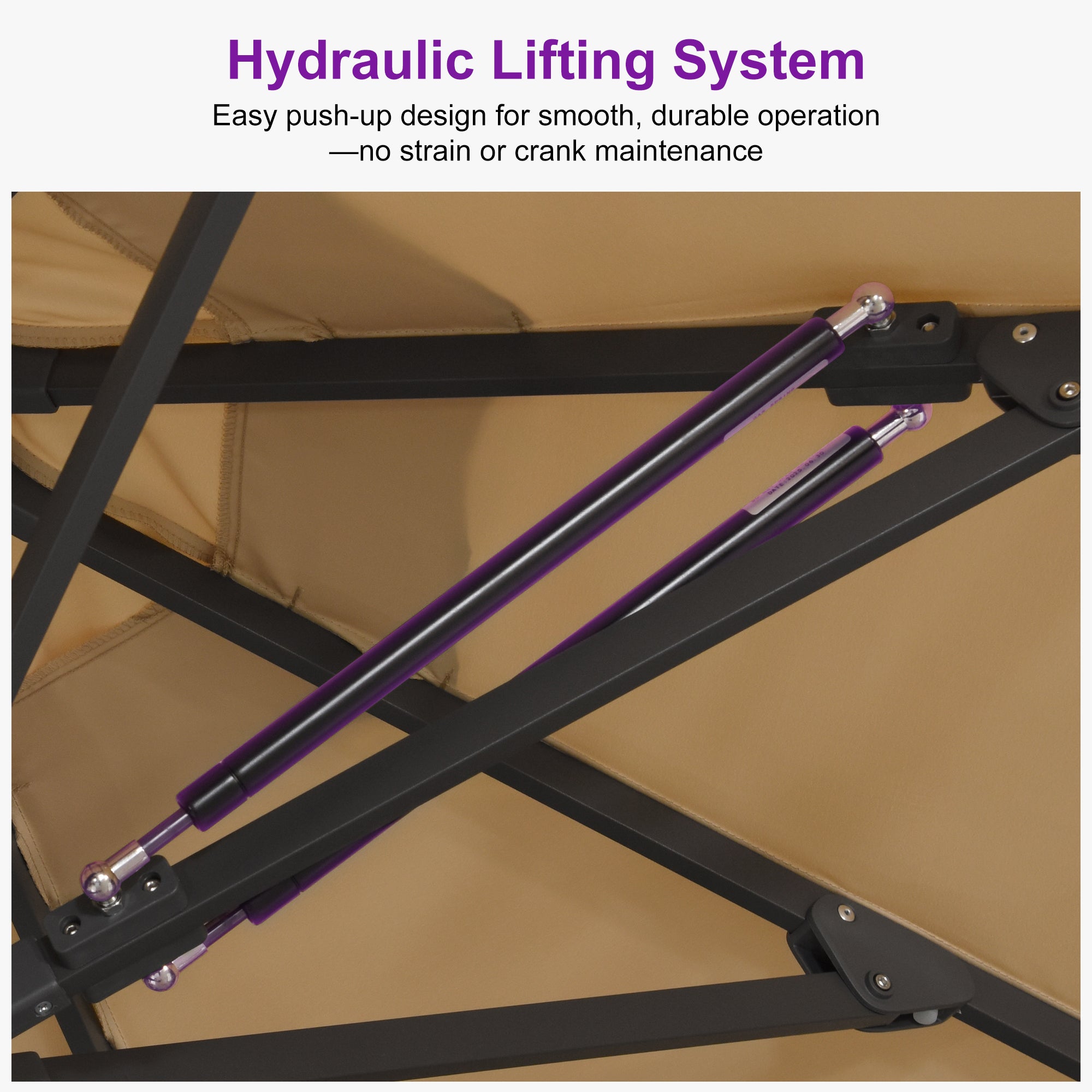
For zones that need modular, staff-managed coverage, our commercial hydraulic market umbrella is built for public and commercial spaces, with a hydraulic semi-automatic lift, a thickened center pole, and reinforced ribs. It comes in three pole diameters sized for compact patios, standard commercial dining, and larger public spaces, so different zones can use different configurations rather than one size for the whole property. The base is separate, and the product carries a 2-year fabric warranty and a 1-year structural warranty. Treat this as a candidate only after your supplier confirms the model-specific base or anchoring configuration, operating instructions, parts path, and warranty exclusions for each site.
The right program connects zone-level specifications with clear operating ownership, model-specific verification, maintenance and parts records, and condition-based repair or replacement decisions. Put those details into the supplier brief before requesting a catalog or quote so the next business step reflects the way each property will operate.
Ready to move forward? Send us your site count, shade zones, approximate coverage, operating schedule, exposure conditions, base or anchoring constraints, storage plan, and parts or service requirements, and we will help you build a commercial inquiry or catalog request around your actual sites.
FAQs
What should a restaurant document before buying commercial patio umbrellas?
Start with a record for each seating zone: its coverage need, clearances, guest and staff circulation, surface type, base or anchoring constraints, and storage access. Add who owns opening, closing, and weather shutdown for that zone, and confirm a service contact before you request quotes.
How do commercial patio umbrellas get maintained?
Maintenance works at a program level. Assign a routine inspection owner, track canopy and hardware condition in a register, and record repairs against the unit ID. Use the selected model's maintenance instructions for cleaning and service details.
What restaurant patio umbrella replacement parts should we keep on hand?
Start with a model-specific parts list from your supplier rather than a generic stocking plan. Typical categories include the canopy, rib and frame components, operating hardware, fasteners, and base or anchor interfaces, with stocking quantities confirmed by the supplier based on lead times.
When should a commercial shade unit be repaired or replaced?
Base the decision on condition, repairability, recurring downtime, guest or staff impact, warranty status, and your budget cycle rather than a fixed age. Isolated, serviceable failures usually favor repair; recurring failures, unavailable parts, or repeated downtime favor replacement.