What Makes a Patio Umbrella Base Compatible?
A patio umbrella base is compatible only when its pole or mounting interface, attachment hardware, footprint, umbrella type, and installation conditions all match your umbrella's actual measurements. A base that looks universal or simply has an opening the right size is not automatically a fit.

The first decision is not weight or price. It is umbrella type: center-pole, cantilever or offset, or a setup inside a patio gazebo or alongside pergola kits. Each of these changes what the base needs to connect to and how it needs to stay put. Once you know the type, you can measure the physical interface, check the available footprint, and decide between a movable weighted base and a fixed, bolt-down approach. The rest of this guide walks through that record in order, then ends with a short verification step before you buy or set anything up.

Measure the Umbrella-to-Base Interface
Before comparing any base listing, record four things about your umbrella: pole diameter, connection style, hardware, and model. Skipping this step is the most common reason a new base does not fit.
Record the Pole Diameter
- Measure the pole's outside diameter where it will enter the base or sleeve, not at the top or a decorative section.
- Write the number down in inches, and note whether the pole is round, tapered, or a shaped profile like square or hexagonal.
- Do not assume fit from diameter alone. Two poles can share a diameter and still use different bases.
Identify the Sleeve, Plate, or Collar Interface
- Check whether the pole slides through a sleeve or collar, or whether it bolts to a plate, frame, or dedicated bracket instead.
- Record the opening shape, the connection points, and any stop or support surface the pole rests against.
- Keep this separate from your diameter measurement. Two bases can accept a similar pole size but use completely different connection hardware.
Match the Attachment Hardware
- List every locking pin, set screw, clamp, bolt, or bracket that came with your umbrella or current base.
- Compare the hardware's location and pattern with the specifications on the new base's listing or manual.
- If any hardware is missing, damaged, or not clearly supported by the listing, stop and confirm the fit with the manufacturer before you buy.
Check the Footprint, Surface, and Clearance
A base also has to fit the physical space around it. Measure the usable footprint where the base will sit, not just the general patio area, and confirm nothing in its path will be blocked.
Deck and Hard-Patio Checks
- Measure the flat, usable area available for the base, including clearance from furniture and walkways.
- Note the surface material: deck boards, concrete, pavers, or something else, since this affects anchoring options.
- Decide whether you need to reposition the umbrella often, or whether a fixed anchoring method is realistic for that surface.
Patio Gazebo and Pergola-Kit Checks
- Check post and beam locations, roof height, and side clearance so the canopy has room to open and swing without hitting the structure.
- Confirm the base will not block a walkway or sit where people regularly pass through the space.
- Ask whether the setup is meant to be freestanding inside the patio gazebo or pergola kits, or whether it needs an approved connection to the structure itself. A physically open spot is not the same as an approved anchoring location.
Match the Base to the Umbrella Type
Your umbrella type decides which base category is even worth comparing. Treat center-pole and cantilever systems as separate compatibility paths, not interchangeable options.
Center-Pole Market Umbrellas
A center-pole umbrella passes straight down through a sleeve or collar. Check the pole diameter, the sleeve or collar shape, the locking hardware, and how deep the base's opening or support column runs. Confirm the base is built for a center-pole arrangement rather than an offset frame before you buy it.
Cantilever and Offset Umbrellas
A cantilever or offset umbrella usually connects through a dedicated plate, frame, or base system rather than a simple sleeve. Check your exact umbrella model, the plate or frame it uses, and the hardware the manufacturer lists as compatible. Treat the base and offset frame as one matched system. Do not substitute a center-pole base for a cantilever setup, or the reverse, unless the manufacturer explicitly confirms that alternative fits.
Choose Weighted or Bolt-Down Support by Movement Needs
Once you know the umbrella type and the space it sits in, the next decision is how the base stays in place. This depends on how often you move the umbrella, how exposed the location is, and what your surface allows, not on a single weight number.
| Support Path | Conditions to Check | Mobility Tradeoff | When to Verify |
|---|---|---|---|
| Weighted base | Repositioning needed; manufacturer lists this setup for your umbrella type | Easier to move, but only stable within its listed configuration | Confirm the exact umbrella model and fill method before buying |
| Bolt-down base | Surface allows permanent anchoring; approved hardware is available | Least likely to shift, but not always permitted on decks or shared structures | Confirm the anchoring method with the manufacturer and any structure owner |
There is no single pound figure that works for every patio umbrella base. A published beach-umbrella anchor standard sets sand-anchor resistance and wind figures, but those numbers apply to beach umbrellas and sand, not to decks, patios, patio gazebo structures, or pergola kits. If your setup can move unexpectedly in wind, that is a sign to check the manufacturer's stated support method rather than guess at a weight, and our cantilever wind guidance walks through how to judge that risk for an offset umbrella specifically.
Complete This Pre-Purchase Compatibility Check
Run through this sequence before you order a base or set one up for the first time.
- Record your pole diameter, connection style, and attachment hardware from the earlier measurement steps.
- Confirm your umbrella type: center-pole or cantilever or offset, since that decides which base category applies.
- Measure your usable footprint, surface, and clearance, including any patio gazebo or pergola-kit constraints.
- Pick the conditional support path, weighted or bolt-down, based on your movement and anchoring needs from the table above.
- Match your recorded measurements against the base's exact specifications, and contact the manufacturer if any interface, hardware, or anchoring detail is unclear.
Before you use any umbrella-and-base setup, follow the manufacturer's assembly and anchoring instructions, inspect the components, and close the canopy if it becomes unstable. That guidance addresses beach umbrella instability specifically, so use it for the setup and inspection habit, not as a patio-specific wind rating.
Where Our Purple Leaf Base Options Fit
Once you have your measurements and umbrella type recorded, you can compare them against a specific listing instead of guessing.
For Listed Purple Leaf Cantilever Configurations
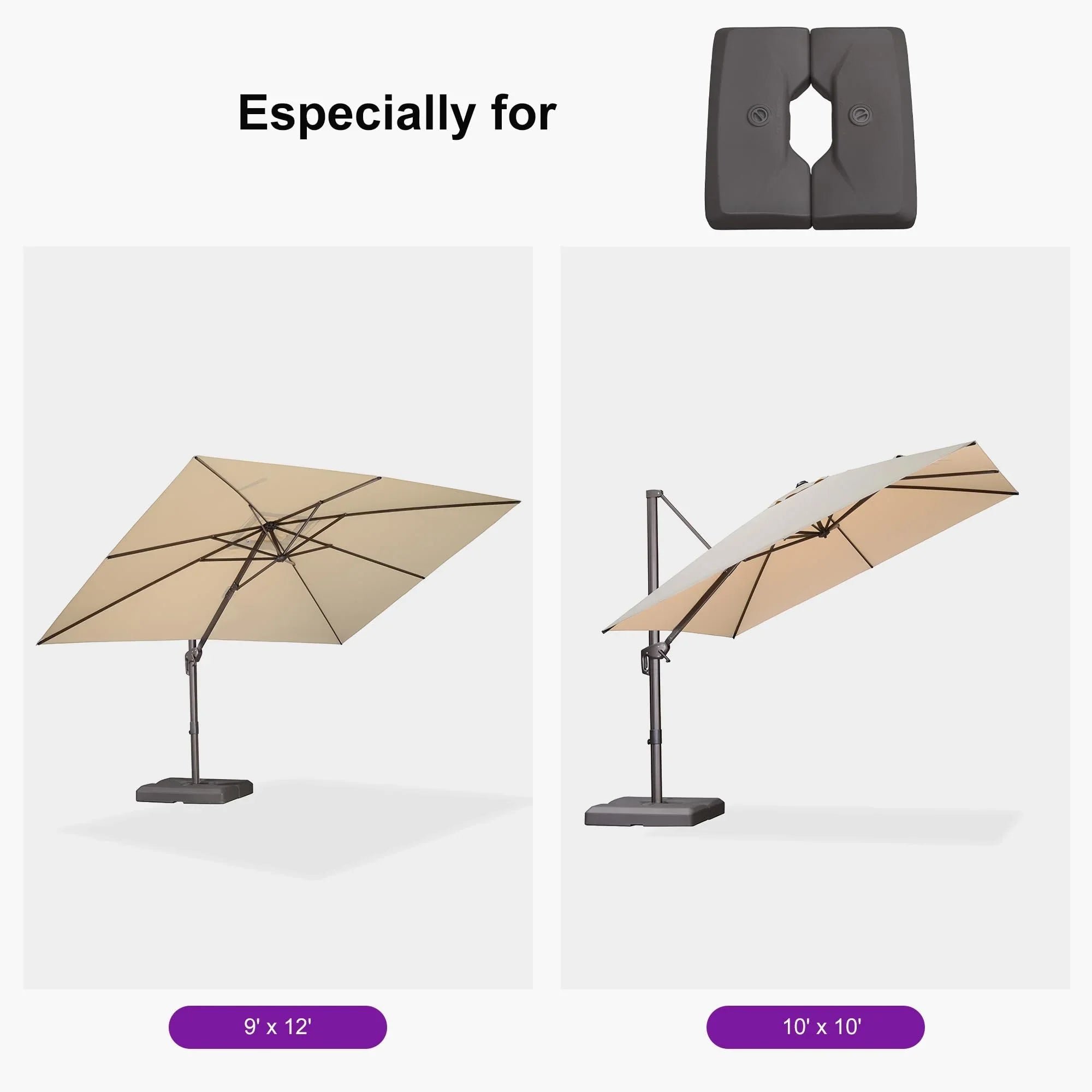
Our ZY02XGTBS-90 weighted base is listed for Purple Leaf 10-foot by 10-foot and 9-foot by 11.5-foot cantilever umbrellas with aluminum offset hanging. It fills with sand or water for stability, and sand fill is recommended for best performance. Before you add it to your cart, confirm your umbrella matches one of those listed configurations, since the base is built around that specific offset frame rather than a generic cantilever fit.
For a Listed Wheeled Option
Our ZYBASE-8 wheeled base is an open-box listing that measures 35.4 by 35.4 by 7.9 inches and can be filled with water and sand for stability, with a bracket and pulley that allow 360-degree rotation. Its stated fit is for specific Purple Leaf cantilever umbrellas, so compare your umbrella model and available footprint against the current listing before ordering, and note that open-box units follow a separate return policy from our standard products.
FAQ
Are Patio Umbrella Bases Universal?
No. A matching pole diameter does not guarantee compatibility. The sleeve, plate, locking hardware, footprint, umbrella type, and anchoring method all need to line up with your specific umbrella. Check the exact model and interface before assuming any patio umbrella base will work.
How Do I Know If My Base Is Heavy Enough?
There is no single pound number that applies to every setup. What counts as enough support depends on your exact umbrella, the surface, how exposed the location is, and the manufacturer's stated support method for that model. A product's listed fill capacity describes that model only, not a general weight target for other bases or umbrellas.
Can I Use a Base Inside a Gazebo?
Sometimes, but only when the base's footprint, connection type, and clearance suit the structure, and the manufacturer permits that setup. Check post locations, roof height, and side clearance first, then confirm whether the umbrella needs a freestanding base or an approved connection to the gazebo itself.
Are Cantilever Umbrella Bases Interchangeable?
Generally no. Cantilever bases are usually matched to a specific plate, frame, and umbrella model. Treat a cantilever base as dedicated to its listed configuration unless the manufacturer explicitly confirms it will work with a different umbrella.