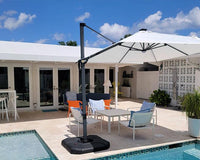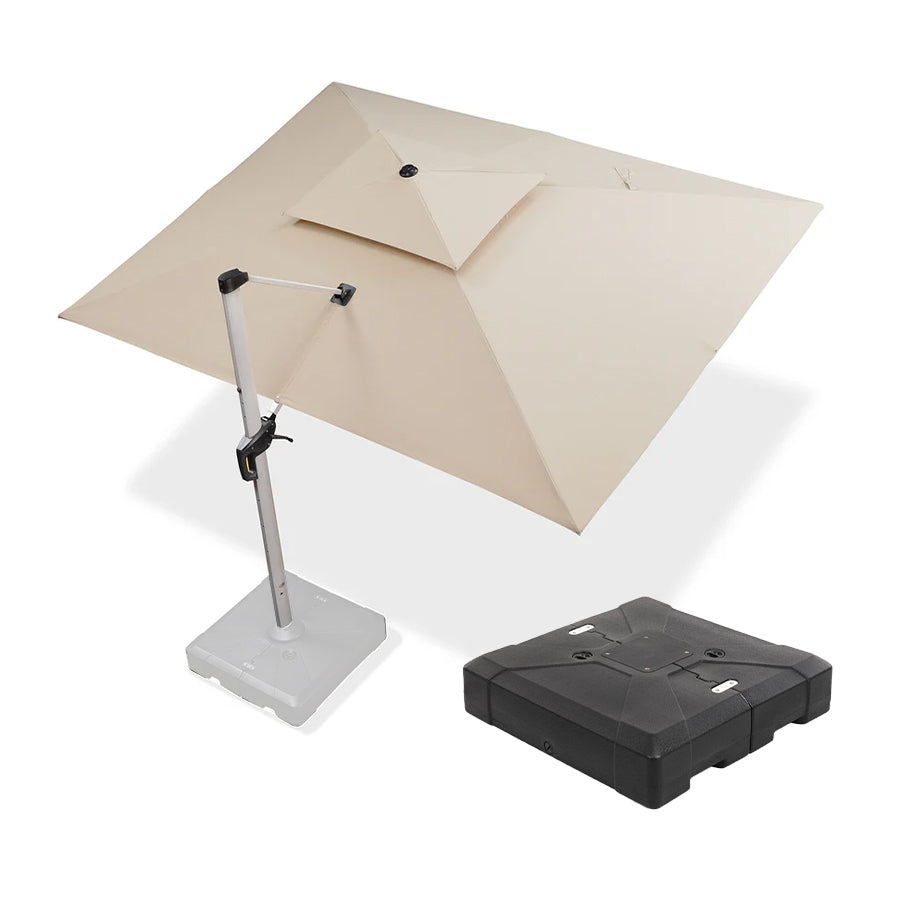
A cantilever umbrella can handle some wind, but how much wind can a cantilever umbrella handle depends on exposure, gusts, base type, anchoring, and where the canopy sits. The offset arm makes the setup more leverage-sensitive than a center-pole umbrella, so it is safer to judge the whole installation, not just the canopy size.

What Wind Risk Means for a Cantilever Umbrella
Wind safety for umbrellas is tested with formal methods. The ASTM umbrella wind-testing standard is the cleanest way to think about the problem: wind resistance is not a vague feeling, it is a structural question about how the frame, canopy, and base hold up under load.
For a buyer, that means there is no single universal speed where every cantilever umbrella becomes unsafe. A sheltered patio, a recessed courtyard, and an open deck do not behave the same way. The same umbrella can feel stable in calm air and much less stable when a gust hits the canopy edge.

That is why this guide focuses on stability instead of a promise. If you want a simple decision sentence, use this: if the umbrella is exposed, lightly anchored, or catching gusts from the side, close it sooner than you would a center-pole model. A better setup reduces tipping risk, but it does not remove it.
Signs Your Setup Is Too Windy
The safest cue is often visible, not numerical. Close or re-secure the umbrella if you notice any of these:
- The pole starts to lean instead of staying upright.
- The base lifts, slides, or twists when the wind picks up.
- The canopy shakes hard enough that the frame keeps bouncing back and forth.
- The umbrella feels stable in calm air but suddenly jerks during gusts.
- Pavers shift, deck boards flex, or wheels drift even when the wind does not feel extreme.
The CPSC's umbrella safety warning about airborne and tip-over risk is a good reminder that large umbrellas can become dangerous when they are not anchored well enough for the conditions. Gusts matter more than a calm average, because one sharp burst can create the load that starts a tip.
A practical decision rule is simple: if you would not leave it unattended in the current wind, close it instead of testing it further. That is especially true for taller cantilever models with the canopy extended.
How Base Weight and Anchoring Change Stability
Base weight helps, but shape and attachment matter just as much. A fillable base, a wheeled base, and an in-ground or fixed base all solve slightly different problems. That is why cantilever umbrella base weight for windy areas should be treated as a setup choice, not a magic number.
| Base Type | Surface Fit | Stability Benefit | Mobility Trade-Off | Best-Fit Scenario |
|---|---|---|---|---|
| Fillable base | Patios, courtyards, and level hardscape | Good when fully weighted and kept level | Easier to move, but less convenient to reposition when filled | Homeowners who want a flexible setup and only moderate wind exposure |
| Wheeled base | Flat patios and areas that need occasional movement | Convenient for repositioning, especially when paired with full ballast | Wheels add convenience, but you still need enough ballast for the wind you get | Buyers who move the umbrella often and can accept a little less permanence |
| Fixed or in-ground anchoring | Open patios, exposed yards, and windier setups | Strongest practical stability because the base is tied down | Least portable and more commitment to one location | Shoppers who value wind control more than easy relocation |
The main mistake is assuming pounds alone solve the problem. A heavier base helps only if the base shape stays flat, the surface stays level, and the attachment method suits the site. For a sheltered space, a movable base may be enough. For a more open yard, the better answer is often a fixed or in-ground setup.
How to Anchor a Cantilever Umbrella on Pavers or a Deck
Anchoring on Pavers
Pavers can work, but they deserve a careful fit check. If the joints move, the surface is uneven, or the base footprint is small, the umbrella can shift before it ever feels obviously unsafe. That is why how to anchor cantilever umbrella on pavers starts with matching the base system to the surface, not just adding more weight.
A practical paver setup usually depends on one of two approaches: spreading weight across the base footprint or using a flush in-ground sleeve style mount under the surface. The paver-weighting options are useful because they reflect the basic trade-off: the umbrella needs broad, stable contact, not a narrow point load on loose or shifting pavers.
Check three things before you leave it open: the surface is level, the base sits fully on solid contact points, and the umbrella does not rock when you nudge it by hand. If any of those fail, the setup is not ready for windy conditions.
Deck and Hard-Surface Considerations
Decks add another layer of caution because the structure can flex. A deck is not just a flat surface; it is a framed structure, so fasteners need to reach structural members rather than just the top boards. The joist-based deck anchoring idea matters here because a screw into surface boards alone does not provide the same resistance.
Before you drill or bolt anything down, check clearance, railing location, and whether the deck can handle the load without creating a trip hazard or rail conflict. If the umbrella sits where people walk often, a fixed arm or base can become a nuisance even when it is stable.
Extra Stabilizing Practices
A few habits reduce risk without pretending to make the umbrella windproof:
- Lock moving parts fully before opening the canopy.
- Recheck fasteners after rain, freeze-thaw, or a move to a new spot.
- Close the umbrella before leaving it unattended if weather may change.
- Keep the canopy lower or closed when gusts begin to build.
These steps are simple, but they matter because most failures happen when a setup that felt fine in calm air gets hit by a sudden change.
Which Base Weight Fits an 11-Foot Cantilever Umbrella
For an 11-foot canopy, the right answer is a sizing framework, not a single pound figure. Bigger canopies create more leverage, so an 11-foot model usually needs more support than a smaller market umbrella. That is the core logic behind the best base weight for 11 ft cantilever umbrella question.
A rough comparison point is that many buyers start thinking in the 200 to 300 lb range for more exposed setups, but that range should be treated as a guide, not a universal rule. The 11-foot base sizing guidance is useful as a background reference, yet your own exposure and surface still matter more than the headline number.
Use this shortcut instead:
- Sheltered patio, occasional breeze: a well-filled movable base may be enough.
- Open yard or corner patio: move toward heavier ballast or a fixed base.
- Windy or highly exposed setup: favor the least portable option that still fits your layout.
That approach is more useful than chasing a number that sounds impressive but does not match your space.
When to Close It and What to Check Next
If you want the safest rule, close or secure the umbrella whenever wind is gusty, the site is unattended, or the base is not firmly planted. For Purple Leaf products, our guidance is to close the umbrella above 30 mph and use an in-ground base for maximum stability in windy conditions.
Before you decide to keep it open, check the weather forecast, the surface under the base, the tightness of the hardware, and whether anyone will be around to watch for changing conditions. If two of those checks are uncertain, close it.
If you are choosing a new setup, compare a heavier base against a fixed or in-ground option, then browse patio umbrellas with base or our Purple Leaf patio umbrellas to match the shade plan to your patio surface.
FAQs
How Do I Keep a Cantilever Umbrella From Blowing Over?
Use the heaviest stable base your surface can safely support, keep the umbrella fully locked and level, and close it before gusts build. If the umbrella still shifts when you nudge it by hand, the setup needs more ballast or a better anchor before it should stay open outside.
What Wind Speed Is Too High for a Cantilever Umbrella?
There is no single universal cutoff for every model. The safest threshold depends on the umbrella's manual, how exposed the site is, and whether gusts are hitting the canopy from the side. If your product gives a closing limit, follow that limit first, then close earlier in open or windy locations.
Can I Anchor a Cantilever Umbrella on Pavers?
Yes, but only if the base system matches the surface. Pavers that shift or sit unevenly can undermine a heavy base, so the best setup uses broad contact, a level footprint, and no wobble at the joints. If the pavers move, add a more fixed anchor method instead of just more weight.
What Is the Best Base Weight for an 11-Foot Cantilever Umbrella?
There is not one number that fits every patio. An 11-foot canopy usually needs more support than a smaller umbrella, and exposed setups often need heavier ballast than sheltered ones. Use product guidance first, then size up if your patio is open or your base is on a surface that can move.
Can I Leave My Cantilever Umbrella Open Overnight?
It is safer to close and secure it when nobody is monitoring the space. Overnight wind can change fast, and a setup that feels stable in the evening may not stay that way by morning. If you will not be there to check it, closing is the lower-risk choice.