Measuring clearance for swivel patio dining chairs takes more than the pull-out space you'd give a stationary chair. The full requirement equals the table and chair footprint, plus the pull-back space, plus the chair's complete rotational sweep, plus any walking route or fixed obstruction buffer, with the strictest condition winning. Some of these inputs come from a tape measure on your deck; others must come from the exact chair's product page or manual, since no single number covers every swivel or rocker design.
That distinction matters because a chair that fits fine at rest can still collide with a railing, post, or neighbor's chair once it swivels or rocks through its full range. The sections below separate what you can measure yourself from what you need to verify before ordering.
The Clearance Formula: Start With the Full Movement Envelope
Required depth or width equals the exact table footprint, plus the chair's positioned depth when pulled out, plus its rotational sweep, plus any route or obstruction buffer that applies to your layout. Use the stricter result whenever two conditions overlap at the same spot.
Start by measuring your table's exact length and width, then mark the table edge on your floor plan. From that edge, note every fixed obstruction nearby: a railing, wall, post, or planter. Also decide whether anyone needs to walk behind seated guests. Keep the table-edge-to-obstruction measurement separate from the rear-of-chair-to-obstruction buffer; they describe the same physical gap, and adding both would double-count the space. For a broader look at fitting an entire table and chair set into a patio footprint, see this guide on full dining footprint planning.
How to Calculate Push-Back Space Behind the Chair
Push-back space is the gap a person needs to slide a chair out and stand up, measured from the chair's rear edge in its normal use position to the nearest obstruction. Put your tape measure where people actually sit, not where the chair sits tucked under the table.
Pick one consistent reference point. If you measure from the table edge, that single number already includes the chair's seated depth, so don't add the chair depth again. If you measure from the rear of the pulled-out chair instead, compare that edge directly against the wall, railing, or next piece of furniture. A 24-inch pull-out planning baseline is a reasonable starting point for a basic dining chair, but it's a planning reference, not a guarantee for every model. Armrests, thick backs, and wide bases can push the real number higher, so check those dimensions on your specific chair before finalizing a layout.
How to Calculate Rotational Clearance
A stationary chair only needs its resting footprint checked. A swivel or swivel-rocker chair needs the maximum sweep of every part that moves, measured from the pivot outward through the full range of motion.

Find the chair's approximate swivel center, then trace the farthest point reached by the arms, back, cushion, and base as the chair turns. If it rocks as well as swivels, repeat the trace through the forward and backward rocking range. A simple way to test this without buying anything is to cut a cardboard outline matching the chair's widest dimensions and walk it through a full rotation at the intended spot. Watch for contact with walls, railings, posts, or the chair beside it. Add a modest collision buffer based on what you observe on-site; no universal swivel-radius number is supported, so this physical test replaces a formula here.
Clearance Buffer Table: Use the Stricter Applicable Condition
Some clearance values come from published planning references, and some can only come from your exact chair, structure, or site. The table below separates the two so you know which numbers to trust and which to verify yourself.
| Layout Condition | Supported Planning Reference | Exact Check Still Required |
|---|---|---|
| Basic chair pull-out | 24 in. baseline | Confirm chair depth and arm/back projection |
| Principal walking path | 36 in. reference, limited scope | Confirm whether an accessibility rule applies |
| Swivel or rocker rotation | No universal number | Test full sweep on-site with chair or template |
| Railing or deck-edge conflict | No universal number | Test full movement envelope at the actual edge |
| Pergola or canopy component | No universal number | Check installation drawings for posts, tracks, canopy |
Whichever condition produces the tightest fit at a given spot controls that spot. A layout can pass the pull-out reference and still fail the rotation test, so check every applicable row before finalizing the plan.
Check Deck Edges, Railings, and Fixed Obstructions
A deck railing, wall, or post is an obstruction to measure directly, not a stand-in for a generic behind-chair number. Test the chair's complete movement envelope, not just its resting position, against that fixed edge.
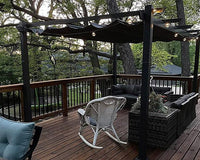
Mark the railing or wall on your floor plan, then move a full-scale chair outline (or the actual chair) through its pull-back, swivel, and rocking range while angled toward the edge. If any part of the chair contacts or crosses that boundary during normal use, the layout doesn't pass as-is. Your options are moving the table, choosing a chair with a smaller footprint, or changing the orientation. If the only workable fix involves moving, removing, raising, or structurally altering the railing itself, stop relying on furniture spacing and get applicable local authority or a qualified professional to weigh in before proceeding.
When a Walkway Changes the Calculation
Whether you need a walkway behind the chairs changes which clearance test applies. No-passage dining only needs the chair's own movement envelope checked against nearby obstructions. A layout with people walking behind seated guests needs a second, separate clear-width check after that envelope is marked.
Don't subtract the chair from a nominal route width and assume the rest is walkable; measure the route only after the chair has been placed in its farthest normal pull-back and rotation position. If the space is meant to serve as a principal path or an accessible route in a covered dining setting, the 2010 ADA Standards specify a 36-inch minimum clear width for those routes, subject to stated exceptions. That standard applies to covered facilities rather than private residential patios by default, so check whether an accessibility requirement actually governs your setting before treating 36 inches as a fixed rule. Either way, preserve whichever route width you decide the space needs, in addition to the chair's own clearance.
Integrate Chairs With Pergolas and Retractable Canopies
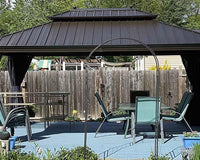
A pergola adds a second layer to the same clearance check: a horizontal footprint test for posts and beams, and a vertical test for roof edges and chair movement. Even when the table itself fits between the posts, a chair back or arm can still strike a post or beam edge during its swivel range.
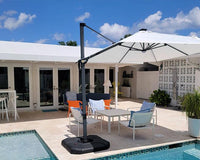
Map the pergola in plan view first, noting every post, beam, roof edge, track, and control location. Then check the elevation: does the chair's back, arms, or rocking motion clear the roof edge or any overhead hardware? If the pergola includes a retractable canopy, repeat this test in every operating position that matters, open, closed, and any position in between, since tracks, brackets, valances, or the deployed fabric can project into the same space the chair occupies. For sizing a pergola around furniture and walkways more generally, this resource on pergola furniture walkways covers the layout basics. Because canopy hardware varies by model, pull the exact installation dimensions from the manufacturer's documentation rather than estimating an overhead clearance.
Verify the Exact Set Before Ordering
Before you order, confirm the exact table configuration and chair dimensions together, since a table's footprint changes with its configuration and a chair's movement range depends on its specific design. A dining set's overall length and width can shift meaningfully between a 7-piece, 9-piece, or 11-piece configuration, so use only the dimensions listed for the exact configuration you plan to buy.
For the chairs, width and depth are a starting point, but they aren't enough on their own for a swivel model. You also need the arm style, base footprint, approximate pivot location, and the swivel or rocker range if the manufacturer publishes it. We list configuration-specific dimensions on our selected dining set page, which you can use as a reference for the kind of specifications to gather, whether or not that particular set includes swivel seating. Once every table dimension, chair dimension, and movement figure is in hand, run it against the obstructions on your floor plan. If every boundary clears during the physical rotation test, proceed with ordering your set; if any point strikes a post or railing, select a more compact seating profile or reorient your layout before purchasing.
FAQs
Is 24 inches enough behind an outdoor swivel dining chair?
Twenty-four inches is a bounded planning baseline for pulling out a basic dining chair, not a confirmed swivel or rocker clearance. Add the exact chair's measured rotational sweep to that baseline and check it against every nearby obstruction before treating the space as sufficient.
Can I use stationary patio-chair dimensions for a swivel rocker?
No. A stationary chair's width and depth only describe its resting footprint, while a swivel or rocker model needs its arm projection, base footprint, pivot point, and full movement range measured separately. Pull those figures from the exact model's product page or manual rather than substituting numbers from a different chair style.
Does the 36-inch walkway reference apply to a private patio or deck?
The 36-inch clear-width figure comes from accessibility standards written for covered facilities and their accessible routes, not from a private-residential furniture rule. Check whether an accessibility requirement actually applies to your setting, and if a walking route matters to you regardless, preserve it after the chair's full movement envelope is marked, not before.
What changes when swivel dining chairs sit under a retractable canopy?
A retractable canopy adds moving hardware, tracks, brackets, valances, and fabric, that can project into the same space a swivel chair uses. Check the manufacturer's installation dimensions for the canopy's open, closed, and intermediate positions, and compare each one against the chair's vertical movement rather than relying on a single overhead measurement.