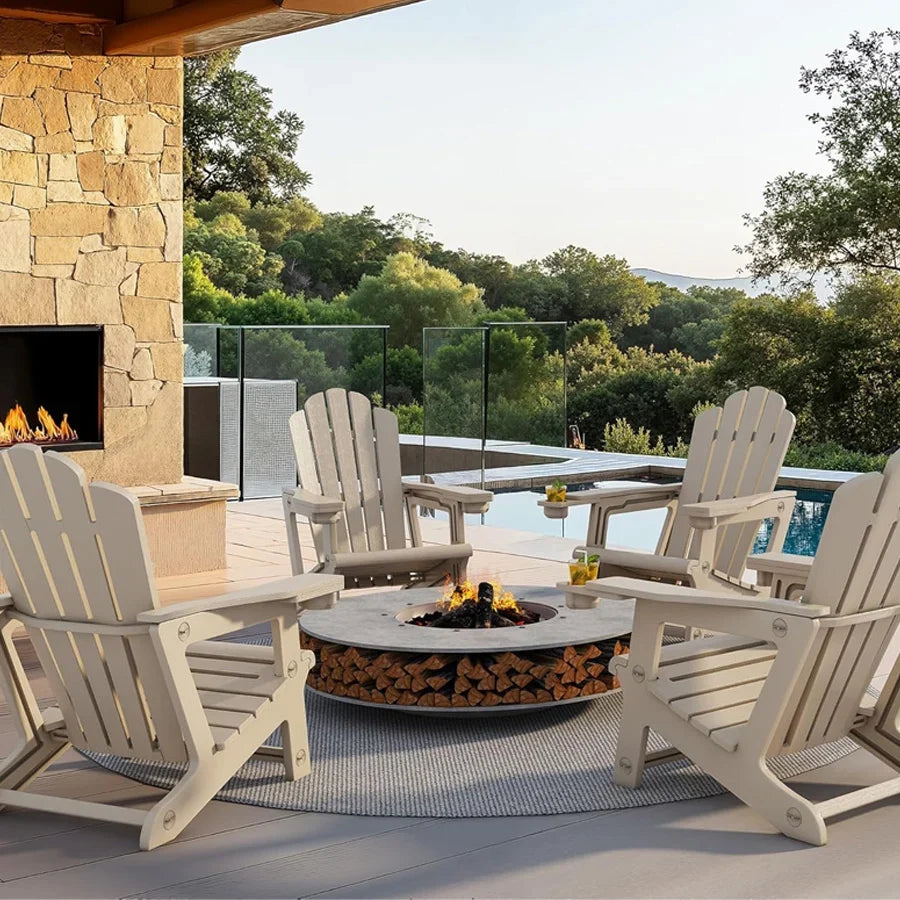
There is no single safe distance that works for every folding Adirondack chair and every fire pit. The controlling boundary comes from your local fire authority and the fire feature's own manual, not from a generic number.
Once that boundary is marked on the ground, you can measure the remaining space, pick a layout, and plan storage with confidence.
Verify the Controlling Clearance Boundary
Before you move a single chair, find out what actually governs your setup. Local rules and the manufacturer's instructions decide the boundary, and the stricter one wins.
Start with the fire feature, not the chair
Identify whether your fire feature burns wood, gas, or another fuel first. Each fuel type has different manual language about required clearance, screening, and shutdown, so locate that section before you measure furniture placement. If your municipality or fire department publishes an open-burning rule, treat it as part of the same check, since these provisions differ from one community to the next. When the local rule and the manual disagree, follow whichever one is more restrictive.
Use 10 feet as general guidance, not a chair-to-fire-pit rule
Educational fire-safety guidance suggests keeping a fire pit at least 10 feet from combustible materials, which includes furniture, fences, roof lines, and dry vegetation. That figure is a starting reference point, not a verified clearance for your specific chair or property. Because local requirements differ by community, confirm the actual number with your fire department or the appliance manual before you mark the boundary.
| Guidance source | What it actually covers | How to use it |
|---|---|---|
| General 10-foot reference | Educational distance from a fire pit to any combustible item | Starting point only; confirm locally |
| Local fire authority | Community-specific open-burning and setback rules | Follow if stricter than the general reference |
| Fire feature manual | Manufacturer-tested clearance for that specific model | Follow if it sets a different distance |
Measure the Usable Seating Area
The usable seating area is whatever patio or yard space remains once the verified boundary, the chairs, and a walking route are all accounted for. A quick walk-through with the actual chairs beats a mental estimate. Work through the space in order:

- Mark the verified fire-feature boundary on the ground with chalk, stakes, or tape.
- Set one chair in place and measure its full occupied footprint, including open arms and the space someone needs to sit down and stand up.
- Reserve legroom in front of each chair rather than measuring only the seat itself.
- Trace a continuous walking route from the main entry point to the seating area and back.
- Check doors, gates, steps, and the fire feature's own access point with chairs already positioned.
- Sit in each chair and confirm nothing blocks the route or crosses the marked boundary before calling the layout final.
A listed seat width is not the same as the full occupied footprint. For example, one HDPE folding Adirondack chair on record has a 24.6-inch seat and 5-inch armrests, but that measurement alone does not tell you how much space it needs once someone is seated with room to move. Measuring the actual model you own, including gravel or paver surface prep, matters more than relying on a generic Adirondack silhouette; our guide on leveling chairs on gravel walks through that surface check.
Choose a Layout That Preserves Comfort and Circulation
Pick a layout by the footprint and route you verified, not by which arrangement looks best in photos. Three practical patterns cover most patios and yards.
Compact arrangement for a small patio
Use the fewest chairs the gathering actually needs and place them along the usable edge of the marked boundary. Keep one clear approach instead of surrounding the fire feature on every side. Reject the arrangement if any chair, armrest, or seated person intrudes into the verified boundary or blocks a doorway.
Semicircle for an open approach
A semicircle faces chairs toward the fire feature while leaving one side fully open for entry and exit. It works well when a patio is wider than it is deep, or when foot traffic naturally follows a single path. Check that the end chairs in the arc do not pinch that route as people pass.
Full circle for a larger yard
Reserve the full circle for yards with enough marked area to support seating and a continuous walking route all the way around the group. Space chairs evenly enough that someone can step in or out without crossing the seating line itself. If the circle would push any chair toward the fire feature or nearby combustible items, switch to a semicircle or compact arrangement instead. Our fire-pit arrangement guide covers additional gravel and paver layout examples.
Store Folding Chairs Safely Between Uses
Store folding chairs in a dry, stable spot that stays separate from the fire feature and never blocks an exit. The same routine works whether you fold chairs after one evening or at the end of the season.
- Choose a storage location that stays dry and out of direct contact with heat or sparks.
- Confirm the spot never sits inside a doorway, gate, or the walking route you traced earlier.
- Follow the chair's own care instructions for cleaning, covering, and stacking.
- Fold and move chairs only after the fire is fully extinguished and the area is safe to approach.
- Recheck the storage area before each new setup so chairs never sit temporarily in the hazard zone while you rearrange.
When the Fire Feature or Chair Changes the Decision
Fuel type and chair material can both change whether your planned layout is even appropriate, and neither should be assumed away.
Wood-burning and gas features are not interchangeable
Wood-burning fire pits need a metal spark screen and complete extinguishment before you leave the area, since embers and sparks behave differently than a controlled gas flame. Gas features still require their own manual and local approval; do not apply a wood-fire rule to a gas unit just because both sit in the same yard. Keep the general 10-foot reference in its limited, educational scope for either fuel type.
Chair material is not a heat-clearance rating
HDPE, resin, or wood construction does not tell you how close a chair can safely sit to an open flame. A product listing HDPE material and specific seat dimensions is describing weather resistance and comfort, not a fire-safe distance or folding capability under heat. Use the chair's own instructions for care and placement, and never treat a material label as permission to move seating closer to the fire.
One exception overrides layout planning entirely: the Consumer Product Safety Commission has issued a CPSC pooled-liquid fire-pit warning covering fire pits designed to burn pooled alcohol or similar liquid fuel in an open container. If your fire feature matches that description, the correct action is to stop using it, not to rearrange chairs around it. This warning is specific to pooled-liquid designs and does not extend to ordinary gas or wood-burning fire pits. Before bringing chairs onto the patio, check your appliance manual and mark the controlling boundary first.
FAQs
Can I make a pooled-alcohol fire pit safe by moving the chairs farther away?
No. Spacing folding chairs farther back does not remove the flame-jetting hazard highlighted in the CPSC pooled-liquid alert. If your fire feature burns pooled liquid in an open reservoir, take the unit out of service immediately rather than attempting a larger seating circle around it.
How do I know which fire pit clearance distance to use for my chairs?
Compare your local open-burning regulations directly against the clearance section in your fire feature's manual. The stricter requirement controls your setup, while general figures such as 10 feet remain broad educational guidance rather than pre-approved chair distances.
When is it safe to fold and move Adirondack chairs into storage?
Wait until the fire is completely extinguished and all embers, ash, or heating elements have cooled to ambient temperature. Never fold or store outdoor furniture along active exit paths or while the fire pit area is still warm to approach.