There is no single safe distance for placing a folding Adirondack chair around every fire pit. The right clearance comes from your fire pit's own manual and any local rules, not from a generic number. Two widely cited 10-foot figures exist, but each one measures a different part of the setup, so neither is a universal chair-to-flame rule.
Key Takeaways
- Follow your fire pit's exact manual and local rules first; no universal chair-to-flame distance is supported by the evidence.
- USFA's 10-foot benchmark covers the fire pit's distance from a home or anything that can burn, not chair placement.
- A named appliance manual's 10-foot furniture clearance is a model-specific example, useful only if you own that exact fire pit.
- Gravel needs a compacted, level footprint; pavers need a joint and slope check. A rocking chair means the footprint failed, on either surface.
- Move or fold chairs only after the fire is fully extinguished and cool, then follow the chair's own folding and care instructions.
How Far Should Adirondack Chairs Be From a Fire Pit?
The fire pit's own manual and any local fire rules set the real clearance boundary for your seating. Two 10-foot figures get cited often, but they answer different questions.
Start with the fire pit's own clearance rule
Begin with the fuel type, the appliance's design, and its exact owner or installation manual. Check any local fire restrictions that apply to your yard, since some jurisdictions add their own limits. Unless the manual says otherwise, treat a folding Adirondack chair as furniture and as a combustible item near an open flame.
Use the 10-foot figures correctly
The U.S. Fire Administration's 10-foot outdoor-fire benchmark tells you how far a fire pit should sit from a home or anything else that can burn. It is a site-safety perimeter, not a chair-to-flame measurement. A separate example comes from the appliance manual's 10-foot furniture clearance for one wood-burning fire pit family, which places furniture and other combustibles at least 10 feet from that specific appliance.
| Source or scenario | What it covers | How it affects chair placement |
|---|---|---|
| USFA general benchmark | Fire pit's distance from a home or anything combustible | Sets a whole-yard safety perimeter, not a chair rule |
| Named appliance manual | Furniture and combustibles near that appliance family | Model-specific 10-ft furniture distance; applies only if you own this fire pit |
| Other fire pit models | Clearance specified by the manufacturer | Verify the exact appliance manual and local codes for required spacing |
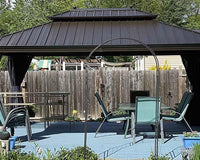
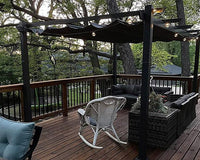
Do not finalize your seating layout until you know which rule actually governs your fire pit. If a metal pergola sits nearby, its posts, roof, or any attached fabric still count as combustible material for clearance purposes; the pergola itself does not shrink the required distance.

How to Stabilize Chairs on Gravel and Pavers
Loose gravel and jointed pavers fail in different ways, so each surface needs its own check before you seat anyone. A chair that rocks after these checks is not ready for use, even if the patio looks level.
Make a stable gravel footprint
Remove loose high spots and fill or compact low areas so the seating footprint sits flat. Every leg needs full support; one leg settling into loose aggregate is enough to make a folding Adirondack chair tip under weight. Outdoor chair testing distinguishes smooth surfaces from rough ones like natural outdoor terrain, which is a reminder that gravel behaves differently than a deck even when a chair performs well in general testing. Recheck the chair after someone sits in it and again after the gravel has been walked on or disturbed. If chairs keep sinking between uses, a few ways to stop chairs sinking into loose ground can help you build a longer-lasting base.
Check paver joints and slope
Avoid landing a chair leg across a moving joint, a broken edge, or a paver that isn't fully supported underneath. Before arranging several chairs, test each one for rocking caused by slope or a shifting block. If a chair still moves, relocate it or rework that section of the footprint rather than bridging the gap with an improvised shim. A sloped patio calls for its own adjustments, and these sloped patio fixes cover several practical options for uneven paver areas.
Arrange the Seating for Access, Circulation, and Folding
Once you know the boundary from the fire pit's own rules, position chairs outside it while keeping the area easy to move through. Access and a clear path out matter as much as the seat itself.
Leave room to sit and pass
Mark the clearance boundary first, then place chairs so each one has a direct approach and a route around the group. Keep the arrangement from narrowing access to doors, gates, or the fire pit's controls, and preserve the kind of open traffic flow that fire-pit manuals recommend around the appliance.
Plan the pull-out route
Stand in the spot where you would lift or pull each chair before finalizing the layout. Avoid setting legs or chair backs across joints or edges that would make that movement awkward later. Treat the future storage route as part of today's layout, since a chair that's hard to remove now will be just as hard to move at season's end.

Fold, Move, and Store Chairs for the Off-Season
Wait until the fire is fully out and the area has cooled before moving any furniture. Then work through a short sequence to fold and protect the chairs correctly.
Fold only after the area is cool
- Confirm the fire is fully extinguished; supervising and putting out the fire before leaving the area is a basic outdoor-fire safety step.
- Wait until the fire pit and nearby surfaces are cool enough to touch safely.
- Clear and inspect the pull-out route you planned earlier.
- Confirm the chair is actually designed to fold before attempting to collapse it.
- Fold or move the chair as its manual directs, watching for pinch points.
Protect the chairs during the off-season
Clean off ash, dirt, and moisture according to the chair's own care instructions. Inspect for heat exposure, loose hardware, surface damage, or a leg that no longer sits flat before you put the chair away. Choose a dry, protected storage spot that won't block next season's access route.
FAQs
What if my fire-pit manual does not list a furniture clearance?
Do not invent a chair-to-flame number. Pause the layout decision until you can confirm the exact appliance instructions, or check with the manufacturer or your local fire authority for the governing distance.
What should I do if a chair still rocks after I level the surface?
Stop using that position. Unload the chair, rework the gravel or paver support underneath it, and retest for rocking with normal sitting pressure before returning it to use.
Can I fold or move the chairs while the fire pit is still warm?
No. Wait until the fire is fully extinguished and the fire pit and nearby surfaces have cooled before moving or folding any chair, then follow that chair's own handling instructions.
What should I check before storing chairs used near a fire pit?
Check for ash, moisture, heat exposure, and loose hardware, and clean the chair according to its own care instructions. Store it in a dry, protected spot that won't block your access route next season.