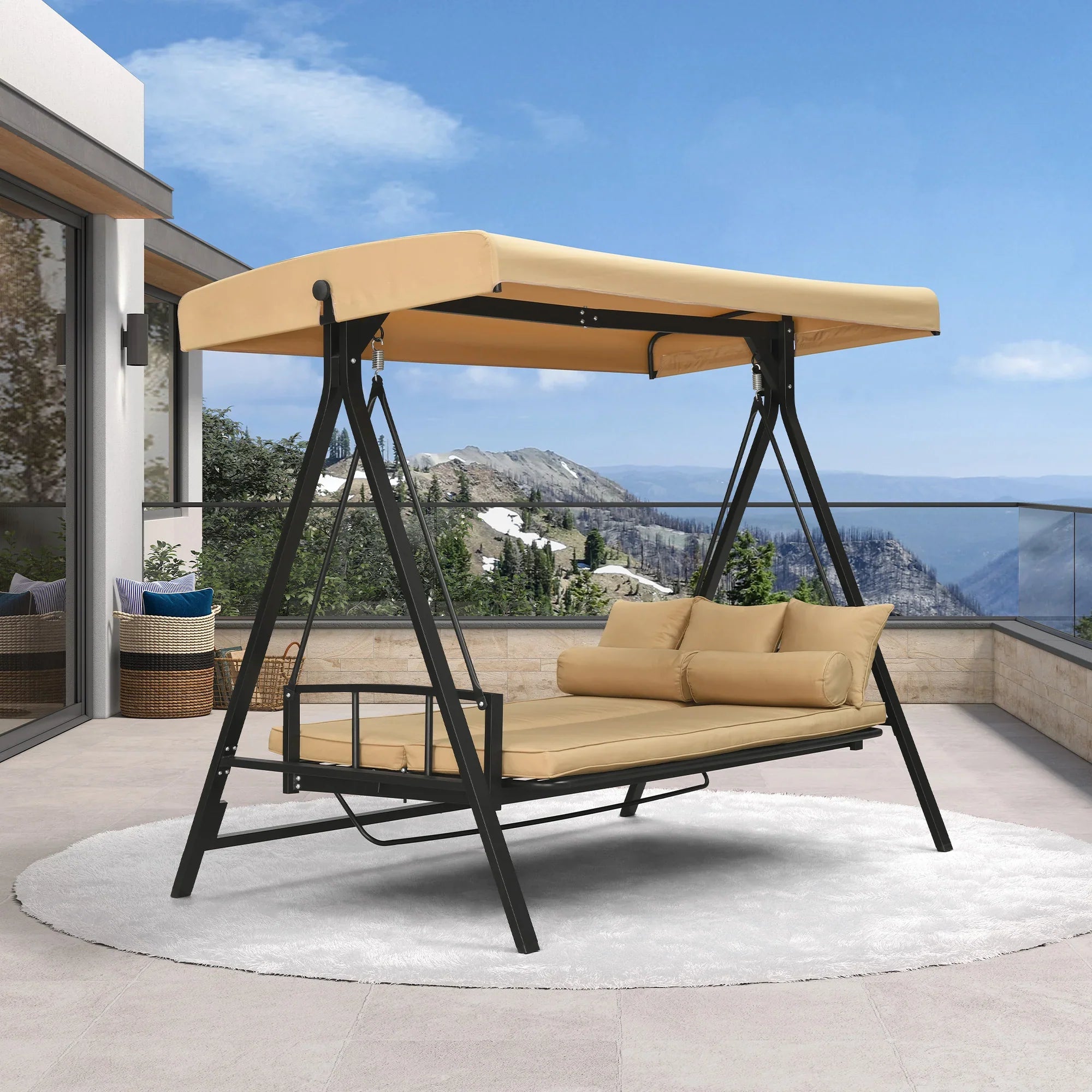
When a patio swing with canopy develops a low spot that traps rain, the fix depends on what caused it. Start by checking the fabric, the attachment points, and the frame before touching anything. Minor slack often responds to a reversible, product-approved adjustment, while stretched or torn fabric, an unsupported span, or a shifted frame usually calls for a different fix, from added support to full replacement.
A freestanding patio swing canopy is not the same structure as a backyard pergola or a retractable awning. Those systems often use different drainage geometry and support hardware, so their adjustment steps do not automatically transfer to a swing canopy.
What to Check First When Water Pools on a Swing Canopy
Before adjusting anything, find out whether the low spot comes from the fabric, the attachment points, or the frame itself. This decides whether you tighten, support, repair, or stop.
Trace the Low Spot and Inspect the Fabric
Look at where the water collects once the canopy has drained enough to inspect safely. A single, localized dip near one corner often points to a loose or shifted attachment point. A low spot that spans a wide section of the canopy, or reappears in the same place after every rain, is more likely a sign of permanently stretched or worn fabric. Check the material closely for tears, pulled seams, deformation, or spots that stay damp long after the rest of the canopy has dried. If the fabric looks stretched or damaged in that area, do not pull it tighter. Forcing tension on weakened material usually makes the tear or stretch worse instead of fixing the sag. General pooling causes on outdoor awnings point to worn fabric and inadequate support as two distinct, possible contributors, though the fix for a swing canopy still depends on your exact product.
Check Attachments and Frame Alignment
Work through the swing's existing hardware without relocating anything yet:
- Inspect fasteners, straps, channels, and corner attachments for looseness, shifting, or wear.
- Look at the frame from the side to see if it sits level, or if one leg or arm appears twisted, bent, or higher than the others.
- If your swing has a tilt feature built into the canopy, check the manual before treating it as a tensioning tool. A tilt adjustment changes the canopy's angle, not necessarily its overall tautness.
- If the swing sits on grass or pavers, an uneven base can also throw off frame alignment; our leveling and stability rules cover how to check and correct that separately.
Each of these checks should point you toward one of three paths: a compatible tensioning adjustment, a support or service decision, or a fabric repair and replacement decision.

How to Restore Canopy Tension Without Damaging the Swing
If the fabric and frame both look intact and the sag is minor, a reversible adjustment using the swing's existing hardware is usually the safest next step. The goal is to even out tension without forcing, drilling, or altering anything permanently.
Use a Reversible Adjustment Path
Follow this order and stop at any point the canopy or frame reacts abnormally:
- Check the manual or manufacturer instructions for an approved adjustment method specific to your model. Not every canopy has one.
- Inspect the original attachment points closely before changing anything, so you know their starting position.
- If an approved method exists, adjust it evenly on both sides rather than pulling hard on one corner. Small, incremental changes are easier to reverse than large ones.
- Recheck the canopy for a clear drainage path once you're done. If it still pools, or if the fabric or hardware shows stress, stop and move to the next section instead of repeating the adjustment.
Know When Tensioning Is the Wrong Fix
Permanent fabric deformation, torn seams, or a visibly bent frame are not ordinary tension-loss problems, and tightening will not correct them. If pooling comes back shortly after a permitted adjustment, that is a signal the underlying cause is something tensioning cannot fix, such as an unsupported span or damaged material. At that point, the better move is to look at structural support or fabric replacement rather than adjusting again.
When a Support Bar Is Appropriate — and When It Is Not
A support bar or added structural piece only makes sense when your exact swing's documentation approves that specific accessory and attachment method. Without that confirmation, adding one is a guess, not a fix.
Treat Support as a Compatibility Decision
Before installing any support bar, confirm three things from the manufacturer's documentation: the approved attachment method, the required clearance, and the frame's load limits. A generic canopy diagram or a support bar designed for a different structure is not evidence that it will fit or hold safely on your swing. Drilling, clamping, or bolting into the frame without that confirmation risks damaging the very structure you're trying to fix. This is different from a retractable awning or pergola, where rain and sag drainage mechanisms rely on built-in tilt features rather than an added crossbar; that guidance does not carry over to a freestanding swing's frame.
Choose Service or Replacement When Support Is Unverified
If your swing's documentation does not mention an approved support solution, do not treat a homemade bar or brace as a lasting repair. A temporary support built from spare materials may hold for a short time, but it is not a substitute for a verified fix. If pooling continues, attachment points start pulling loose, or the frame looks distorted, the better path is to contact the manufacturer for guidance or consider a confirmed, compatible replacement rather than improvising further.
Clean, Dry, Repair, or Replace the Canopy Fabric
Whether you clean, repair, or replace the canopy depends on what's actually wrong with the fabric, not just how it looks after one rainy week.
Match Care to the Fabric
Start by identifying what the canopy is made of, since cleaning instructions are material-specific:
- Identify the fabric type first and follow the manufacturer's care instructions rather than a generic outdoor-fabric routine.
- If your canopy is Sunbrella shade fabric, the maker offers dedicated cleaning instructions for Sunbrella fabrics; this guidance applies specifically to Sunbrella and should not be assumed to work the same way on Textilene mesh or other materials.
- Don't assume a cleaner, brush, or drying method that works on one fabric is safe for another. The wrong treatment can damage a coating or weaken the weave.
Recognize When Replacement Is the Better Path
Cleaning and drying address dirt, stains, and surface moisture, but they will not correct a canopy that has permanently stretched out of shape. If the fabric is torn, visibly deformed, or keeps pooling water no matter how you adjust it, replacement is usually the more realistic option. When you do replace it, match the exact model, attachment style, dimensions, and fabric type your swing uses; a canopy that looks similar but doesn't match the attachment system won't fit correctly. If you can't confirm that fit from the product listing or manual, contact the manufacturer before ordering rather than guessing.
When to Stop DIY Work and Contact Support
Some conditions mean it's time to stop adjusting and get outside help instead of trying another fix yourself.
Stop Conditions That Change the Plan
- No verified attachment or load information: if you can't confirm the approved attachment points or frame-load limits before adding support, don't install anything. Contact the manufacturer for that information first.
- Forcing or drilling required: if the only way to tighten the canopy or add support involves drilling new holes, forcing a fitting, or relocating hardware without documented approval, stop. This step carries real risk of frame or fabric damage.
- Bent, cracked, or pulled-out components: a bent frame member, cracked joint, or fastener that's pulling loose from the fabric or frame is a structural issue, not a tensioning issue.
Use the Right Escalation Route
For attachment or compatibility questions, the manufacturer's manual or official support line is the right first stop, since they can confirm what your specific model allows. If the frame or attachment damage looks structural and you can't safely assess it yourself, qualified repair help is the better route than continued DIY work. Don't substitute a backyard pergola or retractable awning fix for swing-specific guidance; the support geometry is often different enough that borrowed instructions can create new problems instead of solving the original one.
If your canopy remains slack after basic checks, choose your next step right away: order an exact-model canopy replacement if the fabric is torn or stretched, or reach out directly to our support team for verified structural hardware guidance before modifying your frame.
FAQs
What if pooling returns after an adjustment?
Recurring pooling after a permitted adjustment usually means the real cause wasn't loose tension in the first place. Reassess the fabric for permanent stretch or damage, and check whether the frame or an unsupported span is behind the recurring low spot. Repeating the same tightening adjustment without a new observation rarely solves it.
Can a backyard pergola fix be used on a patio swing canopy?
Only if the support geometry and attachment method genuinely match, which is uncommon between a freestanding swing and a backyard pergola or retractable awning. These structures often manage rain and sag differently, through built-in tilt features or motorized retraction rather than a swing's fixed frame. When in doubt, use your swing's own manual or manufacturer support instead of borrowing a fix from a different structure.
How should I clean an unknown replacement canopy?
Identify the fabric type before choosing a cleaner or treatment, since care instructions vary by material. If the tag or listing doesn't specify, contact the manufacturer or seller to confirm before applying any cleaning product. Sunbrella-specific cleaning steps, for example, are built for Sunbrella shade fabric and aren't guaranteed to work the same way on Textilene mesh or another material.