No single number tells you exactly how far a folding Adirondack chair must sit from a fire pit. The only verified numeric baseline covers the fire pit itself, not seating: the U.S. Fire Administration says an outdoor fire pit should sit at least 10 feet from a home or anything else that can burn. Your chair placement still has to follow whatever your fire pit's manual and your local fire authority require, because those documents override any generic seating distance you might find online.
That gap between a general safety baseline and a chair-specific rule is the real planning problem. The rest of this guide shows you how to turn that gap into a defensible layout: what the 10-foot figure actually covers, how to measure your chair's real footprint when it reclines or folds, how to keep an exit route open, and what changes when a patio pergola sits overhead.
What Clearance Can You Defend for Folding Adirondack Chairs?
You can defend two things with evidence: a 10-foot fire-pit-to-combustible baseline, and the fact that your specific appliance manual and local rules control everything closer than that. Universal chair-to-fire-pit setback numbers and separate fuel-type distance rules do not exist in standard fire safety codes.
| Scenario | Supported distance status | What controls placement |
|---|---|---|
| Fire pit to home, deck, or anything combustible | Supported: at least 10 feet, per USFA outdoor fire safety guidance | Use as your outer planning boundary |
| Folding Adirondack chair to fire pit (any fuel) | Not supported as a universal number | Your fire pit's manual and local requirements |
| Wood-burning vs. gas seating distance | No verified numeric difference | Follow the specific appliance's instructions |
| Local restrictions on open burning | Requirements vary by community | Check with your local fire department before setup, since outdoor-fire rules differ town by town |
Treat the 10-foot figure as a conservative starting boundary for the fire pit itself, not a chair-seating rule. If your appliance manual or local authority specifies a different number, that number governs your layout instead.
How to Measure the Chair's Real Fire-Pit Footprint
A folding Adirondack chair does not occupy one fixed space. Its footprint changes with recline angle and with whether it is set up, moved, or folded, so you need to trace the largest position it will actually use.

Mark the fire-pit boundary first
- Find the measurement point your fire pit's manual or local requirement specifies, whether that is the appliance's outer edge, the burner, or the flame itself.
- Mark that boundary on the patio with chalk, tape, or a scaled sketch before placing any chair.
- Keep this fire-pit-to-combustible boundary separate from the chair's seating footprint; they answer different questions.
Trace the chair in every used position
- Mark the chair's upright footprint, including its front edge, arms, and rear legs.
- Recline the chair fully if that position will be used, and mark the new farthest point of the backrest and legs.
- Note the folded or repositioned footprint too. Folding does not remove the chair from the layout; it just changes where it needs to sit or be stored.
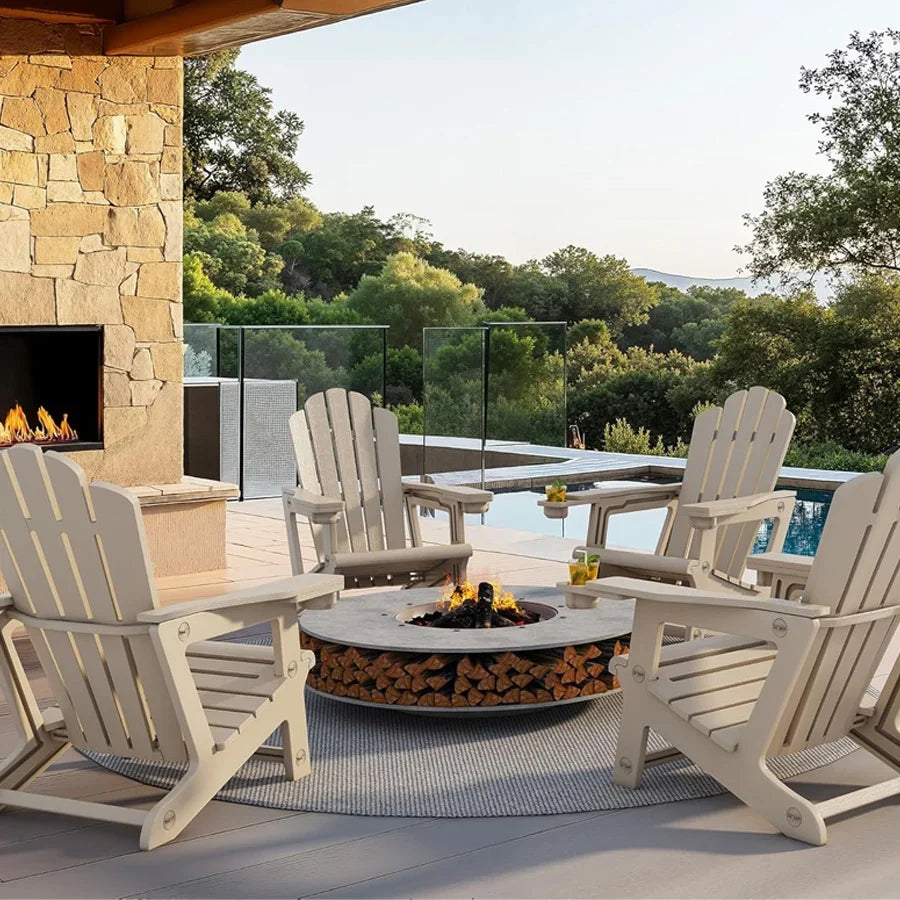
If you are sizing a specific model, use its listed dimensions as a sketch input. On one oversized folding Adirondack chair we sell, the seat is 24.6 inches wide with a 103-degree backrest angle, and that reclined angle pushes the rear of the chair noticeably farther out than its upright footprint. Use the largest traced position, not the folded or upright one, to set your actual layout boundary. The same measurement discipline applies to a full outdoor dining set's furniture footprint if you are planning fire-pit seating alongside a dining area.
Build a Seating Ring With a Clear Exit Path
A seating ring is only safe if at least one route stays open after every chair is occupied, reclined, or moved. Plan that route before you finalize chair placement, not after.
Mark one route before placing the ring
- Pick the route you would actually use to leave the seating area, toward a door, gate, or open yard.
- Position chairs around that route rather than letting the last chair close it off.
- Account for steps, railings, walls, or level changes that could narrow the path once furniture is added.
Run the occupied-chair test
- Sit in or simulate occupying every chair in the ring at once.
- Fully recline any chair that will realistically be used reclined during a fire.
- Walk your marked route without brushing a chair or having to move anything first.
If the route fails that test, adjust chair spacing or drop a chair from the ring rather than accepting a blocked exit. This same test applies on tighter footprints, similar to configuring seating on a narrow-deck walkway clearance where every inch of movement space matters.
Does a Patio Pergola Change the Clearance Plan?
Yes. An overhead structure creates an independent clearance question that comfortable ground-level spacing does not resolve.
Open patio versus overhead structure
- Open sky removes the overhead question but does not remove the appliance or local clearance requirements you already checked.
- A pergola introduces roofline, building material, and ventilation questions that a bare patio does not have.
- General fire-pit guidance already warns against placing a fire pit under overhanging rooflines, though it does not set a pergola-specific number.
Resolve the pergola before use
- Read your fire pit's exact manual for any overhead-use or roofline restriction.
- Confirm with your pergola's documentation and local fire or building authority that the arrangement is permitted.
- Stop and choose an open-sky location instead if either source does not clearly allow it.
If you are still deciding between pergola sizes for a seating layout, comparing gazebo chair pull-out space needs can help you plan movement room, but it will not answer the fire-pit approval question above. Do not use a fire pit beneath or near an overhead structure until the appliance instructions and your local authority clearly permit that specific arrangement.
What to Do When the Sources Disagree
When your fire pit's manual, your chair's material guidance, and local requirements point to different distances, follow the most restrictive one that applies to your setup. Compare the three sources directly instead of averaging or guessing between them.
Start with the exact appliance manual, since it reflects your specific burner or fuel system. Check your chair or material documentation next for any heat-exposure limits. Then confirm local fire or building requirements, since outdoor-fire provisions differ by community. If any of these documents conflict or leave your layout unaddressed, do not light or use the fire pit until that gap is resolved by the applicable manufacturer or local authority.
FAQs
Does folding an Adirondack chair create an exception to the fire-pit clearance?
No. Folding a chair reduces its footprint, but it does not remove the requirement to keep combustible items outside the designated fire-pit safety zone. Any folded chair should be stored well outside that boundary and clear of egress pathways unless the appliance manual explicitly states otherwise.
How should you measure clearance if an Adirondack chair reclines?
Measure the chair's outer edge while it is fully reclined rather than upright. Because the backrest tilts backward and the seat frame shifts, the reclined position represents the chair's maximum footprint and dictates the true setback distance needed for both fire safety and walking clearance.
Can you place folding Adirondack chairs closer to a gas fire pit than a wood fire pit?
Only if the specific gas fire pit manual explicitly permits a closer distance. While gas units lack flying embers, radiant heat remains significant, and safety standards provide no universal exemption or reduced distance based solely on fuel type without manufacturer authorization.