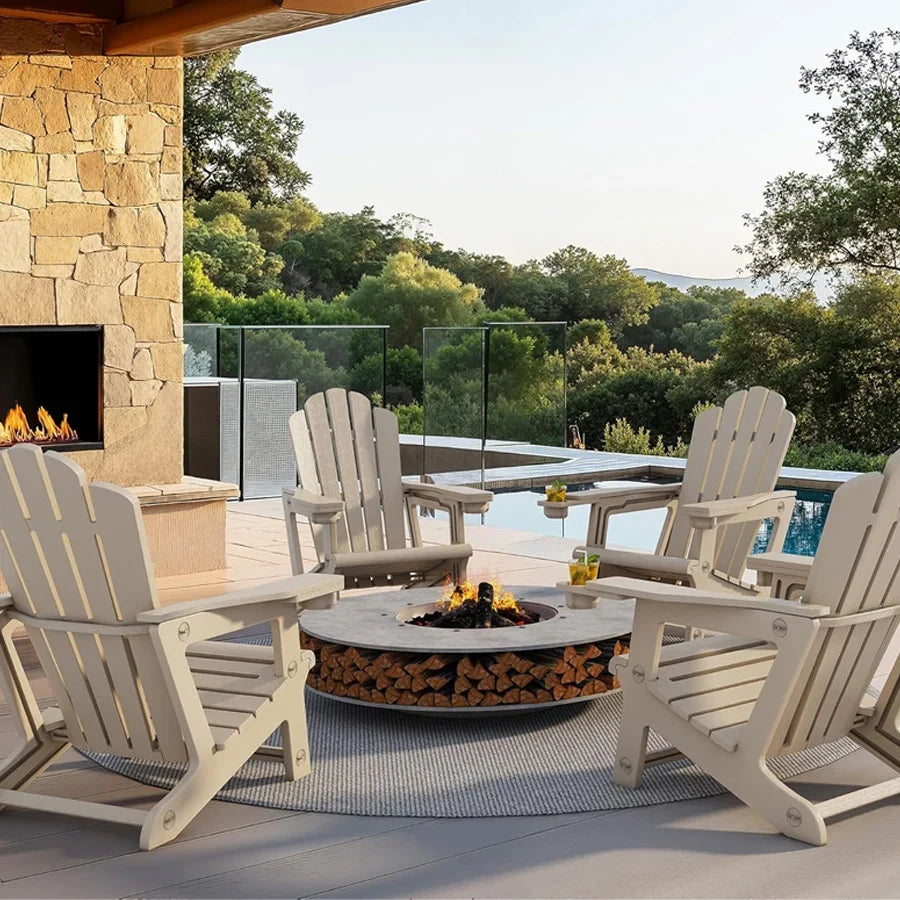
There is no single safe distance that works for every fire pit and every Adirondack chair. The only verified number in the mix is that a fire pit itself should sit at least 10 feet from a home or anything that can burn; the actual chair-to-pit setback still comes from your specific fire pit's manual and your local fire code. On sloped, loose gravel, that clearance question is only half the job. You also have to level and stabilize each chair and keep a clear walking path around the whole setup.
Key Takeaways
- The 10-foot fire-safety distance applies to the fire pit's separation from your home and other combustible material, not to the chair-to-pit setback, which is model- and jurisdiction-specific.
- A 48-by-48-inch clear, firm, stable zone is a sourced planning benchmark for the usable sides of fire rings, not a guaranteed residential chair distance.
- Loose, rounded gravel is an unreliable base; crushed aggregate with fines, compacted in thin layers, holds a level chair position far better.
- Every chair needs an individual rocking-and-shifting test after placement, and a full seating circle should give way to a partial arrangement when it blocks the route around the pit.
Start With the Fire Pit's Verified Clearance Zone
Before you touch a single chair, separate what is actually verified from what still needs checking. Two sourced numbers exist, and neither one is a chair-to-pit distance on its own.
Separate the Fire-Pit Zone From the Seating Setback
The U.S. Fire Administration advises keeping an outdoor fire pit at least 10 feet from combustible materials, including your home, fencing, and overhanging branches. That guidance sets the boundary for the fire pit itself, not for where you place an Adirondack chair around it. Your actual seating distance depends on your fire pit's specific manual and your local fire code, so treat that as a separate question you still need to answer before arranging chairs.
Compare Clearance Decisions by Fire-Pit Type
Different fuel types need different verification paths, and none of them borrow a number from another type.
| Fire-pit configuration | Sourced benchmark | What it does not mean | Required next action |
|---|---|---|---|
| Wood-burning open ring | 10 ft from combustibles; screen over open flame | Not a chair distance | Get chair setback from manual/local code |
| Gas or propane unit | No universal figure supplied | Wood-burning number does not transfer | Follow the specific product manual and local rules |
| Enclosed or other design | 48-by-48-in. clear space applies only within its accessibility scope | Not a residential seating rule | Confirm the manufacturer's clearance instructions |
Once you know which row applies to your setup, hold off on final chair placement until the manual or your local fire authority gives you the actual number for that configuration.

Build a Level, Stable Base on Sloped Gravel
Chair stability is a surface problem, not a leg-adjustment problem. Fix the ground first and the chairs will follow.
Prepare a Firm, Level Gravel Pad
- Mark out the chair footprints and the walking route before you disturb any existing gravel.
- Remove loose, rounded, single-size gravel from that marked area; it shifts under weight and will not hold a level line on a slope.
- Replace it with crushed aggregate that has broken faces and a graded mix containing fines, which the Access Board notes as a firmer, more stable material than uncrushed gravel.
- Compact the material in thin layers, generally 3 to 4 inches at a time, as a general surface-preparation practice rather than a fixed residential rule.
- Check the finished grade with a level before setting any chairs down.
Test Each Chair Before Final Placement
Set each chair on the prepared surface and sit in it, then check for rocking, sliding, or one leg sinking. A cosmetic fix, like sliding a flat stone under one leg, is not a substitute for a properly prepared pad. If a chair still shifts after you've compacted the surface, prepare a firmer section or move that chair to different ground rather than accepting a wobble. For seating elsewhere in the yard that keeps settling into soft turf instead of gravel, our guide on stopping patio chairs from sinking covers base options that pair well with this same compacted approach.
Map Chair Footprints and a Usable Circulation Route
Once the fire-pit zone and the ground itself are settled, lay out the actual walking space. This is where you decide whether a full circle of chairs fits the site.
Mark the Clear Space Before the Chairs
The Access Board's accessibility guidance calls for 48-by-48-inch clear ground space on the usable sides of fire rings in federally regulated outdoor areas, and that space has to be firm and stable, not just visually open. In a backyard, treat this dimension as a useful planning reference rather than a guaranteed residential setback. The clear space still needs the same firm, compacted surface you prepared for the chairs themselves.
Choose Full-Perimeter or Partial Seating
Measure each chair's full outer footprint, not just its seat width, then position every chair outside the fire pit's verified clearance zone. Leave a route that lets people walk to and from the seating area without crossing through that zone or over ungraded gravel. If a complete ring of chairs would block that route or leave uneven footing on the slope, use a partial arc with fewer chairs instead. A smaller, well-placed group that everyone can reach safely beats a full circle that traps someone against unstable ground.

Run a Final Stability and Ember-Exposure Check
Before anyone sits down, walk through one last pass/fail check rather than assuming a symmetrical layout is automatically ready. Sit in each chair again and confirm it stays put, with no rocking, sliding, or leg settlement on the prepared surface. Confirm every chair sits outside the fire pit's verified clearance zone, and walk the route yourself to make sure it stays clear and stable underfoot.
If any chair fails that test, or the route forces someone near the fire pit or across loose gravel, stop and fix the site before use. Relocate the chair, add more prepared surface, or get the missing manual or local-code answer first. For wood-burning fires, keep using a metal screen to contain sparks and fully extinguish the fire before you leave the area; those actions protect the fire zone itself but do not replace the chair-placement checks above.
FAQs
Is the 10-foot fire-pit rule the distance I need between the pit and my Adirondack chairs?
No. The 10-foot figure describes how far the fire pit itself should sit from your home or anything else that can burn. Your actual chair-to-pit distance comes from your fire pit's manual and your local fire code, not from that home-clearance number.
Can Adirondack chairs sit directly on rounded gravel on a slope?
Not reliably. Loose, rounded gravel shifts under weight, so a chair placed directly on it can rock or slide even on a mild slope. Replace that section with compacted crushed aggregate and retest the chair before trusting the spot.
Do propane and wood-burning fire pits use the same chair clearance?
No single number covers both. Wood-burning units add spark and ember exposure that gas or propane units may not, so treat each fuel type separately and follow that unit's own manual and your local requirements rather than reusing one figure for both.
Do Adirondack chairs have to form a complete circle around the fire pit?
No. A full circle only works when it leaves the fire pit's clearance zone open and keeps a usable route around it. On a tight or sloped site, a partial arc with fewer chairs is often the safer, more comfortable choice.