Easy standing from an outdoor Adirondack chair depends on how seat height, seat depth, seat angle, backrest recline, and armrest support work together, not on any single measurement. A classic low, deeply reclined design lounges well but can demand more effort to rise, while a taller, shallower seat with stable armrests usually eases standing, provided your feet still rest flat on the ground. The right balance depends on your own body and how you plan to use the chair, and a short rise test before you buy or assemble confirms it.
Key Takeaways
- No single seat height or angle works for every body, so compare a chair's actual geometry against your own leg length and the way you plan to sit.
- A higher seat can reduce the effort needed to stand, but only if your feet still reach the floor and the chair stays stable.
- Deeper seats, more backward tilt, and deeper recline can feel relaxing but often increase the forward shift and effort needed to rise.
- Armrests only help when your hands or forearms find a stable, reachable surface without lifting your shoulders or blocking your approach.
- Run a sit, recline, and rise test in the chair's actual lounging position, and keep an open approach path if the chair sits inside a 10 x 10 pergola.
What Makes an Adirondack Chair Easier to Stand From?
An Adirondack chair is easier to stand from when its seat height, depth, angle, and armrests are matched to your body rather than chosen for the classic low-slung look alone. A higher seat can help, but only when your feet still land flat on the ground; a deeper or more reclined seat can still work for lounging as long as you can shift forward and use the armrests without wobbling.
This is a conditional choice, not a universal rule. If you plan to get up often, screen out very low, deep, or heavily reclined designs first, then confirm your feet reach stable support. If relaxed lounging matters more, a deeper or more reclined seat can stay on your shortlist as long as the rise test later in this guide comes back a clear pass. No single geometry label wins for every reader or every chair.
How Seat Height Changes Sit-to-Stand Effort
Compare a chair's actual floor-to-seat measurement, taken at the point where you actually sit, against your leg length and the way your feet land. A taller seat can reduce the motion and strength your hips and knees need to stand, but a seat that is too high can leave your feet dangling and make the chair feel less stable while you sit in it.
Treat any general height estimate as a rough starting point rather than an Adirondack standard. Occupational ergonomics guidance for office chairs, for example, uses roughly one-quarter of body height as a loose seat-height estimate, but that figure is explicitly a rule of thumb because torso-to-leg ratios vary widely from person to person, and outdoor seating follows a different geometry than an office chair in the first place. What matters more is checking that your chair fit depends on body dimensions, including feet-flat posture, a front edge that does not press behind your knees, and enough room to shift forward.
Picture the measurement points as you compare listings: the floor, the usable seat surface where your weight actually rests, the front edge of the seat, your lower leg, your feet, and the open clearance zone behind your knees. If a listing's seat height leaves that clearance zone cramped or your feet unsupported, look at a different model rather than assuming the number alone guarantees comfort.

How Seat Angle, Depth, and Recline Change the Tradeoff
A deeper seat pan, a stronger backward tilt, or a more reclined backrest can feel relaxing for reading or resting, but each of these can increase the posture change your body needs to make before you can stand. The comparison that matters is not the angle label by itself. It is whether you can actually leave the chair from the position you plan to use, not just from its most upright setting.
Peer-reviewed seating research developed for aged-care and general seating contexts found that recline and low seat height are often the same features that make a chair more comfortable for extended sitting, which is exactly why the tradeoff shows up in relaxed Adirondack designs. That research is not Adirondack-specific, but the underlying mechanism, more recline meaning more effort to rise, applies to any chair with a similar geometry.
If you expect to stand up often during the day, look for a shallower seat pan and a more moderate recline so the forward shift stays manageable. If you mainly want a chair for long lounging sessions, a deeper or more reclined seat can still work, but test the actual rise from that reclined position rather than judging comfort from sitting upright in a showroom.
How Armrests Help You Rise
Armrests only help you stand when they give your hands or forearms a stable, reachable surface at a height that matches your elbows, not simply because the chair has armrests at all. The same seating research found that armrests positioned high and extending toward the front edge of the seat can support stability while rising, while an armrest that flexes, twists, or sits too far back does little to help.
Check whether your hands land on a firm section of the armrest without forcing your shoulders up or your elbows outward, and confirm the armrests do not block your approach from the side. A wide, sturdy armrest that reaches close to the front edge gives you more leverage during the forward shift than a narrow or decorative one. Before crediting any specific chair with easier standing, look for the seller's actual armrest dimensions and construction details rather than assuming from photos or category listings alone.
How to Test an Adirondack Chair Before You Buy
Test the chair in the position you will actually use, not just its most upright setting, and treat the result as a pass or fail rather than a general impression. Work through this sequence in a showroom, at home after assembly, or when comparing a return policy against a listing you cannot sit in yet:
- Sit fully back into your normal lounging position.
- Place both feet flat and check that they feel supported, not dangling.
- Confirm there is no pressure or pinching behind your knees at the front edge of the seat.
- Shift forward toward the edge of the seat the way you would to stand.
- Reach for the armrests and check that your hands land on a stable, reachable surface.
- Stand up and note whether the chair rocks, twists, or slides during the motion.
These checks adapt feet-flat and knee-clearance checks originally written for office chairs, so treat them as fit observations for outdoor seating rather than guaranteed Adirondack requirements. A pass on all six points is a good sign; a fail on any of them is a reason to look at a different height, depth, or recline.
When you are shopping online instead of sitting in the chair first, you cannot run this test directly, so require the listing to state comparable measurement reference points: floor-to-seat height, usable seat depth, the seat and backrest angle or recline positions, and armrest construction and support details. Skip a listing that omits these facts rather than judging fit from photos, marketing language, or inventory availability alone.
How to Fit Chairs in a 10 x 10 Pergola
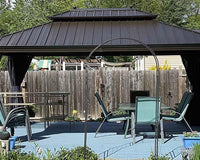
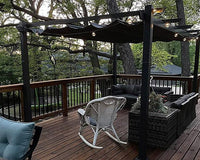
A chair can fit inside a 10 x 10 pergola's footprint and still be hard to use if a post, table, or neighboring chair blocks your approach or exit path. The relevant check is not the pergola's total floor space; it is whether you can walk up to the chair, recline into it, shift forward, and stand again without twisting around furniture or a support beam.

Before you settle on a layout, check the open space directly in front of and beside each chair, especially if you plan to recline fully before standing. Reject any arrangement that traps the chair between a post and a table, since that forces an awkward sideways exit even when the chair itself has ideal ergonomics. For readers zoning dining, shade, and traffic paths inside a compact structure like this, our outdoor room planning guide covers how to keep circulation clear around seating groups.
FAQs
What if my feet do not reach the ground in an Adirondack chair?
Unsupported feet are a fit failure, not just a matter of personal preference, even if the seat feels comfortable otherwise. A chair that leaves your feet dangling can reduce stability during both sitting and standing, so it should not be treated as an easy-standing option regardless of its listed height. Choose a lower or differently shaped seat instead, or add a stable, appropriately sized footrest only if it lets you complete the full rise test with your feet firmly supported the entire time.
Why does a deeper seat make it harder to get up from an Adirondack chair?
A deeper seat pan increases the distance your body must travel forward before your feet can support your full weight. In chairs with substantial recline, this requires a greater shift in posture and more leg and core effort to bring your center of gravity over your feet. Choosing a shallower seat depth keeps your hips closer to the front edge, making the transition to standing more direct.
How can you tell if Adirondack armrests will actually support standing?
Armrests provide useful standing leverage when they extend near the front edge of the seat, remain rigid under downward pressure, and sit at a comfortable elbow height that does not shrug your shoulders. If the armrests stop too far back, flex when you lean into them, or force your elbows outward, they offer little leverage and will not help you rise securely.