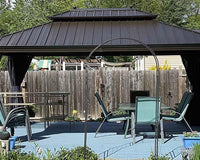
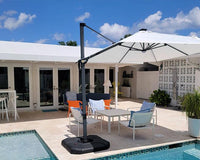
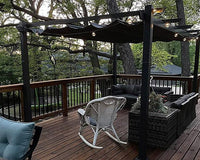
A rocking frame, a squeaky spring, and a sagging canopy on a patio swing with canopy are three different repairs, not one. Check the base and leg contact first for sway, isolate the noisy joint before oiling anything for squeaks, and inspect the fabric and support bars before retensioning a sagging canopy. Fixing the wrong part first usually makes the real problem worse, so the fastest repair starts with a correct diagnosis.
Stop using the swing if any frame connection, suspension spring, or canopy support bar is bent, cracked, severely worn, or cannot be secured the way your manual describes. That single boundary applies across every fix below.
Key Takeaways
- Diagnose the symptom first: whole-frame sway points to the base and connections, motion squeaks point to a specific hardware interface, and canopy sag points to the fabric and support bars.
- Correct frame instability by unloading the swing, checking leg contact, and tightening only the connections your manual documents, then retest before touching the canopy.
- Treat a squeak as a hardware-isolation problem. A water-resistant silicone lubricant can quiet compatible exposed metal parts, but it cannot fix a bent, loose, or incorrectly seated spring.
- Adjust canopy tension bars only when the fabric and hardware are undamaged, and confirm the canopy sheds water without new stress before returning to normal use.
- Replace a part or contact product-specific support when damage, a mis-seated spring, or an unclear procedure makes adjustment unsafe.
Start by Separating Sway, Squeaks, and Canopy Sag
Most freestanding swing complaints fall into three separate problems, and each one has its own first check. Match your symptom to the row below before doing anything else on your freestanding patio swing.
| Symptom | First inspection | Do not do yet |
|---|---|---|
| Whole frame rocks or sways | Base and leg contact, feet, levelers, frame connections | Adjust canopy tension bars |
| Squeak during gliding motion | Suspension spring, pivot, bolt, or bushing interface | Spray lubricant everywhere |
| Canopy sags or holds water | Fabric, seams, pockets, support bars, attachment points | Force or overtighten a tension bar |
This split matters because canopy tension cannot correct a wobbly frame, and lubricant cannot correct a loose or mis-seated part. If your swing rocks, move to the next section. If it only squeaks while the frame is steady, skip ahead to the lubrication section. If the frame is stable but the canopy pools water, go straight to the tension-bar section. Your model's manual controls the exact part locations described in each step, and why furniture gets wobbly covers the broader causes behind uneven or shifting outdoor furniture if you want more background before you start.
If the Frame Sways, Correct the Base or Connection—Not the Canopy
A rocking freestanding swing almost always traces back to the base or a loose connection, not the canopy. Work through these steps in order and stop when the frame sits still.

- Unload the swing completely and check whether every leg or foot touches the ground or deck evenly. An uneven surface or a leveler that isn't seated will cause sway no matter how tight the hardware is.
- Inspect every accessible bolt, joint, and connection point for looseness, missing hardware, or a bent member. Wiggle each connection by hand rather than relying on how it looks.
- Follow your model's manual for the tightening sequence and any approved leveling or anchoring method. Don't guess a torque value or swap in a fastener that isn't specified.
- Retest the frame by sitting and gliding normally. If it still rocks after a documented adjustment, treat that as a structural issue rather than something to force.
Freestanding swings depend on ground contact and connection integrity for stability, which is also why placement and anchoring matter in high-wind conditions; see our guidance on high-wind swing anchoring if your swing sits somewhere exposed to regular gusts. Once the base is steady, move on to squeak or canopy troubleshooting.
Silence Suspension-Spring and Hardware Squeaks Without Guessing
A squeak means something is rubbing at a specific joint, and finding that joint comes before any lubricant. Start by cycling the swing slowly and listening for where the sound originates, keeping your hands clear of pinch points near springs and pivots.
- Check that the noisy spring, bolt, or bushing is seated the way the manual shows. A spring end that hasn't fully passed through its attachment hole is a stop-and-check condition, not something a lubricant will fix.
- If the part is seated and undamaged, apply a small amount of a compatible lubricant only to the exposed metal interface. Manufacturer guidance on water-resistant silicone lubricant describes it as safe for most metal, rubber, vinyl, and plastic surfaces when used as directed, which makes it a reasonable option for exposed hardware when your swing's manual doesn't specify a different product. That compatibility claim covers general surfaces, not every coating, spring treatment, or canopy fabric, so keep it off the fabric and cushions and confirm your specific manual allows it.
- If your swing manufacturer specifies a particular lubricant, use that one instead. A manual instruction outranks a general compatibility claim.
- Shield the canopy and cushions before spraying, cycle the motion several times, then wipe off any excess so it doesn't attract dirt or drip onto fabric below.
If the squeak returns within a few uses, or the part turns out to be bent, loose, or still not seated correctly, stop lubricating and treat it as a repair question instead of a maintenance one.
Adjust Canopy Tension Bars to Reduce Sag and Pooling
Canopy sag usually comes from slack in the support bars or fabric, and you can only correct it safely once the frame is already stable. Work through the fabric and hardware in this order before changing any tension setting on your swing with canopy.
- Inspect the fabric, seams, pockets, support bars, and attachment points for tears, stretching, bending, or a bar that has slipped out of its pocket.
- Locate the actual tension or support components in your model's manual. Bar placement and adjustment points differ between swing designs, so don't assume yours matches a different model.
- Make small, even adjustments only where the manual allows them. Stop immediately if the fabric resists, a bar feels bent, or a seam or pocket starts to pull.
- Confirm the result: water should shed off the canopy, the fabric shouldn't rub or crease sharply against the frame, and the frame itself should remain as stable as it was before you touched the canopy.
An intact, adjustable canopy is what makes this step possible in the first place. Our 3-person swing model lists an adjustable canopy along with polyester fabric and an alloy-steel frame, and that same rule applies to it: adjust tension only through the documented support-bar points, not by forcing the fabric.
Decide When to Repair, Replace, or Contact Product Support
Adjustment is the right call only when the affected part is intact and your manual supports that specific change. Once damage or an unclear procedure enters the picture, adjustment stops being enough.
- Adjust when the canopy fabric, support bars, and frame connections are undamaged and the manual documents the change you're making.
- Replace the canopy, support bar, spring, or connection part when it's torn, bent, cracked, severely worn, or won't stay secured. Tension or lubricant should never be used to mask that kind of damage.
- Contact product-specific support when you can't confirm the correct part, procedure, or replacement piece from the manual alone. For our 3-person swing model, which is rated for an 800-pound capacity, we can walk you through the exact adjustment or replacement steps for that model through the product instructions or our support channel rather than a generic guess.
Before returning any freestanding patio swing with canopy to normal use, confirm all of the following: the frame is stable with no rocking, any suspension spring is correctly seated, the motion is quiet and controlled, the canopy sheds water without new fabric stress, and no damaged part remains in service. If any of those fail, don't resume normal use until it's resolved. Our outdoor swing maintenance guide covers routine upkeep once the swing passes this check.
FAQs
What if only one side of the canopy sags?
Uneven sag usually means one support bar has slipped out of its fabric pocket, or that side has a localized tear or a bent bar, rather than a general tension problem. Check that specific pocket and bar before adjusting anything, and don't force the bar back into place if it's bent or the fabric resists. If the pocket or bar is damaged, reseating it safely may not be possible, and replacement or product-specific support is the more reliable next step.
Is it safe to keep using a swing that still squeaks after lubrication?
Not automatically. A squeak that returns quickly after lubricant usually means the part isn't actually seated correctly or has some wear that lubrication can't fix. Keep using the swing only after you've confirmed the spring or joint is seated per the manual; if you can't confirm that, treat the noise as a signal to inspect further rather than to reapply lubricant.
Can I apply lubricant to the canopy fabric or hinges to stop squeaking?
Keep lubricant off the canopy fabric. The water-resistant silicone lubricant compatibility referenced above applies to exposed metal, rubber, vinyl, and plastic hardware, not to canopy fabric, so treating fabric the same way risks staining or degrading it instead of solving the noise. If a hinge is fully exposed metal and your manual doesn't restrict it, a small, targeted amount on that hinge alone is the more appropriate approach.