Choose a large patio umbrella by working backward from the furniture you need to shade, not from the biggest canopy on the shelf. Measure the table or lounge grouping first, then check overhead height, side clearance, and the base or anchoring option the maker lists for that exact size. A canopy that covers your table can still fail if its listed height, arm swing, or base footprint does not fit your deck.
Key Takeaways
- Measure the furniture footprint before comparing canopy sizes; the shade target and the umbrella's support location are two separate measurements, especially for offset models.
- Treat canopy coverage, overhead clearance, and support/rotation clearance as three separate pass/fail checks, not one decision.
- Match the base or anchoring option to the exact model and size you pick; gross umbrella weight is not a substitute for a listed base requirement.
- Choose a center-post layout when the support can sit in a clear central spot, and an offset layout only when the base and arm-rotation path also fit the space.
- Confirm the exact model's wind, closure, and storage instructions before use; no single wind rating applies to every large patio umbrella.
Start with the space you need to shade
The starting measurement is the furniture footprint, not a canopy size chart. Mark the outline of the table and chairs, or the full lounge grouping, and use that shape to filter which documented umbrella sizes are even candidates.
Measure the furniture footprint first
Measure the length and width of the dining set or lounge area people actually use, including pulled-out chairs. For a center-post umbrella, that measurement is close to the canopy target. For an offset design, separate the shaded zone from where the support pole and base will actually sit, since the two areas rarely overlap.
Match shape to the layout
A round canopy tends to suit a round or square table where shade radiates evenly from the center. A square or rectangular canopy often lines up more efficiently with a rectangular table, a narrow deck run, or a corner near a railing. Our Provence Series umbrella is a current example of how a documented size range narrows the field: it lists 8x8, 10x10, 9x12, and 10x13-foot canopies with maximum heights from 9.8 to 12.2 feet and a different suitable weighted base assigned to each size. Use that kind of listing as a shortlist to test against your marked footprint, not as a universal size recommendation, since the right pick still depends on the clearance and support checks that follow.
Measure clearance in every direction
Coverage over the table is only the first check. Before you commit to a size, confirm the umbrella can actually open, rotate, tilt, and close inside your patio's real boundaries.

- Overhead clearance: Compare the lowest roof eave, pergola beam, or tree limb with the model's listed maximum height, such as the 9.8 to 12.2-foot range on the Provence Series sizes above.
- Canopy-edge clearance: Measure from the planned canopy edge to walls, railings, planters, and the deck's actual boundary, not just to the furniture.
- Furniture and access clearance: Leave room to pull chairs back and walk around the table without brushing the canopy or ribs.
- Support and rotation clearance (offset models): Mark the base footprint and the full arc the arm travels through, since a SUNBRELLA cantilever umbrella with 360-degree rotation and six height positions needs open space well beyond the shaded circle to use those features.
If any single check fails, the umbrella is not a fit at that size or position, even if the canopy alone would cover the table. Our patio umbrella size guide walks through this measuring process in more detail if your patio has irregular boundaries.
Match the base and support to the exact model
The base or anchoring method has to match the exact umbrella size you select, not a general weight rule. Manufacturers assign different bases to different canopy sizes because taller poles and wider canopies change the load on the support.
The Provence Series listings above show this directly: the suitable weighted base changes from a smaller unit at 8x8 feet up through a larger one at 10x13 feet, even though the frame material and rotation stay the same across sizes. Record your chosen canopy size and support type first, then use the maker's listed base for that specific size rather than estimating from the umbrella's gross shipping weight. Confirm next that the base's footprint actually fits your surface, whether that is a wood deck, pavers, or poured concrete, since a base designed for one surface type may need a different mounting method on another. When the product page or manual does not spell out the anchoring option for your surface, treat that as an open question to resolve with the manufacturer before buying, not as a detail to skip. Our guide on base compatibility measurements covers the pole-diameter and footprint checks that confirm a base actually fits a given umbrella.
Choose center-post or offset by furniture layout
Center-post and offset umbrellas solve different placement problems, and the right one depends on where the support pole can physically sit. Neither mechanism is a better choice in general; the layout decides it.
Center-post for central coverage
A center-post umbrella works when the support can occupy the middle of the table or another clear central spot without blocking a chair. Some tables have a built-in umbrella hole that makes this simple, but the base still has to sit flat and clear of foot traffic underneath.
Offset for outside-the-seating support
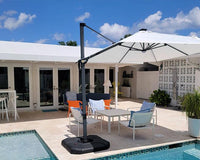
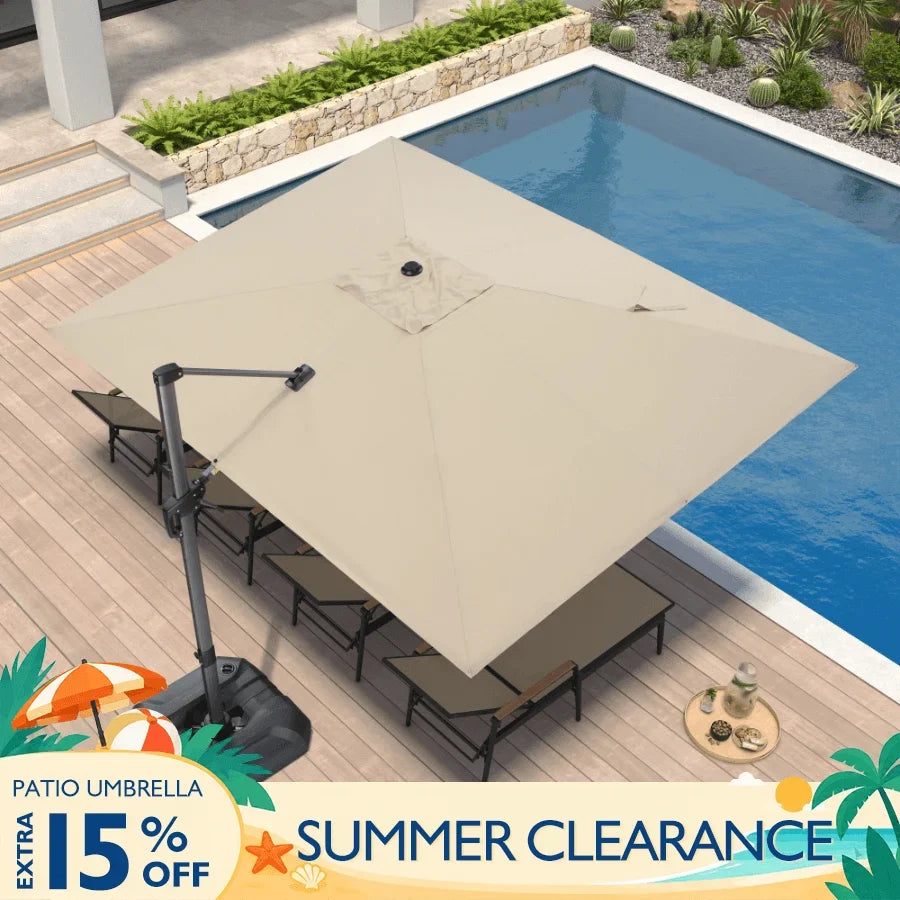
An offset, or cantilever, umbrella moves the pole and base outside the seating area so the arm reaches over the table or lounge grouping instead of through it. That advantage only holds up if the base footprint, the arm's full rotation path, and the height or tilt controls all fit inside your measured clearance zone. Our square rectangular cantilever is one example built for this layout, with a crank lift, tilt handle, and foot-pedal rotation meant for tighter corners and pool edges where a center pole would be in the way.
Finish with the model-specific wind and shutdown check
Before you treat any large umbrella as ready for regular outdoor use, confirm the exact model's own wind, closure, and storage instructions. No canopy vent, frame material, or listed weight establishes a universal wind rating on its own.
Manufacturer guidance varies by model. Our Hailar Deluxe Outdoor Patio Umbrella lists a maximum wind resistance of 30 mph and recommends closing the canopy once winds reach 25 mph; those figures apply only to that model and should not be applied to the Provence Series or any other umbrella without its own documented limit. The CPSC airborne beach umbrella alert is written for beach umbrellas, not patio models, but its underlying advice still applies here: secure the umbrella and anchor exactly as the manufacturer's setup instructions describe, watch for sudden gusts, and close the canopy immediately if it becomes unstable.
Before installing any large umbrella, locate the current instructions for your exact model and size, and confirm the base or anchoring method, any wind-use position or limit, tilt restrictions, and the closure and storage steps. If those instructions are not available for your model, hold off on installing or leaving the umbrella up in wind-exposed conditions until you can confirm them. Our cantilever wind guide walks through how to judge that risk and choose base weight once you have the model documentation in hand. Once your size, clearance, base, and mechanism checks all line up, comparing our documented large-umbrella sizes and mechanisms against your measurements is the next step toward a setup you can trust in your space.
FAQs
How do I measure an offset umbrella when the support sits outside the seating area?
Measure it in two separate frames instead of one. First mark the canopy area that needs to cover the table or lounge grouping, then separately mark the base footprint and the full arc the arm travels through as it rotates and tilts. Keep only the umbrella models whose canopy zone covers your furniture and whose base-and-rotation zone also fits inside your available deck space; if either zone fails, the model is not a fit at that spot even if the other measurement works.
Can I use a universal base weight formula for any large patio umbrella?
No single formula works for every umbrella. Frame height, canopy span, and offset arm geometry determine the necessary ballast, so you must always follow the manufacturer's exact listed base or anchoring requirement for that specific model.
At what wind speed should I close a large patio umbrella?
Shutdown thresholds depend strictly on the manufacturer's manual. For example, our Hailar model has a maximum rating of 30 mph but recommends closure at 25 mph. Never rely on fabric or vent features alone as proof of wind resistance.