When choosing shade for a patio dining table with umbrella hole, start with where the support has to stand, not the umbrella style. A center-pole (table) umbrella needs a compatible opening in the table and works well when floor space around the set is tight. A cantilever (offset) umbrella needs open perimeter space for its base and arm, and it keeps the tabletop itself completely clear.
The right pick depends on your table's actual footprint, chair movement, and how the sun crosses your patio, not on whether the set seats six or eight.
The short choice: match the umbrella to the dining footprint
Match the support location to your layout first, then confirm the details later in this guide.

- Choose a center-pole/table umbrella when the table has a verified compatible opening, you want shade centered over the table, and there isn't much room to spare beside the set.
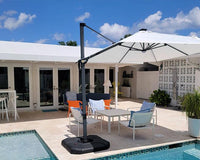
- Choose a cantilever/offset umbrella when the table has no usable opening, you want the tabletop itself left open, or shade needs to come in from the side, and your perimeter can hold a base outside the seating path.
- Confirm both options against the table's real length, chair depth, and walkway space. A 6- or 8-seat label describes headcount, not canopy size or clearance.
Cantilever vs. center-pole: the practical tradeoffs
The two designs solve different spatial problems, so the better fit depends on which constraint matters most in your dining area.
| Decision factor | Center-pole/table umbrella | Cantilever/offset umbrella | What changes the choice |
|---|---|---|---|
| Support location | At the table's built-in opening | Beside the table, on its own base | Whether the table has a compatible hole |
| Legroom | Pole sits in the table center | No pole at the table; base sits outside it | How much you value an unobstructed table center |
| Sightlines | Pole can interrupt eye contact across the table | Clear sightlines across the whole table | Priority on conversation-friendly seating |
| Placement footprint | Uses existing table space only | Needs open floor beside the table for the base and arm | Available perimeter clearance |
| Shade arc | Centered over the table by design | Depends on arm reach and canopy angle | Table length and sun direction |
| Setup dependency | Table opening, pole diameter, and base must match | Base weight and side clearance must match the model | Manufacturer specs for the exact model |
| Best-fit scenario | Compact layouts with a compatible table hole | Longer tables or tight-legroom layouts with open perimeter space | Full footprint, not seat count |
Use this table to narrow your options, then verify the specific measurements below before deciding.
Measure the table, chairs, and umbrella-hole setup before choosing
Before comparing umbrellas, measure the full dining footprint rather than relying on the seat count on the box. A 6- or 8-person label tells you nothing about table length, chair depth, or how much room you need to sit down and stand up.
Map the tabletop and chair footprint
- Record the table's length and width, not just its advertised seating capacity.
- Mark each chair's pulled-out position and the path someone needs to sit down and stand up without bumping a pole or base.
Check the opening and surrounding space
- Confirm whether the table has an umbrella hole and whether its position actually supports centered shade over the seating area.
- Measure the side area next to the table where a cantilever base and arm would sit, including any walkway or chair-movement route that crosses it.
Treat a table hole as a compatibility question, not proof that any pole or base will fit. Reserve a clear side zone before committing to a cantilever so the base doesn't trade one obstruction for another.
Choose a center-pole umbrella when the table can carry centered shade
A center-pole umbrella is the practical match when three conditions line up at once.
- The table has a verified opening in the intended support position, and the pole and base you're considering actually match that opening.
- Floor space around the table is limited, so integrating the support into the table itself, rather than placing a base beside it, is the more workable layout.
- The pole doesn't sit where it would block conversation or the route to a chair; if it does, the centered layout stops being an advantage.
- If the table opening, pole diameter, base interface, or canopy dimensions don't match the manufacturer's stated requirements, treat the table as incompatible rather than forcing the fit.
This setup suits patios where simplicity and a tight footprint matter more than a fully open table center.
Choose a cantilever umbrella when side placement solves the seating problem
A cantilever umbrella earns its higher footprint cost when it solves a real seating problem, not just as an upgrade.
- The table has no usable opening, or keeping the table center completely open matters for conversation, plating, or décor.
- The base and arm can sit entirely outside chair-movement paths and walkways; if they can't, the side-mounted layout doesn't actually free up space, it just relocates the obstruction.
- The canopy's reach covers the full rectangular table, including both ends, rather than assuming a large nominal size automatically covers every seat.
- A current example, our PURPLE LEAF cantilever umbrella, offers 360-degree rotation, six height and tilt adjustments, and canopy sizes from 9 by 12 feet up to 12 by 12 feet, each paired with a specific recommended weighted base. Those facts describe that model only; confirm the matching specs for whatever cantilever you're actually considering.
Judge the shade arc as the sun moves
Canopy size and pole layout only solve half the problem; the shade also has to track the sun during the meal or across the season.
Start with table-edge coverage
Start by checking that the canopy extends at least 2 feet beyond each edge of the table as a baseline, then compare that overhang against the table's actual length and width. Check both ends of a rectangular table, not just the center, since a canopy sized for a round table can leave the ends exposed.
Account for chairs and moving sun
- Mark the side of the patio that gets the strongest or most persistent sun during the times you actually eat outside.
- Check whether chairs pulled out from the table stay inside the shaded zone, since seating shade matters as much as tabletop shade.
- Rely on canopy tilt, rotation, or repositioning only when the specific model's documentation confirms that adjustment range; don't assume every umbrella offers it.
The two-foot overhang is a starting check, not an all-day guarantee, because shade position shifts as the sun moves. For more on tracking that shift, see how to place the umbrella for changing shade.
Make the final pass/fail fit check
Before buying or installing either option, run the fit check that matches your chosen branch.
Run the fit checks
- For center-pole shade, match the table's opening, the pole diameter, the base, and the canopy size against the manufacturer's stated requirements.
- For cantilever shade, match the canopy's listed dimensions and side projection, the required base, and the available side clearance you measured earlier.
Keep performance claims model-specific
Pull wind and durability information from the documentation for the exact umbrella-and-base combination you're buying, not from a different design. According to the market umbrella test standard, test results for one umbrella-and-base design are not interchangeable with another design, since pole, canopy, vent, and base construction all vary between models. If you're looking at a cantilever setup like our PURPLE LEAF cantilever patio umbrella, confirm the canopy size, recommended base, and side clearance against your own measurements before ordering. Choose the branch whose exact dimensions and instructions pass every check; if nothing fits yet, keep measuring and researching rather than forcing a purchase.
FAQs
Does a heavier base always mean a safer cantilever umbrella?
Not necessarily. Base weight has to match the specific umbrella model's canopy size and arm length, since a mismatched base and umbrella combination isn't tested or documented together. Check the manufacturer's recommended base for your exact model rather than assuming a bigger base is automatically safer.
Can I use a cantilever umbrella if my dining table already has an umbrella hole?
Yes. A table hole only matters for a center-pole umbrella; a cantilever umbrella doesn't use it at all, since its base sits beside the table instead of through it. In that case, base clearance and canopy reach matter more than the hole itself.
Will one umbrella size work for both a 6-person and an 8-person version of the same table?
Not automatically. An 8-person table is usually longer, so the same canopy that covers a 6-person table may leave the extra length exposed. Measure the actual table length for your version before matching a canopy size.
Is an outdoor pergola a substitute for either umbrella type here?
Not directly for this comparison. A pergola is a fixed structure rather than a movable or repositionable shade source, so it doesn't solve the same seasonal sun-tracking problem an umbrella does for a single dining table. Treat it as a separate patio project rather than a swap-in replacement.
Sources
- ASTM International. Market umbrella wind test standard.