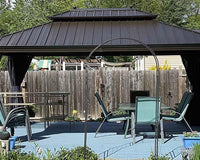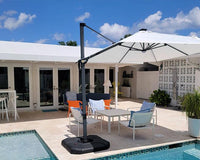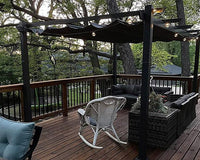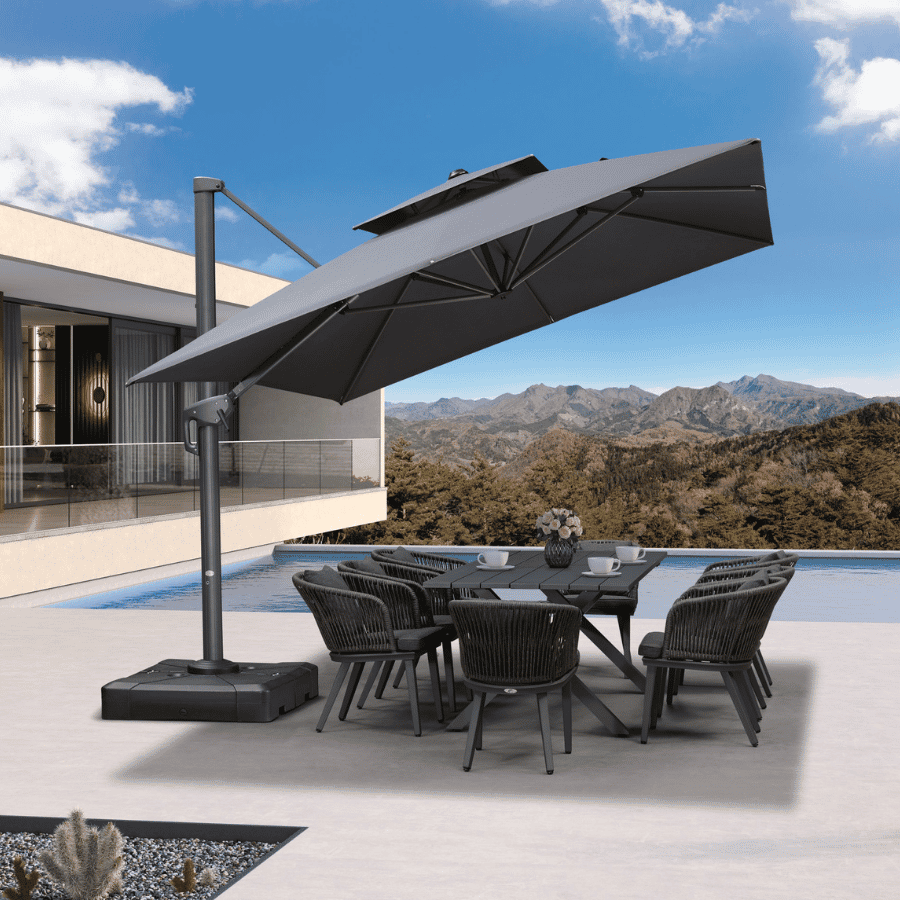
Choose a patio dining table with an umbrella hole when you want centered shade and a clear floor plan around the table, and your table, pole, and base are compatible. Choose a freestanding offset cantilever umbrella when you need an open tabletop center for a centerpiece or serving dishes, and you have room to place a base outside the chair and walking paths. Either choice can fail if the pole, base, or surrounding clearance does not match your patio, so check footprint and legroom before you commit to one setup.

Center-Pole or Offset: The Short Answer for Six-to-Eight Person Dining
A center-pole setup works best when your table already has a matching umbrella hole and you want the shade to stay directly over the table without adding a stand or mast beside it. That keeps the floor around a six-to-eight-person table more open for chairs and walking, since the only extra hardware is the pole running through the tabletop and into a base below it.

An offset cantilever setup works best when you want the tabletop center free for a centerpiece, serving platters, or a lazy Susan, and your patio has space beside the table for a freestanding base. The trade is that the base and mast become a separate obstacle you have to plan around, instead of hiding inside the table itself.
If your current table has no umbrella hole and you do not want to modify it, the offset path is the direct option, subject to base placement. Neither branch is final until you check how the exact umbrella, table, and base fit together, which the comparison below and the verification steps later in this guide walk through.
Center-Pole vs. Offset: Comparison Matrix
The two setups solve the same shading job in different ways, and the difference shows up across seven practical points at a six-to-eight-person table. Our market vs. cantilever guide compares the two umbrella styles more broadly if you want the full category picture.
| Decision axis | Center-pole setup | Offset cantilever setup |
|---|---|---|
| Legroom | Pole and lower hardware sit under the tabletop; fine if they clear chair legs and knees | No pole under the table; legroom depends on where the base and mast sit outside it |
| Table-center clearance | Pole occupies part of the table center, competing with a centerpiece or serving dishes | Tabletop center stays fully open for dishes, decor, or a lazy Susan |
| Shade adjustability | Canopy stays centered over the table; repositioning is limited by the table opening | Canopy can shift across the table when the selected model supports it |
| Tilt flexibility | Tilt is limited by the pole passing through the table and its hardware | Some models tilt or rotate independently of the table, but this varies by product |
| Base interference | Base often sits below or near the table, inside the existing footprint | Base sits outside the table, which can block a chair path or walking lane |
| Setup complexity | Requires matching table hole, pole diameter, and base as one compatible system | Requires a clear base location, mast clearance, and enough canopy reach to cover the table |
| Placement constraints | Works only if the table already has, or can safely take, a compatible opening | Works on tables without a hole, but needs open floor space beside the table |
Pick the row that matches your biggest constraint first. When table-center space or shade movement outweighs a fully open floor plan, the offset setup fits that priority, provided the base has somewhere to go. When keeping the surrounding floor clear matters more than the tabletop center, the center-pole setup fits it, provided the table and pole are actually compatible.
Legroom and Table-Center Clearance at a Full Dining Table
The real test is not which setup looks clearer on paper, but whether the hardware collides with chairs, knees, or walking space once everyone is seated. A center-pole umbrella keeps the tabletop center occupied by the pole, but if the pole and its lower support clear your chair legs and any table pedestal, the floor around the table stays open. An offset cantilever umbrella frees the tabletop center completely, but its base and mast become the new obstacle, and that base has to sit somewhere that does not block a chair pulling out or a path to the grill or door.
Test this on-site before you buy. Mark the table's edge, the back of each pulled-out chair, and the walking lane you use most, then mark where the pole or base would actually sit. Sit in every chair with the table fully seated at six to eight people and check whether anyone's knees hit the pole, and whether the base blocks a chair or a walking route. This site-specific check matters more than either category's general reputation, and it applies whether you already own a table or are still shopping; our outdoor umbrella stand guidance covers base and stand placement basics if you are starting from scratch.
A clear tabletop does not guarantee a clear patio, and a clear patio does not guarantee a clear tabletop. Confirm both before deciding, since either failure means testing the other setup instead.
Shade Movement and Tilt: Which Setup Follows the Sun?
Choose centered coverage when your dining spot doesn't need the shade to move, and choose a verified offset model when you need the canopy to track the sun without disturbing the table. A center-pole canopy stays fixed over the table opening, so it works well when the table's position rarely needs adjusting during a meal. Its main limit is that repositioning it depends on the table's hole placement and the specific model's tilt range, which can be modest.
An offset cantilever umbrella can move shade across the table without touching anything on top of it, but only if the specific model you buy actually rotates or tilts the way you need. Our PURPLE LEAF cantilever umbrella with base rotates a full 360 degrees and adjusts through six up-and-down positions, letting the canopy follow the sun across a long dining session. That range is specific to this offer's design, not a guarantee that every cantilever umbrella rotates or tilts the same way.
If you can't confirm the rotation range, tilt range, or base clearance for the model you're considering, hold off on ordering. Assuming a canopy will cover every seat as the sun moves is the kind of guess that leads to an empty umbrella over an occupied chair by the end of the meal.
Verify the Table, Umbrella, Base, and Patio Before Buying
Before ordering either setup, confirm the table, umbrella, and base work together as one system, not as separate parts that merely look compatible. For a center-pole setup, check the table's umbrella-hole diameter, tabletop thickness, and any pedestal or leg position against the pole diameter and the base you plan to use underneath, and check the open space below the tabletop for knee clearance. For an offset setup, check the canopy's reach and open depth against the table size you want covered, then mark the base footprint, mast position, and clearance from chairs, walls, railings, or a walkway.
Record how much of the table center needs to stay open for a centerpiece or serving dishes, since that answer decides which setup you actually need. Then follow the exact product manual for assembly steps, base weight requirements, and operating limits, because ASTM F3512-21 notes that results for one umbrella-and-base design are not comparable to a different design, given differences in poles, frames, canopies, vents, hubs, and base weights or shapes. That means a wind or stability rating for one umbrella and base combination does not carry over to a different table, pole, or base you might swap in. Keep these records handy when you compare tables, umbrellas, and bases from different listings, since specs only mean something when read together.
Use This Final Choice Path Before You Order
Work through these steps in order, and stop at whichever one gives you a clear result.
- Decide whether the tabletop center must stay open for a centerpiece, serving dishes, or flexible seating for six to eight people. If yes, lean offset; if not, either setup stays in play.
- Mark the center-pole hardware or the offset base location, then test chair pull-out, knee space, and walking routes with every seat occupied.
- Match the exact umbrella, table, and base dimensions, including hole or pole compatibility, canopy reach, base footprint, and overhead clearance.
- Check the selected product's manual for setup and weather guidance. The CPSC safety alert on beach umbrellas advises closing the canopy immediately if it becomes unstable in gusty conditions, a habit worth keeping even though that alert covers beach umbrellas, not patio setups. For general weather context, the NWS Beaufort wind chart describes umbrella use as difficult around 25 to 31 mph, but your umbrella's own manual sets the actual operating limit.
- Choose center-pole if the centered system passes steps 2 and 3, choose offset if the open-center system passes them, or hold the order if a table, pole, base, or clearance fact is still unverified.
FAQs
Can I add an offset umbrella to a table that already has an umbrella hole?
Yes. The hole does not have to be used, and an offset cantilever umbrella can shade the same table if there is room beside it for the base and mast, with clearance from chairs and walking paths.
Does a bigger dining table always need a bigger base?
Not automatically. The base needs to match the canopy size and wind exposure of the specific umbrella, not the table size alone, so check the base weight and footprint listed for your selected model rather than estimating from table dimensions.
Is a center-pole umbrella more stable than an offset umbrella?
Stability depends on the exact umbrella-and-base combination rather than the general category, since test results for one design are not comparable to another. Compare the base weight and manufacturer specs for the specific model you are considering.
What should I check if my current table has no umbrella hole?
Confirm you have space beside the table for a freestanding base and mast without blocking chairs or a walkway. An offset cantilever setup is the direct option since it does not need a tabletop opening.
Sources
- ASTM International. Market Umbrella Wind Safety Standard.
- U.S. Consumer Product Safety Commission. Beach Umbrella Safety Alert.
- National Weather Service. Beaufort Wind Scale.