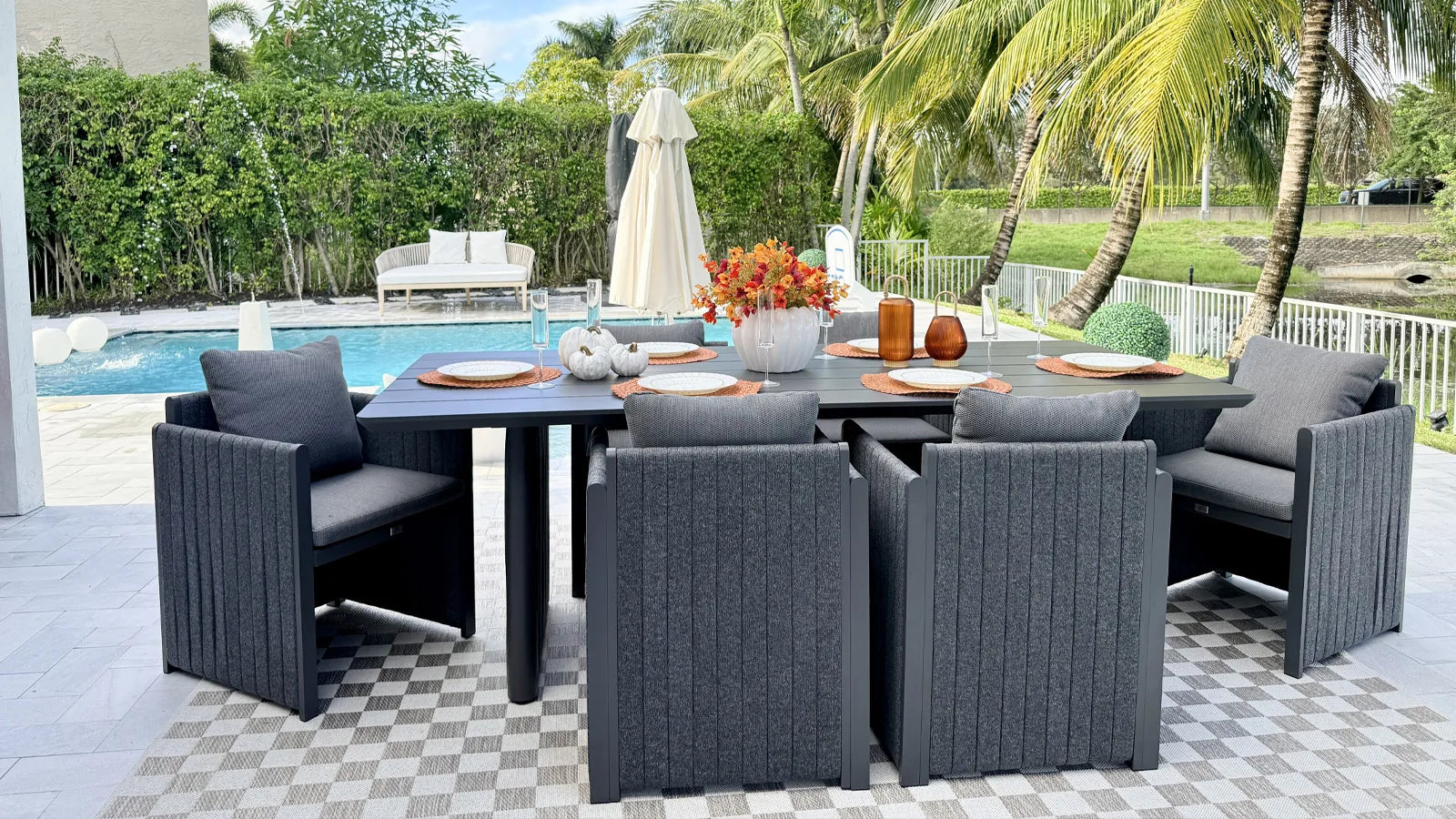
Extendable outdoor dining tables are worth the investment for homeowners who frequently host guests but want to maximize their daily patio space. These tables offer the flexibility to transform from a standard four-to-six-person setup into a larger configuration that seats eight or more.
While they cost more than fixed tables, their value lies in their versatility, space-saving design, and the ability to adapt to various social occasions without requiring multiple sets of furniture.
Evaluate the Versatility of an Extendable Outdoor Dining Set
Choosing an outdoor dining set extendable version is primarily a decision about lifestyle flexibility and space management. Most patios have a limited footprint, and a massive fixed table can make the area feel cramped and difficult to navigate. An extendable set allows you to maintain an open, airy environment for daily family use while remaining prepared for larger gatherings at a moment's notice.
Maximize small to medium patio footprints
In smaller outdoor living areas, every square foot is valuable. A large table that sits empty 90% of the time is a waste of space that could be used for loungers or fire pits. By using an outdoor dining set extendable design, you can keep the table in its compact form for Monday through Friday, ensuring the patio feels spacious. When the weekend arrives, you simply deploy the extension to accommodate extra guests without the need for folding "emergency" tables.
Adapt to different types of social events
Not every gathering requires the same seating arrangement. An extendable table allows you to scale your furniture to match the event. For an intimate brunch, the smaller setup feels cozy and encourages conversation. For a holiday barbecue, extending the table creates a grand dining experience. This adaptability ensures that your furniture never feels "too big" or "too small," regardless of the guest list.
Eliminate the need for secondary furniture storage
One of the biggest headaches of hosting is storing extra chairs and tables. While you still need a place for extra chairs, an extendable table integrates the extra surface area directly into the main unit. This eliminates the need to haul a heavy secondary table out of a garage or shed. It simplifies the hosting process, making you more likely to invite people over spontaneously.
Compare Different Extension Mechanisms
The worth of an extendable table often depends on how easy it is to operate. If the mechanism is clunky or requires two people to struggle with heavy leaves, you likely won't use the extension feature as often as you imagined. Modern engineering has introduced several "user-friendly" designs that make the transition seamless.
Analyze the butterfly leaf design
The butterfly leaf is a popular choice for a modern outdoor dining table. The extension piece is hidden in a compartment beneath the table surface; it unfolds like wings once the table ends are pulled apart. The main advantage is that the leaf is "self-storing," meaning you never have to find a closet to hide the extension piece. However, because it has more moving parts, it requires regular cleaning to ensure the hinges don't get stuck with debris.
Understand the pull-out or slide-out system
Some tables use a simpler slide-out mechanism where the extension leaves sit at either end of the table. You pull them out like a drawer, and they lock into place. This design is often more robust because it has fewer complex hinges. It is an excellent choice for those who want a reliable, long-lasting outdoor dining table for 8 because there is less that can go wrong over years of exposure to the elements.

Evaluate the lift-and-drop mechanism
In this design, the extra leaf is a separate piece that you manually place into the center after sliding the two halves apart. While this is the most stable and strongest configuration, it requires you to store the leaf elsewhere when not in use. If you have a dry, accessible storage spot, this can be a great way to ensure the maximum weight capacity for a large dinner party.
Choose the Right Material for Durability
The outdoor environment is harsh, and an extendable table has more "vulnerable" points than a fixed one. The joints, tracks, and leaves are all exposed to moisture and temperature changes. Selecting the right material is the difference between a table that lasts ten years and one that jams after the first winter. For a comprehensive breakdown of how different materials perform outdoors, the outdoor dining set material guide covers the key trade-offs in detail.
Invest in an aluminum outdoor dining table
An aluminum outdoor bar stools set is often paired with an aluminum outdoor dining table for good reason. Aluminum is the gold standard for extendable mechanisms because it does not rust, warp, or swell. Wood tables can expand when it rains, causing the extension tracks to jam. Aluminum remains dimensionally stable in all weather conditions, ensuring the table opens smoothly every time. It is also lightweight enough that one person can usually handle the extension process alone. Independent material comparisons confirm that aluminum outperforms most alternatives for low-maintenance outdoor use — see aluminum vs teak outdoor furniture for a detailed side-by-side analysis.
Consider the pros and cons of teak
Teak is a beautiful, luxury option for an outdoor dining table for 8. It contains natural oils that protect it from rot. However, even the best teak can move slightly with humidity. If you choose a wood extendable table, you must ensure the tracks are made of stainless steel or high-grade plastic to prevent the wood-on-wood friction that leads to sticking. Regular oiling of the mechanism is required to maintain performance. Research on teak furniture durability confirms that teak's natural oil content makes it uniquely resistant to rot and insects, but dimensional movement in humid climates remains a key consideration for extendable mechanisms.
Evaluate high-density polyethylene (HDPE)
Poly-lumber or HDPE is an eco-friendly material made from recycled plastics. It is incredibly durable and resistant to salt air and heavy rain. While it is excellent for fixed tables, it can be quite heavy for extendable versions. If you choose an HDPE outdoor dining set extendable model, check the weight of the leaves to ensure they are manageable for the primary users of the home. Industry guides on HDPE outdoor furniture durability note that quality poly lumber withstands UV rays, salt air, and extreme temperatures without cracking or fading — making it a strong long-term option despite its weight.
Plan Your Space for 6 to 8 People
One of the most common mistakes is buying a table that fits the patio when closed but blocks the exits when opened. You need to calculate the "extended footprint" to ensure that your outdoor dining sets for 8 don't turn your patio into an obstacle course. The patio dining table size guide provides a practical framework for calculating both closed and extended footprints before you buy.
Measure for a patio dining table for 6
A standard patio dining table for 6 usually measures around 60 to 72 inches in length. To ensure comfort, you need at least 36 inches of clearance around the perimeter of the table for people to pull out their chairs and walk behind them. Before purchasing, use painter's tape on your patio to mark both the "closed" and "fully extended" dimensions to visualize the traffic flow.
Transition to an outdoor dining table for 8
When extended, an outdoor dining table for 8 typically reaches 90 to 110 inches. This transition usually adds about 24 to 30 inches to the length. This extra length can sometimes block doorways or interfere with grill placement. If your patio is narrow, look for a "side-extension" or a narrower table profile to ensure you don't lose the ability to move around the dining area.
Account for leg room and chair width
Not all 8-seater tables are created equal. Some designs have legs at the very corners, while others have a central pedestal or "trestle" base. Corner legs move outward when the table extends, providing maximum legroom. Trestle bases are great for squeezing in extra people, but they can be awkward for those sitting near the supports. When choosing outdoor dining sets for 8, ensure the chair width allows everyone to sit without bumping elbows.

Identify Potential Drawbacks and Maintenance Issues
No piece of furniture is perfect, and extendable tables have specific "pain points" that you should consider before spending the extra money. Knowing these issues in advance can help you decide if the added functionality is worth the extra care required.
Clean the tracks and hinges regularly
The biggest enemy of an extendable table is grit. Sand, dust, and pollen can settle into the sliding tracks. If you close the table with debris in the tracks, it can scratch the finish or cause the mechanism to grind and eventually jam. You should make it a habit to wipe down the internal tracks with a damp cloth every time you open or close the table.
Manage the "sun-fading" difference
If you leave your table closed 95% of the time, the main tabletop will be exposed to the sun while the hidden leaf remains in the dark. Over several years, the main table may fade slightly, creating a color mismatch when you finally pull out the extension leaf. To prevent this, use a full-table cover when the set is not in use, or occasionally leave the table extended for a few days to equalize the UV exposure.
Handle the weight of the extension leaves
Even an aluminum outdoor dining table can be heavy when it reaches large dimensions. If the extension leaf is a "separate lift-out" style, it may weigh 20 to 30 pounds. For some users, this can be physically taxing. Always check the product specifications to see if the table features "assisted opening" or "one-handed" operation if lifting heavy objects is a concern for you.
Modern Design Trends in Outdoor Furniture
Today's modern outdoor dining table doesn't look like the clunky, industrial sets of the past. Designers are focusing on "hidden functionality," where the extension features are virtually invisible until they are needed. This allows you to have a high-performance table that still matches a contemporary, minimalist aesthetic. The outdoor dining set style guide explores how today's designs balance form and function for modern patios.
Look for "seamless" top designs
In the past, you could always see the "seam" where an extendable table pulled apart. Modern designs now use precision CNC cutting to make that seam nearly invisible. This creates a much cleaner look in the compact mode. Some tables even use slatted designs where the extension slats nestle between the main slats, creating a beautiful, rhythmic pattern whether open or closed.
Pair with multifunctional seating
To truly get the most out of an outdoor dining set extendable unit, many people are pairing them with benches instead of just chairs. A bench can easily accommodate three children or two adults, providing even more seating flexibility. Benches can also be tucked entirely under the table when it's in its compact mode, further saving space on your patio.
Explore integrated tech features
Some high-end modern tables now include integrated umbrella holes that remain centered even when the table is extended. Others feature built-in drainage channels so that water doesn't pool in the extension tracks. These small engineering details are what separate a "worth it" investment from a budget table that will cause frustration.
Is it Worth the Investment?
An extendable outdoor table is worth it if you host more than four people at least once a month. The cost per use is lower than buying two separate tables, and the space saved is invaluable for daily living. However, if you rarely host or live in a highly corrosive environment (like direct oceanfront) where moving parts might seize up, a high-quality fixed table might be a more practical choice. For most suburban homeowners, the aluminum outdoor dining table with an extension is the most versatile and durable solution available.

Conclusion: The Smart Choice for Flexible Outdoor Living
Deciding on an outdoor dining set extendable version comes down to balancing your desire for a spacious patio with your need for guest capacity. By choosing a durable material like aluminum and a user-friendly mechanism like a butterfly leaf, you can enjoy the best of both worlds. Whether you are hosting a patio dining table for 6 for a family dinner or expanding to an outdoor dining table for 8 for a neighborhood party, the flexibility provided by an extendable set makes it a premier choice for modern outdoor living.
FAQs
Can one person extend a large aluminum outdoor dining table alone?
Yes, most modern aluminum outdoor dining table models are designed for one-person operation. Because aluminum is lightweight and the tracks are often coated with Teflon or high-grade lubricants, you can usually pull one end and have the other end slide out automatically. However, for very large 12-person tables, a second person may be helpful to avoid uneven tension on the tracks.
Do outdoor dining sets for 8 come with a hole for an umbrella?
Many outdoor dining sets for 8 do include an umbrella hole, but you must check the extension design. In butterfly leaf tables, the umbrella hole is often located in the center of the extension leaf itself. This means you can only use the umbrella when the table is fully extended. If you want to use an umbrella while the table is closed, you may need a cantilever (side-mount) umbrella instead.
How do I stop the extension tracks from rusting?
If you have a high-quality modern outdoor dining table, the tracks should be made of stainless steel or powder-coated aluminum, which will not rust. However, you can apply a light coating of silicone spray to the tracks once a year. Avoid using heavy grease or oil, as these will attract dirt and sand, which can grind down the mechanism over time.
Is an outdoor dining table for 8 too big for a standard deck?
A typical outdoor dining table for 8 requires a space of at least 12 feet by 10 feet to allow for chair movement and walking space. If your deck is smaller than this, the table will feel cramped when extended. In this case, an extendable table is actually the best solution because you only take up that extra space when you absolutely need it.
What is the difference between a patio dining table for 6 and an 8-seater?
The primary difference is the length. A patio dining table for 6 is usually around 6 feet long, while an 8-seater is 8 to 9 feet long. When you use an outdoor dining set extendable model, you are essentially getting both tables in one. This allows you to choose the 6-foot profile for 90% of the year and only use the 8-foot profile for special occasions.