Position a poolside daybed by choosing your main use window first, then checking the real sun and glare at that spot before you commit. Morning use points the canopy toward the morning sun's direction, afternoon use points the opposite way, and mixed use calls for a compromise spot that still protects your view and your path to the water. Once you have a candidate position, confirm it against the sun's actual path and your deck's clearances before you finalize anything.

Choose the primary orientation before you place the daybed
Whether you are placing a daybed or an outdoor chaise lounge with side table, start with when you'll actually use the spot, not with a generic compass rule. If mornings are your main window, judge the spot against the morning sun's direction and where it falls on the canopy and your face. If afternoons matter more, do the same check using the later, lower sun.
For mixed use, don't chase one perfect direction. Instead, pick the position that gives you the most useful combination of shade during your busiest hours, a pool view you actually want, and an open path to the water. A spot that nails the sun angle but blocks your usual walk to the pool steps isn't a workable choice, no matter how good the shade looks.
Treat this first choice as a starting position, not a final one. You still need to confirm it against how the sun actually moves and how much room the daybed needs once it's fully set up, which the next two sections cover.
Track the sun across the pool deck before committing
Confirm your starting position by watching the real sun, not a guess. Do this before you buy, move, or bolt anything down.
- Pick two or three times that match your real use, such as 9 a.m., noon, and 4 p.m.
- Use a location-based solar position tool to see the sun's compass direction and height above the horizon at each time.
- Mark where the daybed's head, canopy edge, and viewing side would sit using tape, chalk, or a movable stand-in.
- At each chosen time, stand at the marked spot and check whether the shade, the view, and the walking path still work.
- If you plan heavy use in a different season, repeat the check then, since the sun's path shifts through the year. One check on one day only tells you about that day.
- Keep the candidate that holds up best across your real use times, then move on to glare and clearance testing.
If you're weighing a chaise lounge placement away from the pool as an alternative, the same time-based check applies; only the access-route stakes are lower.
Reduce pool-water glare without losing the view
Fix glare by testing your actual sightline, not just the frame's compass direction. Pool water and light-colored decking reflect brightness and UV, so reflected UV radiation can raise your exposure even when direct sunlight is blocked. A canopy cuts direct sun, but it doesn't guarantee it blocks every reflection reaching your eyes.
Sit or lie in the candidate spot and look toward the water at the time glare is worst, often low-angle morning or evening light rather than midday. If the reflection is uncomfortable, shift or angle the daybed just enough to move your eye line off the brightest patch of water while keeping the view you want. Test the canopy in the position you'll actually use it, open or angled, since a comfortable midday check doesn't represent early or late light.
Keep sunglasses, protective clothing, and sunscreen in the routine near the pool. Shade position helps with comfort, but it isn't a substitute for those basic protections.
Measure the full footprint and keep access routes open
Measure the daybed as it will actually sit in use, not folded or boxed. That means the frame, an opened canopy, cushions, and a side table if you're using one, plus any room needed to roll it or swing a canopy arm.
- Tape out the fully assembled footprint, including cushion overhang and any wheels or repositioning space.
- If your setup includes an outdoor chaise lounge with side table, add the table's footprint and its normal position to the same tape-out.
- Mark the walking path from the daybed to the pool edge, steps, ladder, and any gate.
- Mark doors, steps, drains, and equipment panels that need regular access.
- Reject any position where the full-use footprint crosses one of those marked paths, even if it fits when the canopy is closed.
Keep those paths continuous and clear. In covered public facilities, the U.S. Access Board describes accessible pool routes as continuous and unobstructed paths, with a 36-inch minimum width cited for those settings. That number applies to covered facilities, not as a fixed residential rule, so check your own local requirements and pool documentation rather than treating it as a universal setback. The same footprint-mapping habit applies whether you're arranging a daybed or a full patio footprint around a dining set.
Adjust for splash zones and wind exposure
Move away from routine splash and heavy foot traffic when it doesn't cost you the view or the access path. Splash from active swimming, pool cleaning, or filter service can reach cushions and fabric faster in some spots than others, so a slightly farther position often pays off without changing your sun plan.
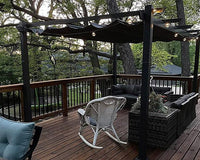
Wind is different: treat an open canopy on an exposed corner as a check against the product's own instructions, not a generic stability call. Anchoring needs, storage guidance, and how a frame handles moisture or chlorine depend on the specific piece and its documented care instructions, not on the general furniture category or frame material alone. If moving the daybed closer to a wall or fence for shelter would block a required path, the position still fails, even though it reduces wind exposure. A garden pergola offers a fixed alternative in windier corners since it doesn't need to be repositioned for gusts, but treat its own anchoring and wind guidance the same way, as product- and site-specific.
Run one final placement test before purchase or installation
Before you buy, move, or secure anything, run this test on the exact spot you've chosen.
- Tape the complete full-use footprint, including the opened canopy and the side table in its normal spot.
- Sit or lie down at your main use time and check the shade, the view, and the glare together.
- Test the canopy in both its open and retracted positions if your chosen piece, such as an adjustable-canopy round daybed, documents that range.
- Walk your normal route from the house or gate to the pool, and from the daybed to the water, without moving the furniture.
- If the daybed, canopy, table, or any loose cushion blocks a required route to the pool, steps, doors, drains, or equipment, do not proceed with that position. Adjust the layout or check local guidance before securing it.
- If wind, anchoring, or material care are still unresolved for your chosen product, pause and check the manufacturer's instructions before finalizing the spot.
If the position clears every step, it's ready. If any step fails, treat that as the reason to adjust the layout rather than the product.
FAQs
Does a poolside daybed have to face a fixed compass direction?
No. The right direction depends on when you use it. Set the orientation from your main use window, morning, afternoon, or mixed, and confirm it by watching the actual sun rather than following one universal rule.
What if my deck is too small for a full clearance path?
A tight deck usually means fewer workable positions, not none. Tape out the smallest configuration that still keeps the canopy and table usable, then check whether a required path still passes. If every spot blocks a route, a smaller or narrower daybed footprint may be the only fix.
How should I care for a daybed canopy near a pool?
Follow the manufacturer's cleaning and storage instructions for your specific canopy fabric and frame, since chlorine, moisture, and UV exposure affect materials differently. Positioning the daybed away from routine splash reduces how often you need to clean it, but it doesn't replace the documented care steps.
Can a garden pergola replace a daybed canopy for shade?
A garden pergola gives fixed shade that doesn't need repositioning, which can help in windier corners of the deck. It still needs the same sun-tracking and clearance checks as a daybed canopy, and any anchoring or wind guidance should come from its own product instructions.
Sources
- National Weather Service. Solar position dashboard.
- National Weather Service. UV safety guidance.
- U.S. Access Board. Swimming pool access guidance.