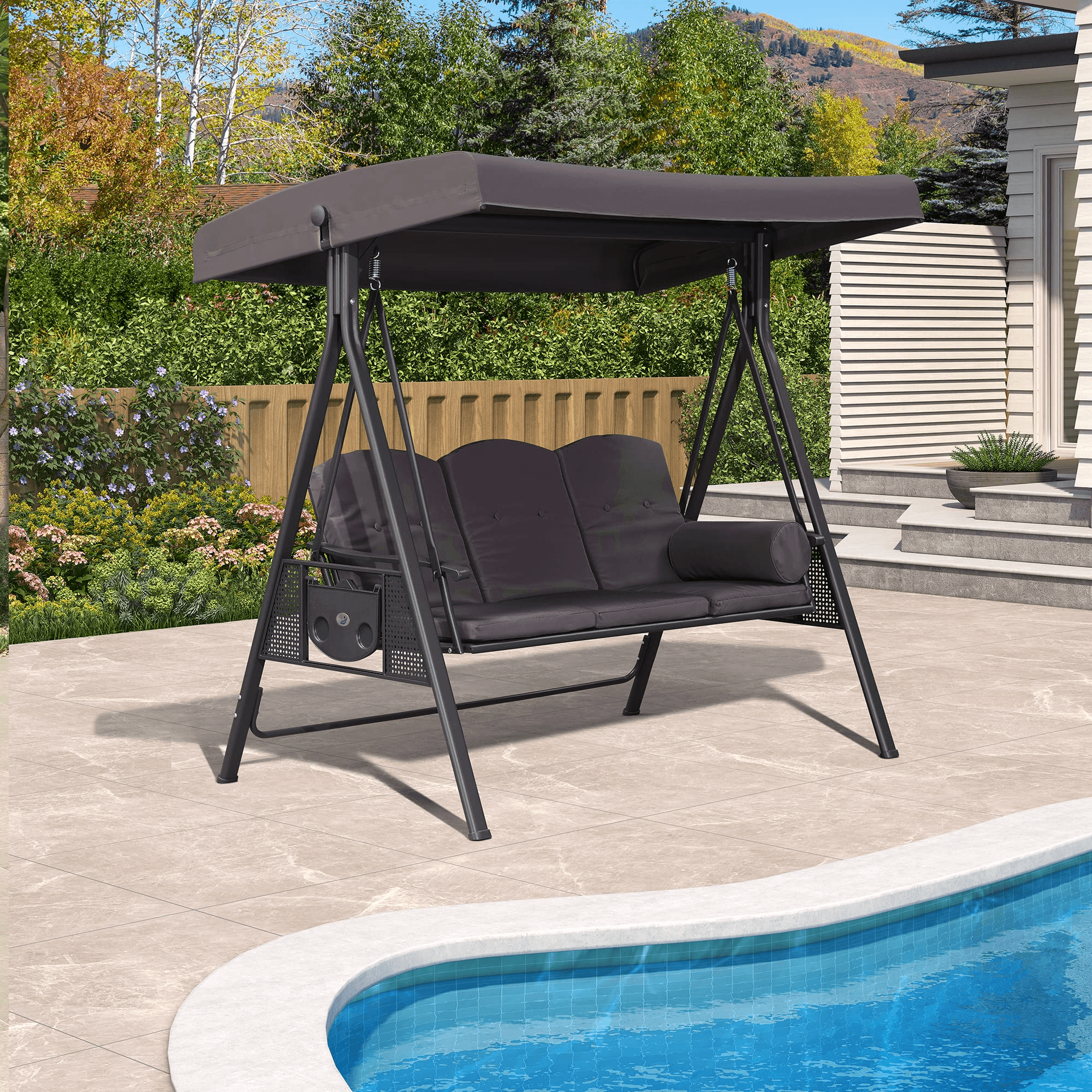
If you do not have verified overhead support, start with a porch swing with a stand. Consider a hanging setup only when you can confirm the framing and attachment path, the product instructions support the installation, and the measured space allows for movement and access. A stand eliminates the need for an overhead mounting point, but it still requires a suitable surface, complete assembly, and enough usable room.

Choose a Freestanding or Hanging Porch Swing Based on Your Space
Start with the structure, then consider the available space and how permanent you want the installation to be. Neither format is automatically safe or suitable without site checks and product-specific instructions.
- If overhead support is verified and the location is permanent, consider a hanging setup. Confirm that the attachment point is part of the structure, not a finished ceiling surface, trim, soffit, or decorative beam. Then compare the swing's documented dimensions, hardware requirements, movement path, and access.
- If overhead support is unavailable or cannot be verified, choose a stand-based setup. This is the practical option for an open deck, patio, lawn, or garden area, as long as the selected stand's instructions allow the intended surface and placement.
- If you expect to change locations, choose the format that fits that plan. A stand may offer more flexibility, but moving it still depends on its assembled dimensions, the route to the new location, and the surface at each destination. A hanging setup remains tied to a verified support point and may require reinstallation.
- If both formats are possible, let the measured usable footprint decide. Include the seat or frame, stand or hanging hardware, movement envelope, entry route, nearby obstacles, and maintenance space. This hanging-versus-stand comparison supports a conditional choice, not a universal verdict.
Next, determine whether the intended structure can support a hanging installation.

Confirm What Can Support a Hanging Porch Swing
A visible porch ceiling or beam does not prove that it can support a hanging swing. Identify the actual framing or structural member, assess its condition, confirm the attachment path and compatible hardware, and review the selected product's instructions before proceeding.
Attached porch and deck assemblies rely on a continuous load path through structural members and connections. Some connections may be concealed behind finished materials. The official guidance on porch and deck attachments explains why the visible surface alone is not enough to evaluate the assembly. A municipal porch construction reference likewise distinguishes ceiling finishes from the roof structure, beams, and columns that carry the assembly.
Use three separate questions:
- What carries the installation? Locate the actual framing or structural member instead of treating a ceiling finish, soffit, trim board, or decorative beam as proof of support.
- How will the swing attach? Match the attachment method and hardware to the selected swing's instructions and the verified structure. General building guidance does not provide a swing-specific capacity rating.
- What limits does the product specify? Use the product documentation for dimensions, hardware, assembly, capacity information, and placement requirements. If information is missing, pause rather than substitute a general rule.
If you cannot establish the framing, its condition, or the attachment method, do not install the swing based on an assumption. Obtain qualified installation advice or use the stand-based option. A stand removes the overhead mounting point, but it still requires surface and product-instruction checks.
Measure the Installed Footprint and Clearance
A swing fits only when its documented dimensions, movement path, access route, and surrounding obstacles work together. Measure the complete selected setup, including the stand or hanging hardware, rather than comparing the seat width with the open area alone.
| Check | Freestanding setup | Hanging setup |
|---|---|---|
| Overhead requirement | No overhead mounting point, but the surface and instructions still matter | Verified framing and compatible attachment are required |
| Installed floor footprint | Include the full stand and the space around it | Include the swing, attachment position, and usable area beneath it |
| Movement and access | Map the swing path, entry route, and space around the frame | Map the swing path from the verified support point and the entry route |
| Nearby obstacles | Keep walls, doors, railings, furniture, and walkways clear | Keep the same obstacles clear, including the support-side structure |
| Placement conditions | Compare the assembled setup with the deck, patio, porch, or garden surface | Compare the mounting location with the structure and surrounding access |
Use the selected product's documented length, width, and height as your starting measurements. Then mark the swing's movement, the entry and exit points, and the space needed for cushions, cleaning tools, and maintenance. A setup can fit within its listed dimensions while still blocking a door or narrowing a walkway.
A practical hanging guide suggests allowing room for the swing's movement and keeping walls and railings clear, but that is a planning starting point, not a universal clearance requirement. The porch swing buying guide can help with general planning, while the selected product's current instructions should control the final layout.
Choose the format and product only when the layout leaves a usable route to the seat, clear movement, and enough room for cleaning and maintenance.
Match the Setup to Portability and Everyday Access
Let permanence and daily access shape the choice after you address support and space. A stand is the practical format when you may move the swing between a porch, deck, patio, or garden area. A hanging setup remains tied to its verified support point.
For a stand, measure the assembled setup and the route it must travel before assuming relocation will be easy. Doorways, steps, railings, gates, and narrow walkways can affect whether the frame reaches the intended spot. Each destination also needs a surface that matches the stand's instructions. The absence of an overhead mount does not make every surface suitable.
For a hanging setup, consider how permanent the support point will be. Moving the swing may require identifying another structural member, adapting the attachment method, and reinstalling the hardware. Keep a clear route to the seat and space for inspection, cleaning, cushion handling, and maintenance. Setup hardware may be useful once the mounting method is established, but swing setup accessories do not resolve an uncertain structure or replace the selected product's instructions.
The best choice for a changing location is not simply the more portable option. It is the format whose assembled dimensions, surface or support requirements, access route, and instructions match every location you plan to use.
Verify the Setup Before You Add One to Your Cart
Use this final purchase check to connect the measured space with the setup you intend to order:
- Document the location. Record whether the swing will sit on a porch, deck, patio, lawn, or garden area. Note doors, railings, walls, walkways, furniture, and access restrictions.
- Verify or rule out overhead support. For a hanging setup, identify the actual framing or structural member and resolve its condition, attachment path, hardware compatibility, and product-instruction requirements. For a stand, document the intended surface and its placement limits.
- Measure the complete usable area. Include the selected setup's documented dimensions, movement path, entry and exit, nearby obstacles, cleaning space, and maintenance access.
- Compare the current product information. Review assembled dimensions, capacity information, included or required hardware, assembly instructions, and placement limits. Use only details documented for the selected product.
- Resolve the one fact that could change the decision. If support, surface suitability, a required dimension, or the attachment method remains unknown, pause the order and resolve that specific issue with the product documentation or qualified installation advice.
- Add the setup to your cart only when the requirements match. A stand-based setup is the practical path when overhead support is not verified. A hanging setup remains conditional on verified structure, compatible attachment, measured space, and supporting instructions.
The right mounting choice follows from the space you can document: verified structure can open the hanging path, while an uncertain or changing location points toward a stand. Measure the full usable envelope and match it to the current product instructions before ordering.
FAQs
These questions address the main support, clearance, and format decisions that come up before installation.
Can It Hang From a Regular Ceiling?
Only when the ceiling contains a verified structural support point that is compatible with the swing and attachment hardware. A finished ceiling or decorative beam is not enough. If you cannot establish the framing or attachment method, use a stand-based option or obtain qualified installation advice.
How Much Clearance Does It Need?
The deciding factors are the selected swing's installed dimensions and movement path, not a universal number. Map the swing's motion, entry and exit, doors, walls, railings, walkways, and maintenance space, then compare that layout with the product instructions.
Do I Need a Stand?
Choose a stand when there is no verified overhead support or when the intended location is open and likely to change. You do not need a stand when a hanging setup has verified framing, compatible attachment, sufficient measured space, and product instructions that support the installation.
Is a Stand-Based Setup Safer Than a Hanging Swing?
Neither format is automatically safer. The deciding factors are the verified support or frame requirements, compatible installation, product limits, surface conditions, and usable clearance. Choose the format whose documented requirements match the location, and resolve any uncertain structural or installation issue before use.