Choosing between a pergola, gazebo, or cantilever umbrella comes down to three things: how much shade you actually need, how tricky your layout is, and whether you want a permanent structure or something flexible. If you want a defined outdoor room with partial shade, a pergola is often the best starting point. If you want a more sheltered, "roofed" feel, a gazebo usually fits better. If your patio is narrow, corner-heavy, or poolside, a cantilever umbrella is often the easiest, most functional fit.
How These Three Structures Solve Different Problems
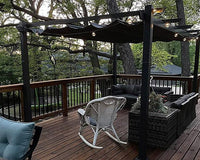
A pergola is a structure-first choice. It defines a patio or dining area and provides partial shade rather than full enclosure, which keeps the space feeling open and airy. A pergola as partial shade works best if your main goal is style, filtered light, and an outdoor room that doesn't feel boxed in.
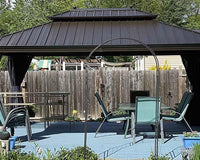
A gazebo pushes further toward true shelter. For buyers who want a more enclosed overhead feel, it usually makes more sense than a pergola, especially when the space is meant to feel like a destination rather than just an open frame. That's why a gazebo as more enclosed overhead coverage is the cleaner mental model.
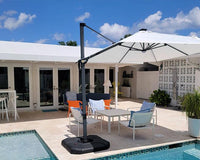
A cantilever umbrella is the flexible option. Its offset base keeps the pole out of the way, which is a game-changer when space is tight or the shade needs to land over specific furniture rather than in the middle of a walkway. For pool edges, corners, and other awkward layouts, the cantilever shade fit often solves the placement problem faster than a fixed structure.
Pergola, Gazebo, or Umbrella: The Fastest Way to Narrow It Down
Start with the layout. A fixed footprint is easiest when the patio is open, rectangular, and meant to be a single, defined zone. A movable shade source is almost always better when the space has corners, narrow sections, or high-traffic paths you don't want to block.
Next, consider the "overhead feel." A pergola works when you want structure and partial shade without closing the space in. A gazebo wins when you want a more substantial, sheltered presence. A cantilever umbrella is the practical choice when flexibility matters more than architectural weight.
Choose a pergola if the space already acts like an outdoor room—like a dining zone or lounge area—that benefits from visual structure. It works best when openness is a feature, not a compromise. If you expect dense, all-day shade, however, this is where the recommendation flips, as an open roof can feel too light for someone wanting heavy-duty sun protection. This is the most common regret; a pergola fit guide is worth checking before you commit to the open-roof style.
Choose a gazebo if you want the most shelter-like feel and don't mind giving up a larger, fixed footprint. It’s a better fit when the goal is a central gathering spot, a shaded sitting area, or a backyard feature that serves as a destination. This is also the right choice if a pergola feels too "exposed" for your sun exposure levels. If you're debating a hardtop gazebo vs. a pergola, choose the gazebo when you prioritize overhead presence over visual lightness.
Choose a cantilever umbrella when the layout is tight, the furniture moves, or you don't want a permanent footprint. It’s the fastest way to add shade without construction. The trade-off is exposure: an umbrella isn't built to handle wind like a fixed structure. The umbrella wind stability limits are the reason to treat it as a flexible shade tool, not a permanent shelter. If you're leaning away from a permanent build, the broader umbrella vs gazebo basics can help you decide.
How Each Option Fits Common Backyard Setups
| Backyard scenario | Pergola fit | Gazebo fit | Cantilever umbrella fit | Best pick |
|---|---|---|---|---|
| Pool deck | Good for defined zones | Good for overhead shelter | Best for offset shade | Cantilever umbrella |
| L-shaped patio | Good for structure | Less adaptable | Best for corners/legs | Cantilever umbrella |
| Outdoor dining | Great for permanent feel | Good for extra shelter | Good for flexible layouts | Pergola |
| Small patio | Often feels too big | Usually too large | Best fit | Cantilever umbrella |
| Open seating | Good for defining zones | Good for enclosed feel | Good for flexibility | Pergola or umbrella |
| Shade over a table | Good fixed shade | Good broad coverage | Best for shifting spots | Cantilever umbrella |
| Focal point | Best for room-like feel | Best for presence | Less effective | Pergola or gazebo |
For a pool deck, the design question is circulation first, shade second. If a center pole would get in the way of chairs or sightlines, an L-shaped patio shade fit points you toward a cantilever umbrella or a fixed structure only if you have the space to spare.
For a dining area, the choice flips when you care more about visual anchoring than repositioning. A pergola usually fits best when the table stays put and you want the space to feel intentionally framed. If the dining setup changes often, a cantilever umbrella keeps the layout adaptable.
What to Check Before You Buy
- Measure the footprint: Include furniture, walkways, and door swing space.
- Check circulation: Ensure the shade source doesn't block paths at the pool edge or along narrow patio legs.
- Decide on permanence: Are you looking for a fixed structure or something you can move?
- Track the sun: Think about peak sun hours, not just how the structure looks at noon from one angle.
- Check local codes: Use the permit exemption threshold as a reminder to check local rules; detached structures may be exempt below certain sizes, but local ordinances vary.
- Be honest about maintenance: A larger, fixed structure is better if you don't want to move or store anything seasonally.
- Start small: If you're torn, pick the smallest structure that solves the problem instead of buying extra footprint you won't use.
For shoppers who want more pergola-specific help, our louvered vs retractable pergolas guide is a good follow-up if you're trying to figure out how much shade control you need.
Which Structure Should You Start With?
If you want a defined outdoor room with partial shade, start with a pergola. If you want the most shelter-like feel, start with a gazebo. If your space is tight, irregular, or likely to change, start with a cantilever umbrella. The right choice is usually the smallest structure that solves your specific layout problem. Once you know that, browse the matching structure family and check dimensions, anchoring needs, and site fit before you order.
FAQs
Which is better for a patio: pergola, gazebo, or umbrella?
For a standard patio, a pergola usually wins when you want a permanent-feeling outdoor room, while a cantilever umbrella wins when the patio is compact or has awkward corners. A gazebo makes more sense when the patio is large enough to handle a substantial footprint and you want a more enclosed feel.
What is best for pool shade: pergola or cantilever umbrella?
A cantilever umbrella is usually the better first pick for a pool deck because the offset pole keeps the shade source out of the way of your circulation. A pergola makes more sense if you want a permanent poolside zone and are willing to sacrifice some flexibility.
When should I choose a hardtop gazebo over a pergola?
Choose a hardtop gazebo when you want a more shelter-like overhead presence and a stronger focal point. If your main goal is a light, open outdoor room, a pergola is the better fit.
Can a cantilever umbrella cover an L-shaped patio?
Yes, it can often handle one part of an L-shaped patio well, especially the corner or narrow leg where a center pole would be awkward. If the whole patio needs even coverage, though, one umbrella may not be enough.
How do I decide if I need a fixed or movable shade structure?
Choose fixed shade if the space stays the same most of the season and you want a permanent feature. Choose movable shade if the layout changes, furniture moves, or you need to avoid blocking a walkway. If you're still undecided, base the choice on the smallest footprint that solves the problem cleanly.