A realistic pergola budget adds several line items to the price you see on a kit listing: site work, delivery, labor, tools, permits, and ongoing ownership costs. The sticker price on pergola kits only fills in one row of that budget. Use the worksheet below to compare a do-it-yourself kit, a professionally installed kit, and a fully contractor-built pergola on the same terms, so you know the real all-in total before you order anything or request a quote.

Fill in the Pergola Project Cost Worksheet
Compare routes by filling in the same rows for each one, not by comparing a kit price to a contractor's lump sum. Mark every cell included, excluded, quoted, estimated, or unknown before you total a route.
| Item | DIY kit | Hired kit installation | Contractor build | Notes or verification source |
|---|---|---|---|---|
| Product or materials | Kit price from listing | Kit price from listing | Materials in contractor's written scope | Confirm footprint, material, and included accessories |
| Site preparation (leveling, surface, drainage) | Homeowner time or quote | Ask if included | Contractor's scope item | Depends on starting surface |
| Anchoring, footings, or attachment | Homeowner time, tools, hardware | Ask if included | Contractor's scope item | Confirm method before ordering |
| Delivery or mobilization | Shipping terms from listing | Installer trip or crew charge | Contractor mobilization fee | Verify current shipping terms |
| Labor (assembly or construction) | Homeowner and helper time | Installer's itemized bid | Contractor's itemized bid | Request a local, itemized bid |
| Tools and equipment | Owned, rented, or borrowed | Installer supplies own | Contractor supplies own | List anything you must buy or rent |
| Permits, zoning, plans, inspections | Homeowner applies | Ask who applies | Contractor's scope item | Confirm with local authority |
| Cleanup or disposal | Homeowner time | Ask if included | Contractor's scope item | Confirm packaging and debris removal |
| Ownership: maintenance, repairs, accessories, warranty | Per product documentation | Per product documentation | Per contractor warranty terms | Record model-specific terms |
| All-in total | Sum of rows above | Sum of rows above | Sum of rows above | Compare only after every row has an entry |
The all-in total formula is the same for every route: kit or materials plus site work, including anchoring, footings, or attachment, plus delivery or mobilization plus labor plus tools plus permits and approvals plus cleanup or disposal plus ownership assumptions. Leave a dollar field blank rather than guessing, and fill it in once you have a local quote or a confirmed listing term. Once every row for a route has a status marker, add the column to get that route's all-in total, then compare totals side by side rather than comparing kit price to contractor price.
Compare DIY Kit, Hired Installation, and Contractor-Built Costs
A kit price is a product input, not an installed-project total. The route that carries the lowest cash labor line depends on who does the assembly, the site work, and the coordination.
DIY Kit Installation
With a DIY kit, assembly, coordination, tool sourcing, helper scheduling, and quality checks all stay with the homeowner. Included assembly instructions or hardware only cover the build steps; they do not mean site work, anchoring, or permit approval is already handled. This route can show the lowest cash labor line on the worksheet, but only after you add your own time, tools, and any site-prep or approval costs as real entries rather than leaving them blank.
Hired Kit Installation
Keep the kit price and the installer's scope as two separate worksheet inputs. Ask directly whether the quote covers assembly only, or also anchoring, footings, leveling, cleanup, and coordinating permits or inspections. National wage tables are not a substitute for this quote. The Bureau of Labor Statistics' occupation and wage data for foundation, structure, and building exterior contractors gives national context on trades like carpenters and construction laborers, but it cannot tell you what your installer will actually charge. Get a local, itemized bid instead.
Contractor-Built Pergola
A contractor-built pergola should come with a written scope covering materials, fabrication or cutting, site work, labor, delivery, permits, overhead, cleanup, and warranty terms. Match the contractor's footprint and intended function to whatever kit you were comparing, so you are pricing the same project. Treat any customization, such as a non-standard size or attachment method, as an explicit line-item difference rather than folding it into one unexplained total.
| Route | Homeowner labor and coordination | Installer or contractor scope | Site and permit responsibility | Strongest cost advantage | Main not-fit condition |
|---|---|---|---|---|---|
| DIY kit | High: assembly, tools, scheduling | None beyond the kit itself | Homeowner unless site is already verified | Lowest cash labor line when site is ready | Not-fit if helpers, tools, or time are missing |
| Hired kit installation | Low: product choice only | Installer handles assembly, possibly more | Shared; must be confirmed in the quote | Keeps product spec fixed while outsourcing labor | Not-fit if quote excludes anchoring or permits |
| Contractor-built | Low: sets the brief, reviews the scope | Contractor manages materials through completion | Usually the contractor's scope item | Coordinates custom or complex work in one contract | Not-fit for a simple, standardized footprint |
Use this table as a responsibility map, not a price comparison. DIY concentrates assembly and coordination with the homeowner. Hired kit installation separates the product from the service scope. Contractor-built work shifts more coordination into the contract, so the written scope still determines what you will pay.

Price Site Preparation, Permits, and Excavation Before Purchase
Site and approval conditions change the estimate before you buy, no matter which route you pick. Confirm the surface, access, and required approvals first, since these can add cost that no kit price includes.
Existing Patio or Deck
Check the dimensions, levelness, drainage, and access of your existing patio or deck, plus the exact attachment or anchoring method you plan to use. An existing surface does not prove that no site or approval cost applies; it still needs to be verified for load, level, and attachment before you count it as ready.
Ground, Footing, or Attachment Work
Post holes, footings, grading, attaching a structure to your house, utility conflicts, and difficult access all belong in a separate scope line, whichever route you choose. If your project includes any digging, call 811 before digging and wait for the utility marks to come back before work starts. This is a required stop, not an optional step, for post holes, footings, or grading of any depth.
Permit, Zoning, HOA, and Inspection Checks
Check your local building department and zoning authority directly rather than relying on a general size or height rule you found online. Permit and zoning requirements vary by location and project scope. Miami-Dade County's own guidance, for example, notes that local permit requirements for pergolas can apply to pergolas and gazebos alongside additions and fences, which is useful as one example of how a local authority treats these structures, not as a nationwide threshold. Record in your worksheet who is responsible for plans, applications, fees, inspections, and HOA approval, whether that is you, an installer, or a contractor. Our pergola permit guidance walks through the size, height, setback, and HOA factors that most often trigger a review.
Before requesting quotes, work through this short checklist and add every result to your worksheet:
- Identify your surface type and exact dimensions.
- Inspect levelness, drainage, access, and your planned attachment or anchoring method.
- Contact your local building department, zoning office, and any HOA.
- Identify required plans, permits, fees, and inspections.
- Contact 811 and wait for utility marks before any digging.
- Add every confirmed result to the worksheet before comparing routes.
Choose the Route That Fits Your Household Scenario
The route that fits depends on your site's complexity and your household's available time and help, not on the lowest advertised price. Match your situation to one of the three scenarios below.
Prepared Surface and Available Helpers
DIY kit installation can fit when your base, access, tools, helpers, and approvals are already verified. Add your own time and every non-product row to the worksheet before calling this the lower-cost route; skipping those rows is what makes DIY estimates look artificially cheap.
Standardized Kit Without Enough Time or Help
Hired kit installation can keep your product choice separate from assembly or site work when the kit itself fits your needs but you lack the time or helpers to install it. Require an itemized service scope from the installer and identify every exclusion before comparing this total with DIY or a contractor build.
Custom, Attached, or Difficult Project
A contractor-built route is usually more practical when you need custom dimensions, house attachment, difficult ground, formal plans, inspections, or coordination across multiple trades. Compare the contractor's written scope against the same functional brief you used for the kit options, so the comparison stays apples to apples.
Verify the Quote and Kit Inputs Before You Commit
Before you order a kit or accept a quote, record the exact product scope and make every bid comparable using the same worksheet rows.
Record the Exact Product Scope
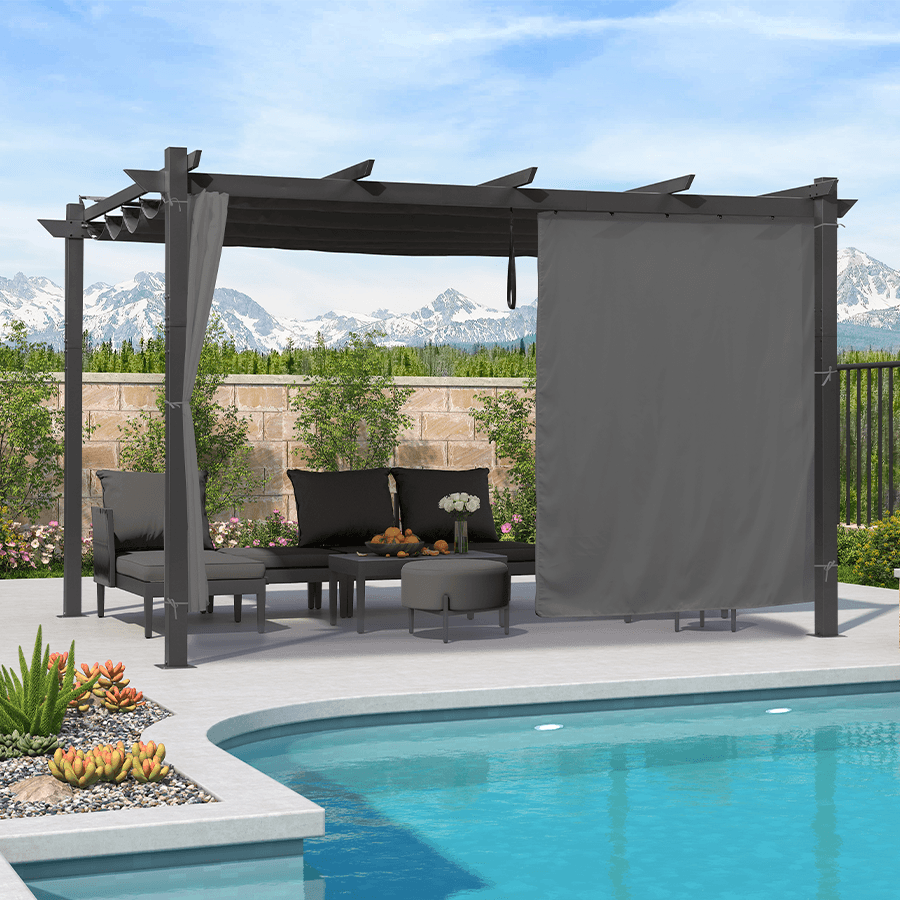
Use the selected model's footprint, material, roof or shade type, accessories, included components, helper requirement, and warranty as your worksheet assumptions rather than a general product title. Our Athena louvered pergola uses a powder-coated aluminum frame and is listed in 10 by 12, 10 by 13, 10 by 14, and 10 by 16 foot sizes, with shutter-wall options and a hidden gutter system. Those are product inputs to verify on the live listing, not substitutes for your site, permit, labor, or ownership entries. If your site needs footings or ground anchoring, our anchoring guidance explains when a concrete footing, ground anchor, or weighted base applies.
Make the Quotes Comparable
Ask every installer or contractor to separate materials, site work, labor, delivery or mobilization, permits, cleanup, and warranty terms in writing. Mark every exclusion before you compare totals. Once your worksheet, site checks, and quotes are complete, choose the route that fits your verified scope and explore our pergola kits to match the footprint and features you've confirmed.
FAQs
Is It Cheaper to Build a Pergola or Buy a Kit?
A kit can have a lower product price or cash-labor entry, but only a completed all-in worksheet can tell you which route is actually cheaper for your property. Compare totals after adding site work, delivery, labor, tools, permits, and ownership costs to both options, not just the sticker prices.
What Costs Are Usually Excluded From a Pergola Kit Price?
Kit prices commonly exclude site preparation, anchoring or footings, delivery beyond standard shipping, installation labor, tools, permits, and ongoing ownership costs like maintenance or accessories. Confirm the exact inclusions on your specific listing rather than assuming every kit excludes the same items.
Do I Need a Permit for a Pergola?
It depends on your local authority and the project's scope, size, and attachment method. Check with your building department, zoning office, and any HOA before purchasing, rather than relying on a general nationwide size or height rule.
When Should I Hire Someone to Install a Pergola Kit?
Hire installation help when the kit itself fits your needs but you lack enough helpers, time, tools, or comfort with anchoring and site work. Move to a contractor-built route instead when the project needs custom dimensions, house attachment, difficult ground, or coordination across several trades.
How Should Maintenance Affect My Pergola Project Budget?
Treat maintenance as a model- and site-specific ownership assumption in your worksheet, not a fixed number. Verify expected care, replacement parts, warranty terms, and any weather-related precautions from the product's own documentation before finalizing your budget.