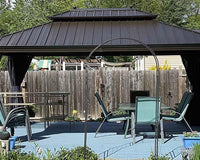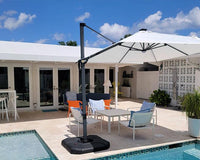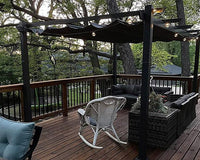
Start with where the umbrella and its support will sit. If the pole will pass through a table opening, look at a table-through setup. If the support will stand apart from the table, look at freestanding, and if the canopy should hang over the seating while the base sits somewhere else, look at an offset (cantilever) setup.
Picking a layout narrows your options, but it doesn't prove that a specific patio umbrella with base will fit. After that, measure your table and usable space. Then confirm the exact umbrella and base models in official product information before you buy.
Choose a Layout from the Planned Umbrella Position
Pick the row that matches where you want the pole and base to go before you compare products. The Consumer Reports patio umbrella guide notes that market-style umbrellas can slip into the center hole of a patio dining table, while cantilever styles use a base that sits off to the side, such as a patio umbrella base with wheels. Family Handyman describes freestanding umbrellas for open yards and cantilever umbrellas that angle out over larger seating areas.
| Layout | Worth considering when | Still to confirm for your exact models |
|---|---|---|
| Table-through (market-style) | The pole will pass through the table's center hole | Pole and opening fit, base space under the table, permitted base |
| Freestanding | The support stands on its own, apart from the table or seating | Permitted umbrella and base pairing, base footprint |
| Offset (cantilever) | The base sits off to the side and the canopy angles over seating | Base listed for that umbrella, footprint, surface or installation rules |
Treat your matching row as a candidate, not a verdict. A table with a hole doesn't mean any market umbrella and base will work with it. An open corner of the yard doesn't mean any freestanding base is allowed either. If you can't confirm a row for the exact models you have in mind, don't count that setup as a fit yet.
No center opening? Then the table-through row is off the list. Our guide for a table without an umbrella hole walks through other shade paths, including cantilever umbrellas and pergola kits.

Screen the Table Opening and Usable Support Space
Measure your own table and patio, then compare those numbers with the dimensions published for the exact models you're considering. No single size works for every setup, so the model's specs decide whether your plan passes or fails.
- Check the opening and pole path (table-through only). Measure the table's hole or insert and compare it with the pole size and any opening requirement listed for the umbrella. Our table hole and pole fit guide covers measuring the pole, the insert, and base clearance.
- Check the space under the table (table-through only). Measure the open area where the base would sit, between the legs or frame and up to the tabletop. Compare it with the base's listed dimensions. If the base can't sit directly where the pole comes down, the plan fails as drawn.
- Mark the support footprint (every layout). Use tape or chalk to outline the base's listed length and width on the exact spot you plan to use. Then pull out the chairs and walk the path to doors and steps. If the outline blocks them, move the spot or drop that candidate.
A failed comparison rules out that candidate as currently planned. If a dimension you need isn't published, the layout stays unconfirmed. Get that number before you buy.
Verify the Exact Umbrella and Base Models
Before you order any patio umbrella with base, read the official product page and manual for both exact models. A category label like "cantilever base" or "market umbrella" won't settle fit on its own.
Compare the Exact Model Information
These are the fields that decide the match. As you compare table and cantilever umbrellas or offset designs with bases, open each model's own page for:
- Pairing: whether this exact umbrella is listed for this exact base, in the arrangement you plan to use. Our base compatibility checks explain why bases and umbrellas don't all mix.
- Interface: for a table-through plan, any stated pole or opening size and any table-support requirement.
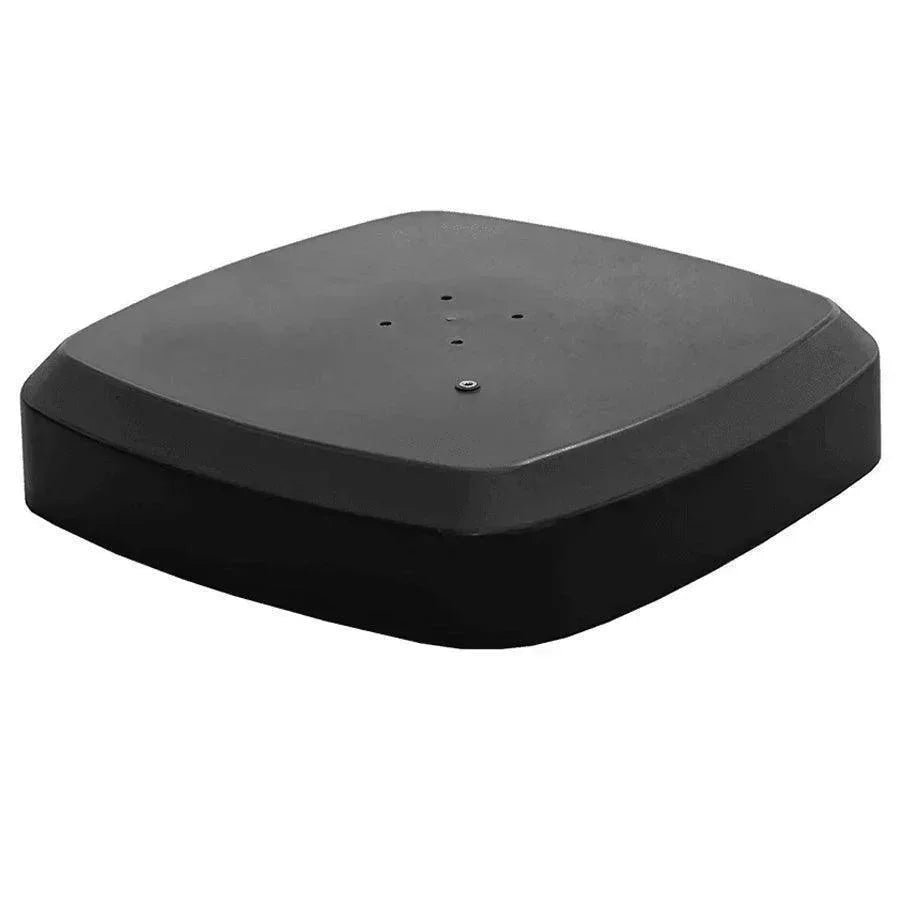
- Dimensions: the base footprint and height, so you can compare them with the spot you taped out.
- Installation and surface: any stated surface, fill, or anchoring rules. Our guide to anchoring a cantilever umbrella covers concrete, decks, and pavers.
Here's an example of a listing that covers these fields. Our ZY01HLRBASE-75 cantilever base listing gives dimensions of 33.5 × 32.6 × 5.4 in and names the umbrella configurations we recommend that base for. Those recommendations apply to that base only, so check any other model against its own listing.
If a Required Detail Is Missing or Conflicting
Pause instead of guessing. A base that looks similar, a shared brand name, or a recommendation written for another model doesn't confirm your pairing. Contact the manufacturer with both exact model identifiers and your planned table or surface setup. Get a clear answer before you buy or set anything up.

FAQs
Does a base recommended for one umbrella work with another model in the same line?
Not automatically. A recommendation covers the exact umbrella and base models it names. A sibling model can differ in pole size, canopy size, or mounting, so check that model's own listing or manual. If it isn't named there, ask the manufacturer before assuming it transfers.
What should I do if the product page and the manual disagree?
Don't pick whichever answer suits your plan. Note what each document says, including where you found it, and treat that point as unconfirmed. Send both versions to the manufacturer and ask which one applies to your exact models and setup.
What information should I give the manufacturer when I ask about fit?
Include the umbrella model number, the base model number, and your planned layout (table-through, freestanding, or offset). Add your table opening measurement and under-table space if the pole goes through a table. Also include the footprint available at your chosen spot and the surface type, such as concrete, deck, or pavers. With those details, they can answer about your actual setup rather than a general case.