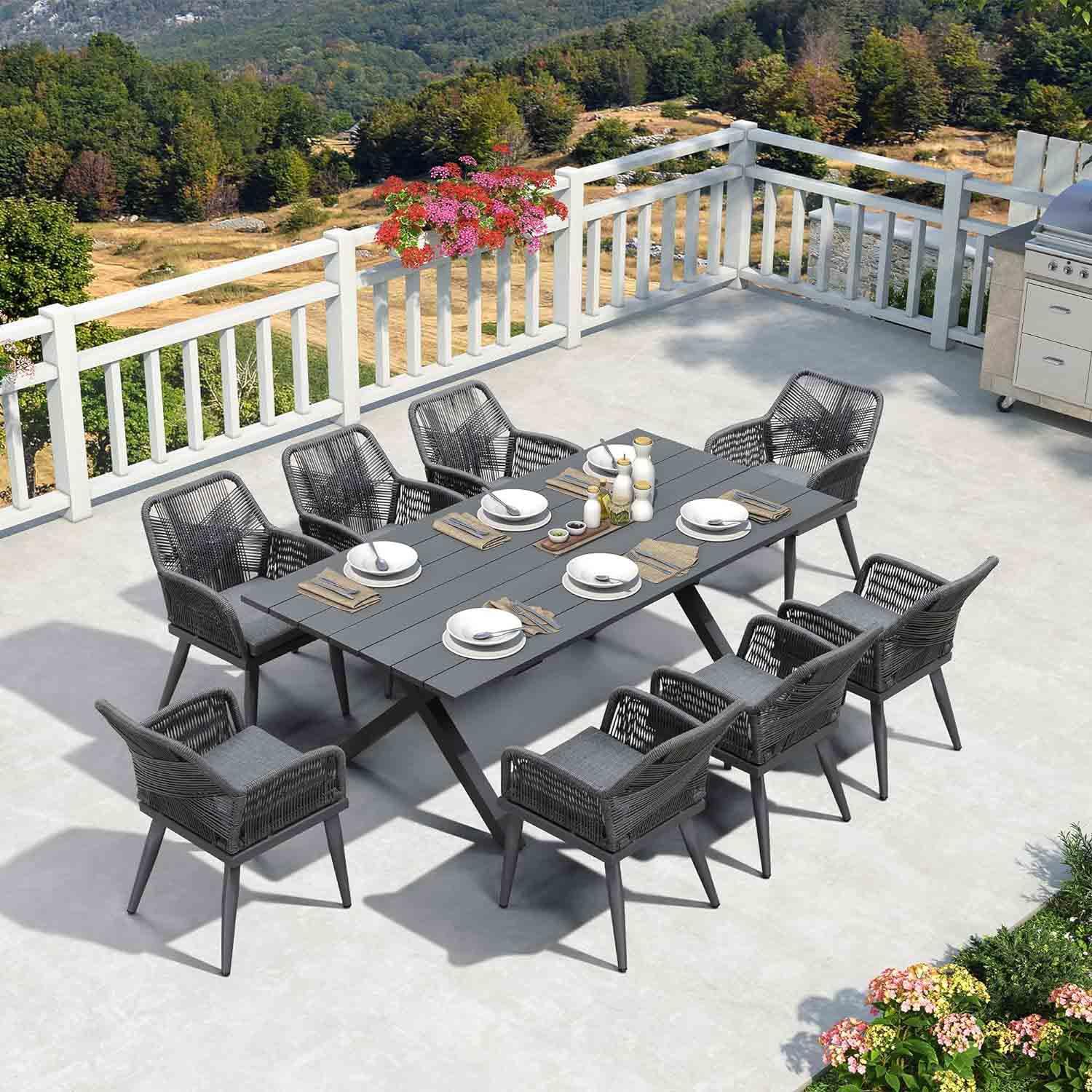
Start by measuring the entire assembled dining set, not just the tabletop, before choosing patio furniture covers. Record the outside length, width or depth, and height from the ground to the highest point, including chair backs, armrests, cushions, and fixed protrusions. Then compare those measurements with the listing's defined dimensions and feature requirements. The result should be pass, conditional, or no fit before you add a cover to your cart.

Choose Patio Furniture Covers by the Full Dining-Set Envelope
The right patio furniture covers are sized for the arrangement that will remain under the cover. A tabletop measurement is only one input because chairs can extend the footprint in both directions and rise above the table.
Use one unit throughout, such as inches, and compare your measurements with the listing's own dimension convention. A listing may show finished cover dimensions, the furniture envelope it is designed to cover, or a stated fit range. If it does not explain which one it means, treat the result as conditional rather than assuming the numbers are directly comparable.

| Measured input | What to include | Ordering result |
|---|---|---|
| Overall length | The farthest covered point at one end of the set to the farthest point at the opposite end | Pass only when the listing's length definition covers this measurement |
| Overall width or depth | The widest front-to-back span, including chair backs, armrests, cushions, and extensions | Pass only when the listing's width or depth condition covers this measurement |
| Overall height | Ground to the highest point, such as a chair back, cushion stack, table edge, umbrella component, or fixed hardware | Pass only when the listing's height condition covers the full profile |
| Protrusions and features | Openings, center posts, handles, hardware, shape, attachment points, and bottom-edge guidance | Conditional when the listing is silent, or no fit when a stated requirement conflicts |
A pass means the measured envelope fits every stated dimensional and feature condition. A conditional result means one decision-changing detail, such as the listing's dimension definition or guidance for an opening, remains unclear. A no fit means a measured limit or required feature falls outside the listing's stated conditions.
This is the practical answer to what size patio furniture cover do I need: choose a listing that accommodates the complete three-dimensional envelope, not one selected from table length or seating capacity alone.
Measure the Table, Chairs, and Highest or Widest Points
The most reliable way to learn how to measure a patio furniture cover is to measure the furniture in the exact position it will occupy under the cover. Do not use a compact layout if the chairs will normally stay pulled out or angled around the table.
- Arrange the set for coverage. Push the chairs in, leave them partially pulled out, or use another arrangement that matches how the set will actually sit under the cover. If the arrangement changes, measure the larger or more frequently covered position.
- Measure the table. Record the table's length and width, or its diameter if it is round. Measure its height as well. These readings establish the set's central shape, but they are not the final cover dimensions.
- Find the outermost points. Measure from the farthest chair back or armrest on one side to the farthest point on the opposite side. Include cushions, armrest extensions, chair legs or frames that extend beyond the main profile, and any fixed part that will remain under the cover.
- Record the highest point. Measure from the ground to the top of the tallest chair back, cushion, table component, umbrella hardware, handle, or other covered feature. The table may be the highest point on one set, while a high-back chair or cushion stack controls another.
- Measure the complete footprint. Take the outside length and width or depth of the arranged set rather than adding individual table and chair measurements. This captures the actual perimeter created by the furniture together.
- Note the shape and protrusions. Record whether the set is rectangular, square, round, or irregular. Sketch the arrangement or take a photo, then mark umbrella holes, center posts, handles, sharp hardware, and other features that may affect the listing comparison.
Use the same unit for every reading and keep the measurements with the listing you are evaluating. For general planning around the table itself, this dining table size guidance can help you think about the table's footprint, but it does not replace measuring the assembled set for cover compatibility.
Allow for Chair Backs, Armrests, and Cover Function
Chair profiles often determine whether an apparently suitable outdoor table and chair cover works in practice. The widest armrests control one part of the footprint, while the highest chair back, cushion, or hardware controls the vertical profile.
Use these three checks after recording the basic length, width, and height:
- Profile limits: Compare the tallest chair back, cushion stack, and table component with the listing's height information. Measure across the widest armrests and any extensions instead of averaging chair sizes.
- Feature requirements: Look for the listing's guidance on umbrella holes, center posts, handles, openings, ventilation, drainage, bottom coverage, and attachment points. These are listing-specific conditions, not universal allowances that apply to every size.
- Placement and removal: Consider whether the measured arrangement leaves the cover practical to put on and take off. A neat-looking fit and an easy-to-handle fit are different goals, and the listing may define the intended bottom coverage or attachment method.
Matching length and width do not resolve an incompatible opening, post, shape, height, or attachment requirement. Likewise, no general number of extra inches can establish ventilation, drainage, ground clearance, or removal space for every cover. Use the product listing's own instructions for those features.
If the listing is silent about a feature that matters to your setup, record that exact issue as conditional. Do not force a cover over a fixed obstruction or treat a size label as proof that the feature will work. This keeps patio dining set cover sizing tied to the actual furniture profile and the cover's documented conditions.
Decide Whether One Cover Fits the Layout Before You Order
One cover is a viable choice only when the complete arranged set fits the listing's length, width or depth, height, shape, openings, and attachment requirements. Use the layout you intend to keep covered, because a result for tucked-in chairs may not apply when the chairs are pulled out.
| Setup | Fit result | Next action |
|---|---|---|
| Chairs tucked in around the table | Pass when the tucked-in envelope fits every stated dimension and feature condition | Order only after the listing's measurement definition is clear |
| Chairs partially pulled out | Conditional if the listing was compared with the smaller tucked-in envelope | Remeasure the extended arrangement and compare that envelope instead |
| High-back or armchair-heavy set | Conditional until the tallest and widest points fit the listing | Use the chair profile as the controlling limit, then evaluate any feature guidance |
| Round, square, or irregular layout | Conditional when the listing shape or feature guidance does not match | Use a shape-compatible listing, change the arrangement, or evaluate separate covers |
If the measured envelope exceeds a stated limit, the result is no fit for that listing. If the main dimensions fit but an opening, hardware point, bottom edge, or attachment condition is unresolved, the result remains conditional. The next action is to find a listing with compatible stated conditions, change the furniture arrangement, or evaluate separate covers. Separate covers are an option to assess, not an automatic solution.
A dedicated rectangular dining-set cover can be a useful catalog path when your set has a rectangular footprint, but the category or shape label does not prove compatibility. Compare the actual dimensions and feature requirements before ordering. When all relevant conditions match, you have a supportable reason to choose one cover for the set.
Measure the arrangement you will actually cover, compare its full length, width or depth, and height with the listing's definitions, and resolve feature conditions before checkout. That process gives you a defensible pass, conditional, or no-fit result without inventing clearance allowances. If the dimensions and requirements match, choose the compatible listing; if one does not, change the configuration or continue evaluating alternatives.
FAQs
These questions address common fit decisions that arise after you measure the complete dining-set envelope. Use the listing's stated dimensions and feature guidance for the final comparison.
How do I measure for a patio furniture cover?
Arrange the table and chairs as they will sit under the cover. Measure the complete outside length, width or depth, and height, using the farthest chair, armrest, cushion, or fixed protrusion as the relevant limit. Keep the measurements in the same unit for the listing comparison.
Should a patio furniture cover touch the ground?
Not automatically. Follow the individual listing's bottom-edge guidance and consider whether the planned coverage remains practical to put on and take off without dragging or blocking access. If the listing does not explain a decision-critical bottom or drainage condition, keep the fit assessment conditional.
Can one cover fit a table and chairs together?
Yes, when the complete arrangement fits the listing's length, width, height, shape, openings, and attachment conditions. If the chairs are pulled out or have high backs and arms, remeasure that arrangement because a tucked-in result may no longer apply.
How do I size a cover for dining chairs with arms?
Measure across the widest armrests and from the ground to the highest chair back, including cushions and extensions. Compare those readings with the listing instead of sizing from the tabletop or chair count. If the armrests create a feature conflict, evaluate a different configuration or listing.