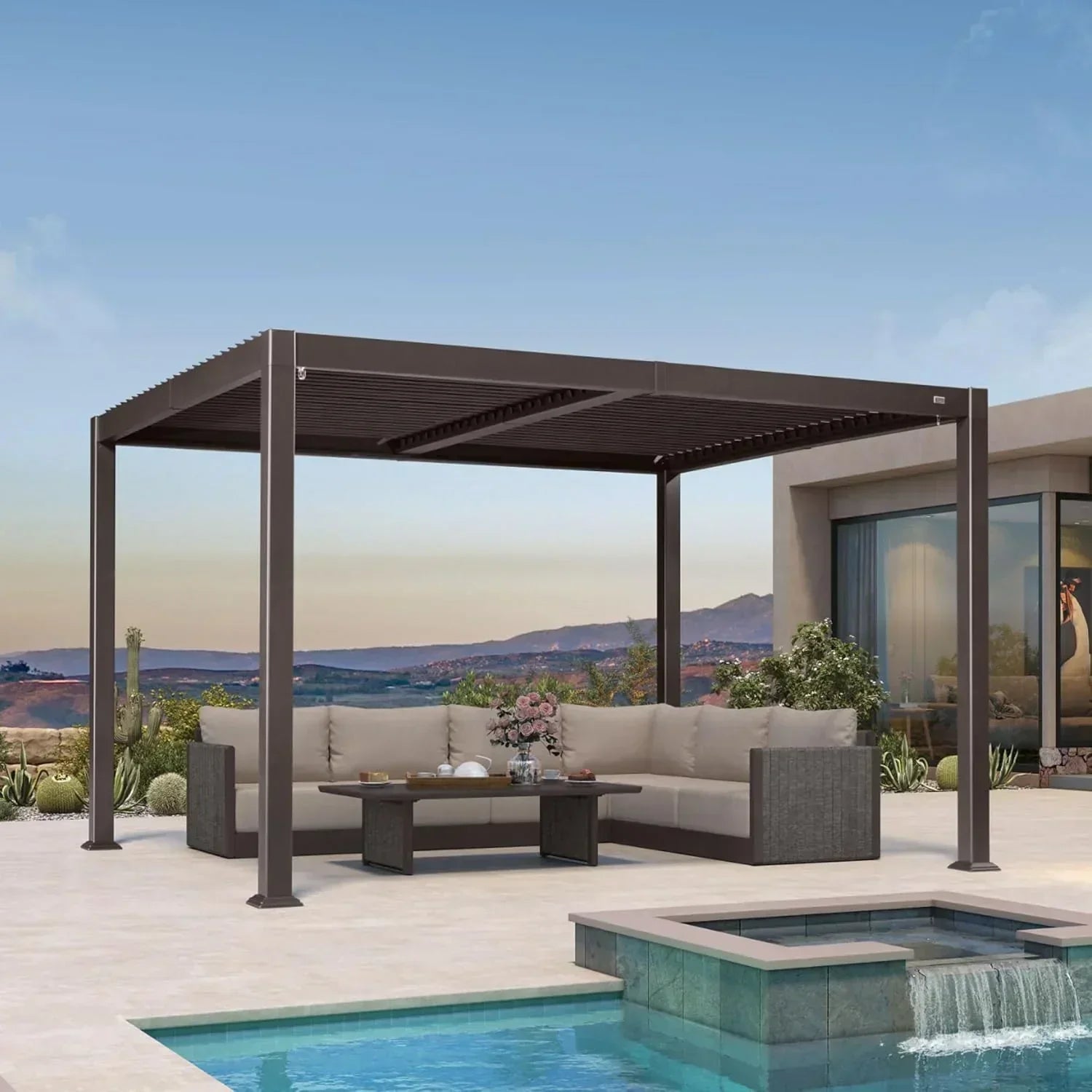
An adjustable louvered roof is the best fit when you want to change shade and airflow throughout the day and are comfortable with moving-part upkeep. Choose a fixed roof for consistent overhead coverage and simpler operation, or an open roof for sky exposure and natural airflow when limited rain management is acceptable. A pergola with roof can provide overhead shade while remaining open at the sides, so none of these options automatically functions like an enclosed patio.

Which Pergola Roof Fits Your Main Outdoor-Living Priority?
Start with the condition that matters most instead of assuming one roof style works best for every patio. This quick comparison shows where each option fits and what you give up.
| Roof type | Strongest fit | Main tradeoff |
|---|---|---|
| Adjustable louvered | Changing shade, sunlight, and airflow throughout the day | More operating mechanisms and upkeep to manage |
| Fixed | Consistent overhead coverage and predictable operation | Less ability to respond to changing sun or openness preferences |
| Open | Sky exposure and natural airflow when partial shade is enough | Limited control over direct rain and overhead coverage |
For a buyer comparing a louvered pergola versus a fixed roof, the central choice is flexibility versus simplicity. Adjustable louvers can change position as conditions change, while a fixed roof behaves consistently. An open design keeps the outdoor setting more exposed and does less to manage overhead weather.

The amount of shade also depends on roof design, louver position, sun angle, site exposure, and installation. Treat roof type as a starting point, not a measured performance rating. If changing comfort is the priority and the household will actually operate the roof, an adjustable system is the strongest category fit. If predictable coverage matters more than daily adjustments, fixed is the clearer choice. If openness matters most, choose open while accepting less rain response.
How Do These Roofs Handle Rain and Runoff?
Roof style affects how much overhead rain a space may manage, but it does not eliminate exposure from the open sides. Closed or angled louvers may reduce direct rainfall over a seating area when the system is designed and operated for that purpose, while a fixed roof offers consistent overhead coverage and an open roof provides little managed rain response.
What Closed Louvers Can and Cannot Do in Rain
Closing louvers may reduce direct rain above the seating area and may direct water into designed channels. Wind-driven rain can still enter from open sides, gaps, roof edges, and other exposure-dependent paths. A louvered roof is therefore a conditional rain-management feature, not proof of a sealed or indoor-like room.
If dependable enclosed protection is the main goal, compare a more enclosed structure instead of relying on the word “louvered.” The shade-structure guidance describes pergolas and similar overhead elements as shade structures over open areas, reinforcing the distinction between overhead shade and an enclosed room.
Drainage Details to Check Before Buying
Trace water from the roof surface to its final discharge point before placing furniture or committing to a configuration. Roof style alone does not establish where runoff will go. General stormwater guidance recommends directing roof runoff through a planned discharge method, such as a downspout or another designed drainage approach, rather than letting it collect unpredictably. Plan the roof runoff path as part of the purchase decision.
- Follow the water path from the roof surface through channels, gutters, or downspouts to the discharge point.
- Review edge behavior and identify where water could land near seating, walkways, foundations, or neighboring areas.
- Match the drainage arrangement to the installation conditions and the site's existing runoff plan.
- Keep channels and discharge components accessible for cleaning and inspection.
The best roof for rain and sun is the one whose documented drainage route and open-side limitations match the site. If the water path cannot be explained clearly, the roof design is not ready for a purchase decision.
How Do Manual and Motorized Louvers Change Roof Use?
Control choice affects how easy it is to adjust the roof, not its underlying rain or wind capability. Choose based on adjustment frequency, reachability, who will operate the louvers, and the model's documented operating requirements.
Manual Control for Occasional Adjustments
Manual control can suit a roof that is easy to reach and will be adjusted only occasionally. It keeps operation straightforward when users do not need frequent changes as the sun moves.
The tradeoff appears when the control point is difficult to reach or the household wants to respond often to changing sun and comfort. In that situation, hands-on operation may make the flexibility less useful. Choose manual when occasional adjustment is realistic for everyone who will use the space.
Motorized Control for Frequent Changes
Motorized control can make frequent adjustments more practical when the household regularly changes shade, openness, or airflow. It is a convenience choice that reduces operating effort, not a guarantee of better weather performance.
Before ordering, match the specific model's power source, controls, operating limits, outage instructions, and severe-weather guidance to the intended routine. Automation does not remove the need to understand when and how the roof should be operated. Choose motorized when frequent changes justify the added control system and its operating requirements.
What Upkeep Comes With Each Roof Type?
Moving louvers and drainage paths add ownership tasks that deserve attention, while fixed and open roofs may simplify operation without becoming maintenance-free. An adjustable roof is a poor fit when the household cannot safely access or manage the components that make its flexibility possible.
Cleaning and Inspection for Louvered Roofs
Use the model instructions as the authority for cleaning products, access, and inspection. A practical ownership routine includes:
- Clearing surface debris and drainage paths using the documented method.
- Inspecting louvers, seals, channels, and other accessible interfaces without assuming a particular cleaner or pressure-washing method is suitable.
- Keeping the relevant drainage and operating areas accessible for future inspection.
For general background after choosing an adjustable system, our louvered pergola cleaning tips can help frame the cleaning task. The specific system instructions still control the appropriate method.
The Simpler Ownership Tradeoff
A fixed or open roof may suit a buyer who values fewer operating mechanisms more than changing weather response. The choice is not between “maintenance” and “no maintenance.” It is between different care obligations, including drainage access, surface cleaning, and the presence or absence of moving components.
Choose adjustable when the household will use the flexibility often enough to justify those responsibilities. Choose fixed or open when a simpler operating routine matters more, provided the resulting shade and rain boundary fit the space.
What Should You Verify Before Ordering a Pergola With Roof?
Use this sequence before committing to an adjustable, fixed, or open system. It turns the category comparison into a decision based on the site and household.
- Define the dominant condition. Decide whether changing shade and airflow, consistent coverage, sky exposure, or rain response matters most.
- Inspect the roof behavior. Determine how the roof provides openness, overhead coverage, or changing louver positions. Do not treat a roofed pergola as an enclosed room by default.
- Match the control routine. For an adjustable roof, confirm whether manual or motorized control fits reachability, adjustment frequency, household users, power needs, and documented operating limits.
- Trace the drainage route. Follow water from the roof to channels, gutters, downspouts, and the final discharge point. Account for furniture placement and site exposure.
- Review upkeep access. Confirm that the louvers, drainage paths, and relevant interfaces can be reached for the care described in the model instructions.
- Set the weather boundary. If the project requires dependable enclosed-room protection, compare a more enclosed structure rather than expecting open sides and louvers to provide it.
- Check local requirements. Local rules can apply to pergolas, patio covers, and other outdoor structures. Portland's outdoor-project guidance illustrates why requirements should be checked with the authority having jurisdiction before installation, even though its rules do not determine requirements elsewhere.
After these checks, choose adjustable for active shade and airflow control, fixed for consistent coverage and simpler operation, or open for maximum openness when limited rain management is acceptable. That is the practical roof-type decision for this purchase.
A louvered roof earns its extra complexity when the household will regularly use its changing positions and can manage drainage and upkeep access. Fixed works better when predictable coverage is the priority, while open works when sky exposure and airflow outweigh rain control. Before you order, trace the water path and match the roof's actual weather boundary to the way you plan to use the space.
FAQs
These answers clarify the practical limits of adjustable, fixed, and open roof systems, especially around rain, shade, and enclosure expectations.
Does a louvered pergola keep rain out?
It may reduce direct rain when the louvers are positioned as designed and the system has a planned drainage route. Open sides, wind-driven rain, gaps, exposure, and model limits still affect the result, so trace the discharge path and do not expect an enclosed dry room automatically.
Does a louvered pergola provide shade and airflow?
Yes, adjustable louvers can change the balance between overhead shade, sunlight, and openness. The useful question is whether the household will adjust them often enough to justify the added mechanism, because the result also varies with louver position, sun angle, roof design, and site exposure.
Are adjustable pergola roofs worth it compared with fixed roofs?
They are most compelling when the household regularly changes shade or openness and accepts the related control and upkeep responsibilities. A fixed roof is usually the better fit when consistent coverage and simpler operation matter more than adjustability.
Is a pergola with a roof the same as a covered patio?
No. A pergola with a roof can manage shade and some weather exposure while remaining open at the sides. A covered patio may provide more consistent overhead protection depending on its construction and enclosure, so compare the expected weather boundary rather than the label alone.