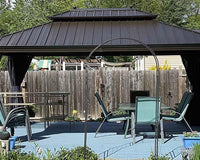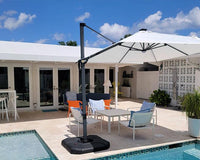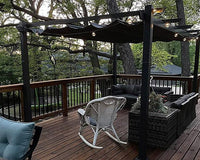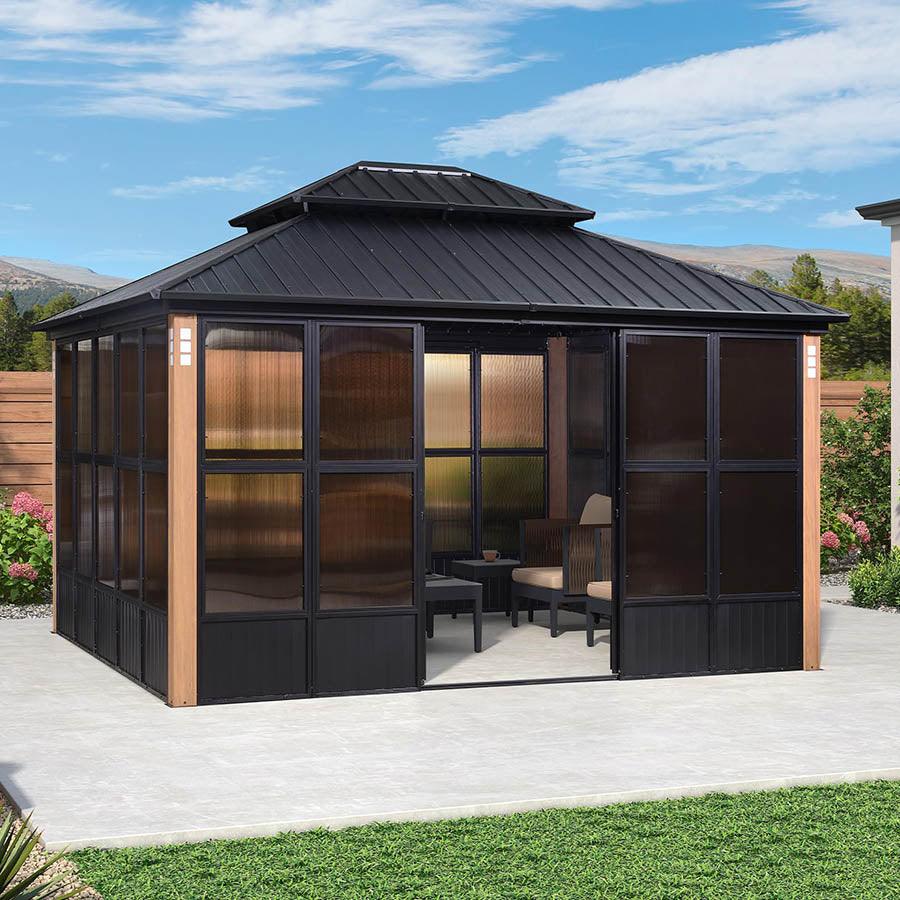
Before placing an order for patio furniture delivery, measure the complete path from the driveway or curb to the assembly area. Compare the exact dimensions of every carton or rigid component with the narrowest opening, tightest turn, lowest obstruction, and most difficult vertical transition. Then compare the assembled dimensions with the final patio, deck, porch, yard, or garage space.

Your result should lead to one of three actions: proceed when the package and finished-space comparisons support the order, prepare when movable obstacles or staging conditions remain, or contact support before checkout when package information, handling requirements, or route conditions are uncertain.
Find the Controlling Clearance Before You Order
The first useful measurement is not the finished furniture footprint. It is the route point the shipment must physically pass, based on exact carton or component information for the selected configuration. Use these furniture measuring and buying checks before committing to an order.
- Obtain the package information. Record the carton count and the listed length, width, and height of each carton. For a rigid structure, also record the dimensions of each long or fixed component. If these details are missing or vary by configuration, the fit decision is not complete.
- Measure the route controls. Identify the narrowest usable opening, tightest turn, smallest landing, lowest overhead obstruction, and most difficult stair or elevator transition between the delivery point and the assembly area.
- Compare the relevant dimension at every control point. The package dimension that must pass through a particular opening or movement point controls that comparison. Account for the need to tilt, rotate, pivot, or move across a landing rather than relying on a straight-line width alone.
- Assign a route status. Mark the order as ready to proceed only when the exact package information and every controlling comparison support a plausible movement path. Mark it as prepare when the route appears workable but movable obstacles, access permissions, surface protection, or staging still need attention. Mark it as confirmation needed when a package dimension, movement condition, or service detail is missing or close enough to affect the decision.
This approach works for a single gate, a multi-step side-yard route, or an oversized structure. A large outdoor furniture delivery is not ready simply because the finished item appears to fit the destination.

Measure the Patio Furniture Delivery Route From Drop-Off to Assembly Area
To measure your patio furniture delivery route, follow the path in the order the shipment will move. Record usable conditions, not just the nominal size printed on a gate, door, or hallway.
- Start at the drop-off point. Record the surface, slope, distance to the property, and any access restrictions at the curb or driveway.
- Measure each opening. Check the usable width and height of gates, doors, and hallways, including hinge or latch intrusion, door swing, trim, and thresholds.
- Measure movement areas. Record the pivot space at turns and landings, along with wall projections, railings, and overhead clearance.
- Record vertical transitions. Measure stairs, elevators, and slopes, including landing size, surface, overhead restrictions, and access permission.
- Finish at the assembly area. Note the surface, overhead obstructions, gate or deck access, and distance from the final approach to the work zone.
Photograph each control point and label the images by location. Include a straight-on view of openings, a view showing the approach and pivot area, and any obstruction that a measurement alone does not explain. For a rental, shared driveway, condominium, or apartment property, include access permission and any time or elevator restrictions that could change the route.
When measuring a turn, ask what the carton must do next. It may need to rotate around a corner, tilt beneath an overhang, pass a railing, or rest temporarily on a landing. Those movement conditions are part of the usable route. Do not resolve an uncertain route by assuming that heavy components can be lifted, hoisted, dismantled, or moved without appropriate help and confirmed instructions.
Use Package Dimensions for Access and Finished Dimensions for Placement
Measure both sets of dimensions because they answer different questions. Use package or component dimensions for the trip to the site, and use assembled dimensions for the final location.
| Dimension set | Question answered | Decision location |
|---|---|---|
| Package or carton dimensions | Can each shipment unit pass the route? | Gates, doors, hallways, turns, stairs, elevators, landings, and overhead restrictions |
| Assembled dimensions | Will the finished item fit and remain usable? | Patio, deck, porch, yard, garage, or other final placement area |
| Multiple-carton or rigid-component dimensions | Can every separate unit or fixed piece complete its own path? | Each carton, beam, panel, post, or other component with a distinct movement requirement |
For patio furniture package dimensions, record the dimensions of every carton rather than using the largest finished measurement as a substitute. A flat-packed seating set may travel in several boxes, while a gazebo or pergola may include long rigid components that require a separate route comparison. The longest component is not automatically the only controlling piece. Compare each unit with the opening, turn, landing, and overhead condition it must pass.
The assembled footprint matters after access is resolved. A set can pass through the gate and still occupy too much of the usable patio. A structure can fit the planned area and still fail at a side gate, sharp turn, or low overhead point. If the seller does not provide carton count and configuration-specific package dimensions, keep the route result conditional instead of inferring them from a collection or category page.
Reserve a Safe Place to Unpack and Assemble
The destination needs two separate plans: one for the finished footprint and one for temporary work. A route is not practically ready until there is a place to set down cartons, open packaging, sort parts, use tools, and keep packaging out of the travel path.
Check the Finished Footprint
Compare the assembled product's listed dimensions with the usable destination area, including the space needed to move around the finished furniture. For a gazebo or pergola, draw the proposed location and account for the surrounding site before treating the footprint as settled. A university extension planning guide explains that studying the site and drawing a site plan can lead to changes in a proposed structure's location, dimensions, or design, according to its guidance on site planning for outdoor structures.
For outdoor seating, compare the furniture with the available finished space and preserve 2 to 3 feet of walking room around chairs where that planning context applies. This outdoor furniture circulation guidance applies to the finished layout, not to the delivery route, package, or assembly clearance. Keep it separate from the measurements used to move cartons through gates and turns.
Plan the Work Zone
Reserve a protected area for the cartons, parts, tools, and packaging. Keep the work zone separate from the route so opened boxes and loose hardware do not become obstacles during the next movement step.
- Match the work area to the product form. Flat-packed furniture needs room to open cartons and sort parts; rigid structures may need a longer staging path for beams, panels, or posts.
- Check the product instructions and actual site conditions for assembly space, surface protection, overhead clearance, weather exposure, and packaging storage. A generic number cannot replace product-specific instructions.
If the destination is exposed, plan when the shipment can be unpacked and where parts can remain protected. For a large outdoor furniture delivery, the final footprint, temporary work zone, and route are three different checks.
Choose Your Next Step Before Checkout
Use the measured route and exact product information to choose one action before ordering.
- Proceed when the carton count and package dimensions are available, each route control has a plausible movement path, the assembled footprint fits the destination, and the staging area is ready. Keep the measurements and product configuration with the order details.
- Prepare when the route comparison supports access but movable conditions remain. Clear furniture or planters, arrange access to gates or shared areas, protect the staging surface, coordinate timing, and make the work zone ready before the delivery arrives.
- Contact support before checkout when carton information is missing, a turn or vertical transition is uncertain, the route requires difficult handling, or the delivery handoff is unclear. Stairs, elevators, carrying distance, and move type can affect service conditions or charges in some arrangements, so ask the seller or carrier about the exact product, destination, and route instead of assuming inside placement or extra labor is included. Government moving guidance also treats difficult access as a detail to discuss when arranging a move, but it does not establish this delivery's service terms.
Send the product configuration, carton information, route measurements, labeled photos, and one specific question. That gives support enough context to address the controlling condition rather than offering a general fit answer.
Measure first, compare package dimensions with the route, and use assembled dimensions for the final placement. If every controlling point is supported, proceed. If the path is workable but not ready, prepare it. If a package fact or handling condition remains uncertain, contact support before checkout.
FAQs
The right next step depends on the exact package information, the measured route, the finished footprint, and the service conditions that remain unresolved. These answers clarify common route and placement questions.
How Do I Prepare for Patio Furniture Delivery?
Confirm the delivery point and service scope, measure and photograph the route, remove movable obstructions, and reserve a protected staging area. If access is restricted or the route includes stairs, an elevator, or a tight turn, send the measurements and photos to the seller or carrier before checkout.
Will a Gazebo Fit Through My Gate?
The gate is only one checkpoint. Compare its usable opening with the exact package or rigid-component dimensions, then account for the approach, turns, landings, overhead restrictions, and final assembly area. If any controlling dimension or movement condition is missing, pause for confirmation rather than treating the gate measurement as proof of fit.
Do I Measure the Box or the Assembled Furniture?
Measure both. Package dimensions control movement from the delivery point to the site, while assembled dimensions control the finished footprint. For a multi-carton shipment, compare every carton, and for a rigid structure, compare each component that must follow a different path.
What Should I Do If My Delivery Route Has Stairs or a Tight Turn?
Measure the stair, landing, turn, overhead conditions, and usable approach, then send those details with the exact product and package information to the seller or carrier. Do not assume that difficult handling, special equipment, inside placement, or extra labor is included in the delivery service.