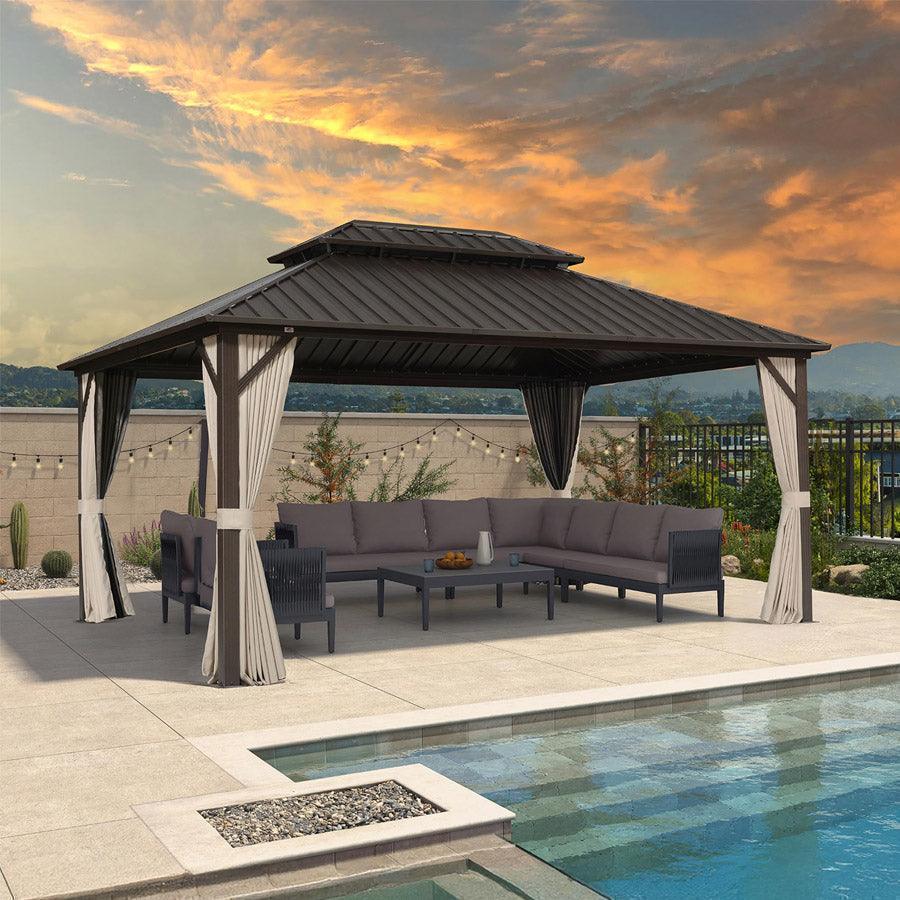
Don't assume a fire pit or heater is safe under every gazebo in the fall. A fire pit under a gazebo is appropriate only when the exact heat source and gazebo instructions allow that setup and all applicable clearance, ventilation, weather, and local requirements are met. Wood-burning equipment requires the most careful review because of sparks, embers, smoke, hot exhaust, and combustible materials. Propane or gas equipment depends on model-specific enclosure and combustion-air requirements. Electric heat avoids an open flame but still requires checks for the product, electrical setup, placement, and weather. If any controlling condition is unclear or unmet, don't operate the appliance there.

Can You Use a Fire Pit Under a Gazebo? Classify the Heat Source First
The heat source determines the first level of risk, but no category is automatically approved just because a gazebo is outdoors or open-sided. Identify the fuel or power source and exact model before evaluating the structure.
Wood-Burning Fire Pits and Outdoor Fireplaces
Treat a wood-burning fire pit or outdoor fireplace beneath a roof as a setup that requires specific approval. Flames, sparks, embers, smoke, and hot exhaust can reach combustible roofing, curtains, furniture, decorations, dry leaves, or nearby vegetation. USFA recommends using chimneys, outdoor fireplaces, and fire pits at least 10 feet from a home or anything that can burn, and using a metal screen over wood-burning fires in its outdoor-fire guidance. That general distance is not a universal overhead-clearance rule for a gazebo.
The appliance instructions and gazebo instructions must expressly allow the arrangement. A spark screen does not resolve every roof, smoke, heat, or clearance concern. Wind, falling leaves, smoke entering the home, and local burning restrictions can change the decision even after the physical setup has been reviewed.
Gas or Propane Heaters
Propane or gas fuel does not automatically make covered use acceptable. Check the heater's listing and manual for required clearances, ventilation, cylinder placement, and permitted locations, including whether the model may be used in a covered, screened, curtained, or enclosed area. NFPA outdoor-heater guidance also takes a model-specific approach to electric heaters, including their clearances and installation requirements.
A gazebo with its curtains or screens open is not necessarily the same approved operating environment as one with those coverings closed. Don't infer propane compatibility from a patio-heater label, a general product category, or the fact that the unit produces fewer visible sparks than a wood fire.
Electric Outdoor Heaters
Electric heat avoids an open flame, but it isn't risk-free or automatically approved for a gazebo. Follow the exact heater listing and manufacturer's instructions for clearances, wiring or connections, stable placement, outdoor suitability, and moisture conditions. Use only the connection method and installation allowed for that product. Keep the heater from being easily overturned, and don't treat an improvised cord arrangement or a roof design as proof of compatibility.
Electric heat can be an approved alternative when the actual heater and installation fit the gazebo. It isn't a substitute for checking the product instructions or local and property requirements.
Is the Gazebo Open Enough for Fall Heat? Inspect the Structure and Conditions
Inspect the gazebo as it will actually be configured when you operate the heat source. Screens, curtains, walls, furniture, decorations, or lighting can change airflow or put materials near the heat, so calling a gazebo open-sided isn't enough. For a fuel-burning heater, poorly ventilated enclosed conditions can create a carbon-monoxide hazard. CPSC warns that portable propane radiant heaters need sufficient air for combustion and can create a CO hazard in small, poorly ventilated enclosed areas.
That warning applies to the actual heater and enclosure; it does not classify every gazebo as unsafe or approved.
Inspect in this order:
- Actual enclosure condition: Note whether the sides are open, screened, curtained, or enclosed during operation. Treat any change in that condition as a new operating configuration.
- Surfaces and accessories: Review the roof, posts, side panels, flooring, curtains, furniture, decorations, lighting, and anything overhead or nearby that can burn or be damaged by heat.
- Debris and vegetation: Remove or control dry leaves and loose combustible items only in ways allowed by their product or structure instructions. Consider nearby plants, mulch, fencing, and other property that sparks or embers could reach.
- Smoke and ember travel: Identify where smoke, sparks, and embers could move, including toward the home, people, neighboring property, or enclosed areas.
- Fall conditions: Reassess wind direction, smoke drift, moisture, worsening weather, air-quality alerts, and any changed local restriction before use and while operating.

A ventilation design or double-tiered roof does not establish that a fuel-burning appliance is approved. For related structural information, see this double-tiered roof ventilation guide, but use the appliance and gazebo instructions to make the actual compatibility decision.
How Do You Verify the Rules for Your Exact Setup?
Verify the exact appliance and structure together, using their current instructions and the real installation measurements. There is no single overhead distance that applies to every fire pit, outdoor fireplace, heater, roof, and gazebo.
- Identify the appliance: Record the exact model, fuel type, and whether it is wood-burning, gas or propane, or electric.
- Read the appliance documents: Find the listing and manual language for covered or enclosed use, overhead and side clearances, floor placement, combustible materials, ventilation, spark or exhaust controls, cylinder placement, and electrical requirements.
- Read the gazebo instructions: Check the structure's permitted use, materials, installation conditions, and any limits involving heat sources or attachments.
- Measure the actual setup: Compare the overhead, side, floor, roof, curtains, furniture, decorations, and other combustible relationships with the clearances defined by the appliance and gazebo instructions. Don't replace those instructions with a generic internet distance.
- Check the operating enclosure: Confirm that the open, screened, curtained, or enclosed condition matches the appliance's permitted location. If the documents conflict, follow the stricter applicable requirement.
- Check current restrictions: Review fire department or fire marshal guidance, municipal or county rules, HOA or rental terms, property restrictions, and current air-quality or burn restrictions. EPA notes that local governments may restrict backyard recreational fires and recommends checking local authorities. It also advises considering wind direction and neighbors and avoiding wood burning during air-quality alert days in applicable conditions through its backyard recreational fire guidance.
If any required appliance, structure, clearance, ventilation, enclosure, or local-fire requirement is missing, unclear, or unmet, don't operate a flame or fuel-burning heater beneath the gazebo. Relocate it to a setting approved by the instructions and applicable authority, or choose an electric option separately approved for the actual installation.
FAQ: Fire Pits, Gazebos, and Propane Heaters
These answers apply the same conditional rule to common fall-use questions.
Can You Put a Fire Pit Under a Gazebo?
Possibly, but not by default. A fire pit may go beneath a gazebo only when the exact appliance and structure instructions permit that setting and all clearance, ventilation, weather, enclosure, and local requirements are met. Otherwise, relocate it and don't rely on the gazebo's open-sided design alone.
How Much Clearance Does a Fire Pit Need Under a Roof?
There is no universal clearance number for every fire pit, roof, and gazebo. Use the exact appliance label and manual with the gazebo instructions to determine overhead, side, floor, and combustible-material clearances. A general outdoor-fire distance is not a substitute for those product-specific requirements.
Can You Use a Propane Heater in a Gazebo?
Possibly, but only when the exact model permits the gazebo's actual enclosure and meets its ventilation, clearance, cylinder-placement, weather, and local requirements. If screens, curtains, or walls create a poorly ventilated condition, stop rather than improvising a solution.
Use the Go/No-Go Decision and Take One Next Step
Use one of these three outcomes after checking the heat source, gazebo, instructions, measurements, and current conditions.
| Situation | Decision | Next action |
|---|---|---|
| Every applicable appliance, structure, clearance, ventilation, weather, and local requirement is verified | Proceed only within those verified conditions | Operate and monitor the setup. Stop if the approved configuration changes. |
| Any requirement is unclear or unmet | No-go | Do not operate beneath the gazebo. Relocate the appliance to an approved setting or choose a separately approved alternative. |
| Wind, smoke, sparks, combustible buildup, enclosure, weather, or restrictions change during use | Stop and reassess | Stop according to the appliance instructions, then relocate or do not resume until the requirements are re-established. |
When the checks support changing the structure rather than the heat source, our hardtop gazebo options and grill gazebo options are shopping navigation only, not proof that a heat source is compatible. If any controlling requirement remains uncertain, don't light or run the appliance under the gazebo. Relocate it to a location approved by its instructions and applicable local authority, or choose an electric heater separately approved for the actual installation.