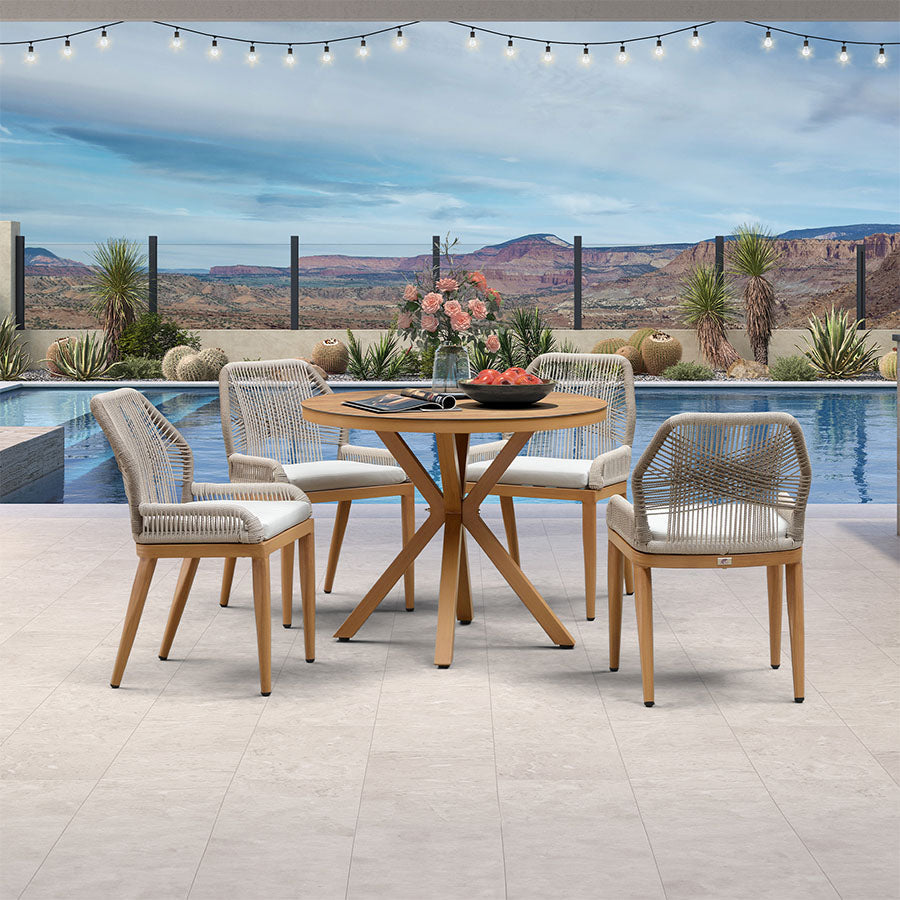
An outdoor dining table should fit both your patio and the way you use it. Round is a practical starting point for a compact or irregular space where close conversation matters. Square suits a balanced, centered dining area, while rectangular often works best on a longer patio, for a larger group, or when serving runs along one side. Make the final choice only after considering the table, chairs, pull-out space, door route, walkway, and serving path together.

Which Outdoor Dining Table Shape Fits Your Patio?
Use the table below to identify a leading shape, then test its full footprint in your actual patio orientation. These are practical starting points, not universal rules. A door, grill route, narrow passage, or wide chair can change the answer.
| Shape | Choose it when | Main limitation |
|---|---|---|
| Round | Corners, irregular edges, or a compact group make direct conversation the priority. | Its footprint can be hard to align with a long wall or narrow linear run, and chairs may still extend into the circulation space. |
| Square | The usable area is balanced and a centered, compact layout feels natural, such as a square outdoor table for four. | It may use a long patio less efficiently than a rectangle, especially when the group or serving setup needs more length. |
| Rectangular | The patio has a longer open run, seating needs are higher, or food and serving work best along one line, such as a rectangular patio table for six. | Its ends and long sides can create traffic conflicts when the patio is narrow or the main route runs beside the table. |
For a small patio, start with round when corners or fixed features create conflicts. Start with square when the usable dining area is balanced and the table can sit without taking over a route. On a longer patio, start with rectangular, then rule it out if pulled-out chairs interfere with the door or walkway. A shape that fits on paper is only a candidate until it passes a full-footprint test.

Measure the Patio Space You Can Actually Use
Measure the area left after accounting for fixed features and required routes, not the patio's total surface area. The usable footprint includes the table, every chair position, room to pull chairs out, and the paths people use to enter, sit, serve, and pass.
- Map fixed features and routes. Mark doors and their swing, steps, railings, walls, planters, grills, and storage. Identify the main route from the door and any route to the grill, yard, or kitchen.
- Measure the usable dining area. Record the open length and width where the set can actually sit. Note which edge must stay open for the door, walkway, or food route. A shape that fits only with chairs pushed in is not a practical fit.
- Record the complete product footprint. Use the table's actual length, width, or diameter from the product page. Add the real chair width and depth, armrests, and the position of table legs or a pedestal. Treat the listed seating capacity as a starting point, not proof that the full set will feel comfortable.
- Mark the routes that must remain open. Include the path to sit down, stand up, carry food, and pass the table. If accessible seating is part of your project, apply the relevant accessibility approach guidance as an additional check for that setting. Those requirements are not a general clearance rule for every residential patio.
A patio table size guide can help organize the measurement process. Use the proportions of the usable area to narrow the choice: a balanced area may favor square, a compact or irregular area may favor round, and a longer unobstructed area may favor rectangular.
Compare Conversation, Seating, and Serving Tradeoffs
Shape affects how people face one another and how food is arranged, but the table base, chair design, diner count, and surrounding circulation can outweigh general shape tendencies. Prioritize the use that happens most often, as long as the layout keeps the required route open.
Conversation and Everyday Use
A round table often keeps a small group oriented toward one another, making it a natural first option for close conversation on a compact patio. A square table can create a similarly centered feel when the usable area is balanced and seating is distributed evenly. A rectangular table organizes diners along longer sides, so it often suits family meals, larger groups, or a linear arrangement near a wall or serving area.
These are tendencies, not guarantees. A round tabletop can still feel awkward if its chairs block the only path. A rectangular table can support easy conversation when diners are spaced comfortably and the ends remain accessible. When comparing a round vs. rectangular outdoor dining table, judge the actual seating positions and routes rather than the shape label alone.
For everyday outdoor dining, favor the shape that keeps the people who use the table most often comfortable without forcing chairs into a walkway. For casual entertaining, rectangular may offer more useful length for platters and place settings, while round or square may keep a smaller group within easier reach when the surrounding space allows.
Seating and Serving Space
Listed capacity helps you find a starting category, but it does not establish comfortable everyday seating. Compare the product's actual table dimensions with chair width, armrests, leg or base placement, serving dishes, and the space needed to enter, leave, stand, and pass. A table advertised for a certain number of seats may work for occasional use but feel crowded with broad armchairs and full serving dishes.
A square outdoor dining table for four can be practical when four diners need a compact, centered arrangement and the chairs fit without crowding. A rectangular outdoor dining table for six is a reasonable starting point when the patio has enough length for the table and pulled-out chairs, but the listed seat count still needs a footprint test. Round can make a compact group easy to reach, while its curved edge may provide less natural alignment for a long serving layout.
If accessible seating is required, treat it as a separate design condition. Municipal outdoor-dining guidance can inform that setting, but it is not a general patio furniture standard. Compare the product's under-table and approach dimensions instead of assuming that a nominal seat count proves usable access.
A broader dining set buying factors guide can help you compare shape alongside size, style, material, and functionality. Keep the space-and-route test as the deciding step for this purchase.
Test the Full Layout Before You Order
A full-scale floor-tape test is the fastest way to find out whether your leading outdoor dining table shape works in daily use. It is a planning method, not a universal clearance standard, so use the actual dimensions of the table and chairs you are considering.
- Confirm the candidate dimensions. Write down the actual tabletop length and width or diameter, plus the dimensions of each chair. Include arms, the table base, and any product-specific seating arrangement.
- Mark the tabletop. Use removable painter's tape or paper to reproduce the table at full scale in the intended orientation. Test the orientation you would use after delivery, not just the shape in isolation.
- Mark every chair and pull-out zone. Place a rectangle for each chair with enough room for someone to sit, stand, and pull the chair out. Use the real chair footprint where available rather than a generic placeholder.
- Walk the working routes. Move through the door, walkway, sitting positions, standing positions, and serving path with the chairs pulled out. Try carrying a plate or serving dish if that is part of normal use. If a route works only when chairs are pushed in, the layout fails the everyday-use test.
- Compare a credible alternative. Test a second shape or a different orientation when the first option is close to the usable-space limit. Select the shape that keeps the required routes open while matching the way you plan to dine. If none passes, reduce the footprint or change the orientation before shopping.
For more layout ideas, browse these outdoor dining layouts after measuring your own routes. The right choice is the shape that passes the movement test and supports your usual meals, not simply the one with the most attractive tabletop.
Round is the leading candidate for a compact or irregular patio and close conversation, square for a balanced compact dining area, and rectangular for a longer run, larger group, or linear serving setup. Before placing the order, tape the leading shape and one alternative on the patio, pull out every chair, and choose the option that keeps the required routes open.
FAQs
These questions cover the main shape, seating, and layout decisions. The complete table-and-chair footprint remains the deciding test when a patio is tight or the intended seating is near its limit.
What shape outdoor dining table is best for a small patio?
Round is a useful first candidate when corners, railings, or irregular edges create conflicts. Square may fit better when the small dining area is balanced and centered. Tape the complete table-and-chair footprint before ordering, because the better shape is the one that preserves the main route with chairs pulled out.
Is a round patio table better for conversation?
A round table often keeps a small group oriented toward one another, so it can be a strong choice for conversation. Access, the table base, serving needs, and chair placement can make square or rectangular more practical. Compare the actual seating positions and walk the route before deciding.
Which patio table shape seats the most people?
No shape guarantees the most usable seats. Compare the documented capacity with chair width, armrests, leg placement, serving space, and the room needed to sit, stand, and pass. For a six-person goal, a rectangular layout may be a starting candidate when the patio has enough length, but the full footprint determines whether it works comfortably.
How do I check whether a patio table will block the door or walkway?
Use removable tape to mark the tabletop, every chair, chair pull-out zones, the door route, walkway, and serving path. Walk through the layout with chairs pulled out. If the route works only with chairs pushed in, test another shape or orientation before ordering.