
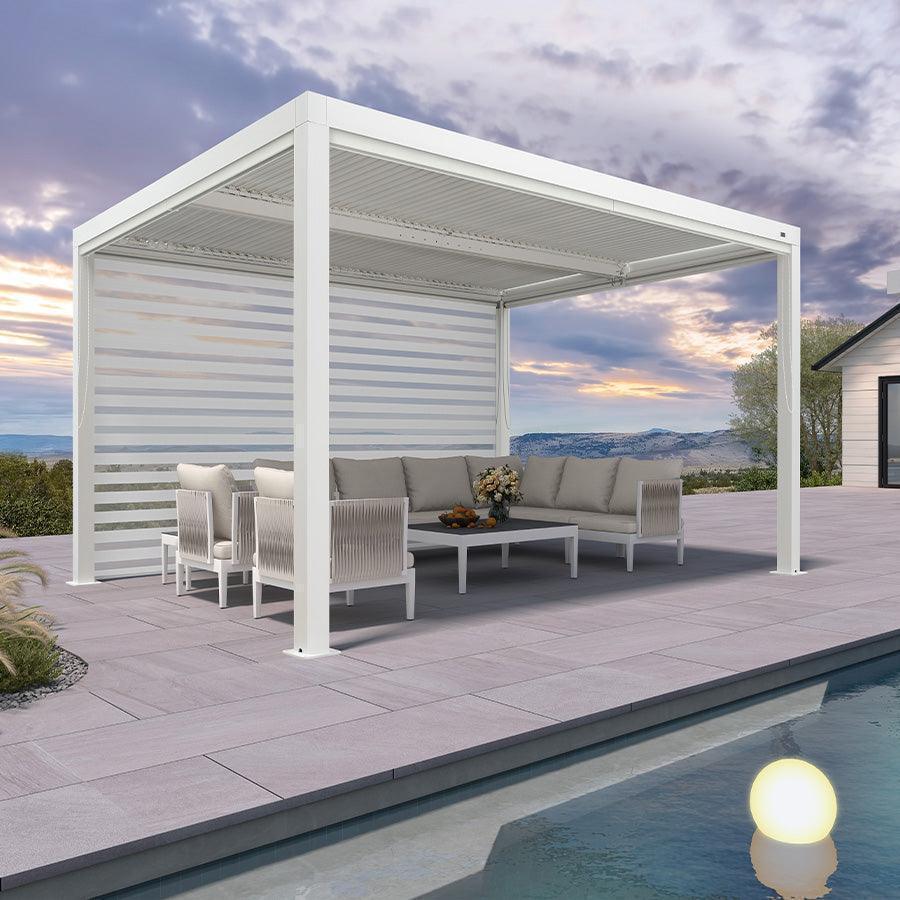
A roller blind fits your pergola only when three things match that exact structure: the blind's product-defined dimensions, its brackets and attachment points, and the space it needs to roll up and down. A blind that looks like the right style, or carries a matching size label, still needs all three checks.
If any of those details is missing from the product information, treat the fit as not yet verified. Get a direct answer for your exact pairing before you order.
Start With the Exact Blind and Pergola Pairing
Write down the exact blind listing and the option you selected, then the pergola's model name and size. Every later check depends on comparing these two specific products rather than assuming similar models share the same dimensions or mounting hardware. Treat any listed size or model pairing as a starting point until the measurements, bracket attachment points, and operating clearance are all confirmed.

Compare Product-Defined Dimensions With the Intended Coverage
Compare the blind's stated dimensions with the exact area you want it to cover, using the product's own definition of each number. A size label alone may not be a finished measurement.
- Find out what each listed dimension measures. Check whether the product information defines width and height as the fabric, the assembled blind, or another measurement. A label such as "10-ft" is not automatically the finished blind width.
- Measure the space you want covered. Record the opening or coverage area at the exact spot where the blind would mount, in the same units the product uses.
- Compare like with like. Line up the product's defined width against your measured width, and its defined height or drop against your measured height.
- Mark gaps honestly. If the product doesn't say what a number measures, or a needed value is missing, leave this check unverified. Ask for the measurement basis and the exact dimensions instead of guessing from the label.
If you are still choosing the pergola itself, our guide to comparing pergola listings before buying covers fit details worth checking early.
Match the Brackets to the Pergola's Mounting Locations
The blind's brackets have to attach where the product says they should, on a surface the pergola actually has at that spot. Use the blind's manual or specifications, plus the pergola's own documentation, to compare:
- Bracket type and orientation: which bracket style ships with the blind and which way it faces when mounted.
- Designated attachment points: where the instructions say the brackets go on the pergola frame.
- Mounting surface at your chosen position: whether the pergola has a matching surface at that exact spot, as the blind's requirements describe.
If a required attachment condition clearly conflicts with your pergola, the blind is not compatible in that configuration. If either product's documents leave a requirement unclear, the mounting check stays unverified. Ask about the exact models rather than planning to modify the frame or swap in different hardware. Retrofit attachment questions also come up with covers; our article on pergola roof panel fit checks walks through similar compatibility points.
Check the Blind's Operating Space
A blind also needs room to sit and room to move. Find the product-stated space for both, then compare it with your pergola:
- Space for the installed hardware: how much room the roll, cassette, or other supplied hardware needs in the mounting setup you picked.
- Space for full movement: the path the fabric takes from fully raised to fully lowered, checked against beams, posts, furniture, lights, or anything else near that spot.
No single clearance number applies to every blind, so use only the figure given for your exact product and mount. If something documented blocks the hardware or the blind's full travel, it is not compatible in that position. If the product gives no clearance or movement detail, mark this check unverified and request it.
Classify the Result and Close Any Gaps
Sort the pairing into one of three outcomes, always tied to the exact blind option, pergola model, and mounting position:
- Compatible for this setup: dimensions, mounting, and operating space are all supported by product information and all match.
- Not compatible in this setup: at least one required condition clearly conflicts.
- Not yet verified: any decisive value or requirement is missing. On the listing details alone, our 10-ft size/model pairing falls here until the other checks are confirmed.
To close a gap, send the seller or maker the exact blind option, pergola model, intended mounting position, and your site measurements. Then ask for a direct answer on each open item: what each dimension measures and its value, the bracket and attachment requirements, and the operating clearance for that mount. A general "yes, it fits" doesn't settle those points. For a pairing with one of our pergolas, contact our team with those details before you buy.
FAQs
Can I return a roller blind if it doesn't fit my pergola?
It depends on the seller's policy, so read it before ordering. Our listing states that our roller blinds suit only the specific models named on that page, and returns or refunds are not accepted for purchases made for other pergolas. That's why confirming fit first matters.
Does the frame color match the fabric color?
Not always. On our roller blind listing, the grey color option refers to the roller shade frame, while the shade fabric itself is white. Check color notes on any listing so the finished look matches your pergola.
Where do I find more product details for a pergola that already includes a blind?
Start with the product page for that exact pergola, such as our louvered pergola with roller blind, and check the size and add-on options listed there.
How should I care for an outdoor roller blind after installing it?
Follow the care and maintenance instructions provided in your specific roller blind's manual or product documentation, as approved cleaning agents, drying methods, and hardware maintenance schedules depend on the exact fabric and frame materials used.


