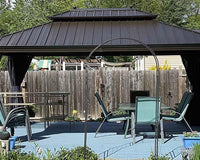
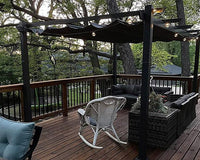
Use pergola drainage as a roof-to-ground inspection, not a waterproofing test. Before fall rains and leaf buildup, trace the collection surface, accessible channels or gutters, outlets, and discharge endpoint. Clear only permitted, reachable debris; when practical, observe water during or soon after rain; and document splash, bypassing, staining, erosion, or pooling. Then choose the narrowest supported action: clean, redirect, repair, or arrange a qualified evaluation.

Trace the Pergola’s Water Path Before the First Fall Rain
The most useful first step is to follow the actual water path from the top of the pergola to the ground. Louvered and covered systems may collect water differently, so start with what you can see rather than assuming a standard layout.
- Identify the collection surface. For a louvered pergola, start with the louvers in the closed position and the visible collection channels. For a covered pergola, start at the roof edge and any visible gutter route. Do not reach into moving parts or climb to inspect a blockage.
- Follow the accessible channel or gutter. Track each visible transition and note leaves, debris, displaced covers, staining, or any point where water could bypass the collection path. A pergola gutter inspection before rain should include accessible collection points and visible connections, not just the roof surface.
- Trace the outlet transition. Follow each open outlet, downspout, or leg passage to the point where water leaves the structure. Look for loose connections, leaking joints, backups, or discharge that stops against the structure.
- Observe the ground-level endpoint. When practical and safe, watch the pergola during or soon after rain. This can show where water flows, bypasses a collection point, or leaves the intended route. The EPA’s inspection guidance supports observing stormwater in operation and documenting the finding, but this observation does not establish engineering adequacy or waterproofing performance.
- Record the finding. Note the date or weather conditions, collection point, outlet, endpoint, visible symptom, and affected feature. Photos taken from stable, ground-level access can help you compare the next rain event and explain the issue to an installer, manufacturer, or qualified professional.
Pergola Water-Path Inspection Sequence
Ordinal inspection sequence only—not a measurement, design assessment, or waterproofing guarantee.
View chart data
| Category | Inspection order |
|---|---|
| Collection surface | 1.0 |
| Channel or gutter | 2.0 |
| Outlet transition | 3.0 |
| Discharge endpoint | 4.0 |
| Rain observation and notes | 5.0 |
Use stable, ground-level access and follow the exact owner’s manual. If observing rainwater is not practical, complete the visual trace and reserve conclusions about actual flow for the next suitable rain event.
Clear Pergola Drainage Channels, Gutters, and Outlets Before Leaves Build Up
Clear accessible loose leaves and debris before the season if the exact care instructions permit it. Check the entire visible collection path, including screens, covers, outlets, seals, connections, and transitions. An open roof edge does not prove that a concealed channel or outlet is clear.
Do not force tools, pressure, chemicals, or your hands into hidden channels, louvers, seals, or outlets. The available assembly guidance supports mild soap and water for frame care and cautions against bleach, acid, and solvents, but it does not establish one universal drainage-cleaning method for every model. Follow the manual for your specific pergola before removing or adjusting any component.
A clear, accessible obstruction that remains open after removal supports a cleaning outcome. A blockage you cannot reach, a damaged or displaced connection, a leaking joint, or repeated overflow points to repair or qualified evaluation. For broader seasonal upkeep, use these seasonal pergola care tips as a follow-up, while keeping model-specific drainage decisions tied to the exact owner’s manual.
Verify Downspout Discharge and the Splash Zone
Pergola water should end at a site-appropriate receiving area that does not send runoff back toward the structure or vulnerable nearby features. There is no universal endpoint distance, slope, grading rule, or buried-drainage solution for every property.
Confirm that each visible outlet is open and connected, then follow the discharge to the receiving surface. Look for splashback, erosion, return flow, or water contacting doors, stairs, furniture, foundation-adjacent ground, or another area where it could cause property damage. The EPA’s downspout guidance also emphasizes checking site conditions and local requirements before redirecting water.
If the problem is a simple, accessible above-ground discharge and the receiving area is clearly suitable, an extension or splash block may help move the flow away from the affected spot. Before making that change, identify the replacement endpoint and confirm that it will not send water toward a door, stair route, neighbor, foundation-adjacent area, or erosion-prone surface. If the change requires digging, altering grading, rerouting buried drainage, or connecting to a shared building system, document the condition and obtain qualified, site-specific advice instead.

Read Pooling and Runoff Around Doors, Stairs, Furniture, and Foundations
Visible splash marks, wet posts or walls, erosion, damp furniture areas, and returning water show where to investigate next, but they do not diagnose the concealed cause. Compare each symptom with the outlet and discharge route you recorded during the inspection.
Move portable furniture and other items out of the splash or pooling zone while you monitor the next suitable rain event. Record whether the symptom is isolated or recurring, what weather preceded it, where it appears, and which feature is affected. Recurring pooling, staining, erosion, overflow, or bypassing calls for investigation rather than repeated cleaning alone. The visible signal may come from a connection, surface, grading, buried drainage, structural, or waterproofing issue, and observation alone cannot distinguish among those causes.
If water repeatedly reaches a doorway, stair path, foundation-adjacent area, or interior space, stop relying on routine observation alone and arrange a qualified repair, drainage, structural, or waterproofing evaluation. That escalation does not by itself prove waterproofing failure; it recognizes that the condition is consequential or unresolved.
Choose the Next Step: Clean, Redirect, Repair, or Escalate
Match the action to the visible finding and its consequence. Clean only accessible debris that the exact care instructions allow you to remove, and redirect only to a suitable above-ground endpoint. Damaged, disconnected, concealed, or repeatedly failing components call for repair or qualified evaluation, consistent with roof-runoff maintenance guidance, applied here as a maintenance boundary rather than a pergola engineering standard.
| Visible finding | Next action | Boundary |
|---|---|---|
| Accessible loose leaves or debris | Clean the permitted collection point, then observe the next suitable rain event. | Do not force tools, pressure, chemicals, or access methods that the exact manual does not allow. |
| Blocked or disconnected outlet | Repair the visible connection or arrange qualified repair if it is damaged, concealed, or inaccessible. | An open roof edge does not prove the hidden route works. |
| Splash or discharge toward a vulnerable area | Redirect only through a clearly suitable, accessible above-ground route. | Do not assume a universal distance, slope, endpoint, or grading result. |
| Repeated pooling, bypassing, overflow, or leakage | Arrange repair or qualified drainage evaluation and preserve the evidence. | Do not diagnose the hidden cause from pooling or staining alone. |
| Concealed, structural, foundation-adjacent, interior-entry, waterproofing, or engineering uncertainty | Escalate to the installer, manufacturer, or appropriately qualified professional. | Do not drill, seal, reroute buried drainage, alter grading, or modify components as a routine cleaning step. |
Save photos and notes before contacting the installer or manufacturer about model-specific care, or a qualified repair, drainage, structural, or waterproofing professional about a concealed or consequential condition. For questions about weather protection, keep the distinction clear: louvered pergola weather protection is not established by a visual drainage inspection. The practical next action is to follow the exact manual and arrange the right evaluation when the finding is damaged, recurring, concealed, or consequential.
Pergola Drainage FAQ
These answers address common fall-maintenance questions while keeping visible inspection separate from site-specific drainage design and waterproofing assessment.
How Do I Keep Leaves Out of Pergola Gutters?
Clear accessible leaves and loose debris from pergola gutters, channels, screens, outlets, and downspout ends before leaf season and after heavy leaf fall when the exact care instructions permit it. If debris is hidden, the path remains blocked, or overflow returns after cleaning, stop forcing access and arrange repair or qualified evaluation.
Where Should Pergola Water Drain?
It should follow the pergola’s intended collection route to a site-appropriate endpoint that does not send water back toward the structure, doors, stairs, furniture, foundation-adjacent ground, or another vulnerable area. Buried drainage, grading changes, shared systems, and local requirements need site-specific review rather than a universal distance or slope.
Why Is Water Pooling Under My Pergola?
Possible categories include an accessible blockage, a leaking or disconnected connection, splashback, discharge aimed toward the structure, or broader site drainage conditions. Trace the route and document when pooling occurs. If it recurs or reaches a doorway, stair path, foundation-adjacent area, or interior space, arrange qualified evaluation instead of treating it as a leaf problem alone.
Can a Pergola Drainage Inspection Prove That the Roof Is Waterproof?
No. A visual check can identify accessible debris, visible leaks, discharge behavior, and pooling, but it cannot prove engineering adequacy, concealed construction, code compliance, or waterproofing performance. Use the inspection to document an observable condition, then consult the exact owner’s manual or the appropriate qualified professional for the unresolved question.