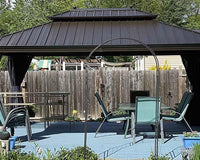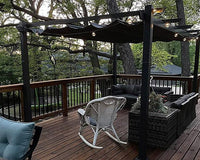
Act in late summer or fall on a dry, stable day, with enough time to address any issues before your local first freeze. This hardtop gazebo maintenance pass covers safe access, debris removal, gentle cleaning and drying, drainage, visible connections, removable fabric accessories, and repair triage. It does not set snow-load limits or replace your model’s owner instructions.

Start with a Dry, Safe Hardtop Gazebo Maintenance Pass
Start your fall gazebo maintenance checklist when the structure is dry and accessible, rather than waiting for freezing weather to make unresolved moisture or damage harder to address. Keep the inspection at ground level whenever possible, and use the owner’s manual to distinguish hardtop care from fabric-accessory care. Some manuals allow the hardtop structure to remain installed while making curtain or netting removal conditional on the model, as shown in these seasonal owner instructions.
- Choose the work window. Pick a dry, stable day in late summer or fall, before the first hard freeze in your area, and leave time to get support or qualified help if you find a problem.
- Gather the manual and supplies. Have the owner’s manual, gloves, a camera or phone, a record sheet, and only the gentle cleaning supplies allowed by the instructions.
- Set up safe access. Inspect from the ground or another stable position permitted by the manufacturer. If you must work at an elevated height, use a sound ladder on stable, level footing, inspect it before use, maintain three-point contact, and do not overreach. These are practical homeowner safety principles reflected in OSHA ladder guidance, not a homeowner legal requirement.
- Clear loose debris. Remove accessible leaves, dirt, and other debris without disassembling roof sections or forcing material into openings.
- Clean and dry accessible areas. Use the method approved for your model, then let panels, joints, frame surfaces, and accessible undersides dry before assessing stains, corrosion, cracks, or possible water entry.
- Check visible drainage and connections. Look at drainage openings, channels, outlets, eaves, screws, nuts, fasteners, anchors, and joints where those features exist.
- Separate fabric tasks. Identify curtains, netting, ties, tracks, and hooks that the manual says may be removed. Do not force an attachment.
- Photograph and route every finding. Classify each condition as safe routine work now, monitoring, model-specific support, or qualified-professional review. Do not use this pass to begin structural repairs or snow-load preparation.
For a broader record of routine inspection areas, use this annual gazebo inspection checklist as a guide, not as a substitute for your model’s instructions.

Clean and Dry the Roof, Frame, and Drainage Paths
Clean accessible hardtop and frame surfaces with the gentlest method allowed for the installed materials and by the owner’s manual, then dry them completely. One care guide gives a limited example of mild soap or water, a soft sponge or cloth, rinsing, and complete drying while warning against bleach, acid, and abrasive cleaners for that model: gentle cleaning directions.
Clean the Hardtop Roof and Frame
Remove loose leaves and dirt without assuming that pressure washing, harsh chemicals, coatings, or disassembly are appropriate. Wipe or rinse only when the owner’s manual permits that method. Let roof panels, seams, frame joints, and accessible undersides dry before deciding whether a mark is surface dirt, corrosion, cracking, or a possible leak.
If the installed materials or cleaning method are unclear, limit the work to accessible surface cleaning and record the question for model-specific support. Cleaning prepares the area for inspection; it does not diagnose structural condition.
Clear Drainage Paths and Check for Trapped Moisture
Where the design includes them, check visible channels, gutters, outlets, eaves, and downspout paths. Remove accessible leaves or sediment without forcing debris through a blockage or into a connection. A model-specific guide also warns that unapproved silicone can block designed drainage openings, so treat this drainage and outlet guidance as conditional, not universal.
Look for these observable conditions:
- Standing water or damp joints after the area has had time to dry.
- Overflow marks, blocked outlets, or moisture collecting where roof and frame sections meet.
- A damaged drainage component or an opening that appears altered.
Clear what is safely accessible, then record unresolved moisture or drainage findings. Do not add sealant, change an outlet, or alter the drainage path unless the model’s instructions specifically direct that work.
Decide Which Roof, Frame, and Connection Findings Need Escalation
A gazebo inspection before winter should end with an owner assigned to every visible condition, not an improvised repair. Routine cleaning or monitoring is appropriate only when the area is stable and the task is supported by the instructions. Use model-specific support for identification or confirmed component questions, and arrange qualified-professional review for unsafe structural findings.
| Area to inspect | Observable condition to record | Pre-freeze decision |
|---|---|---|
| Roof panels and seams | Loose movement, sagging, deformation, cracks, separation, or water-entry signs | Stop using or working on the area and arrange qualified-professional review; document it first. |
| Frame members, posts, and brackets | Bending, cracks, instability, unusual movement, or visible deformation | Stop and escalate rather than attempting to bend, brace, or tighten the structure. |
| Fasteners and connections | Damaged or missing bolts, screws, nuts, separation, or looseness | Use routine checks only for a stable condition covered by the manual; route damage, missing hardware, or movement to support or qualified help. |
| Anchors and base area | Movement, separation, damage, or an unstable-looking connection | Keep the area out of use and arrange qualified review if stability is in question. Do not infer adequacy visually. |
| Drainage-related joints | Blockage, retained water, damp joints, overflow marks, or an altered opening | Clear accessible debris only; ask model-specific support about unresolved or altered drainage. |
If supports or roof panels move, the roof sags or is deformed, fasteners are damaged or missing, or another component appears loose, bent, cracked, unstable, or unsafe, stop using or working on that area. Document the condition and arrange qualified professional help before proceeding. The owner-care warning conditions support this stop-and-escalate boundary. Documentation does not make an unsafe gazebo safe to use.
Clean, Dry, and Store Removable Curtains and Netting
Curtains and netting need a separate decision from hardtop roof and frame care. Remove them only when the owner’s manual permits removal for that model. Some instructions distinguish fabric-accessory storage from hardtop structure care, so do not assume that every panel should be removed or that every component should stay installed.
- Confirm removal first. Check the instructions before detaching a curtain, netting panel, tie, track, or hook. If the intended installed position or removal method is unclear, pause and contact support.
- Inspect attachments and fabric. Look for tears, mildew, distortion, missing pieces, or a damaged track. Do not force a fastener.
- Clean with the approved method. Use only the cleaning method allowed for that fabric and accessory system.
- Dry completely. Do not fold or pack fabric while it retains moisture.
- Keep pieces together. Store related ties, hooks, and other attachment hardware with the labeled fabric item.
- Record the outcome. Mark each accessory as stored, left installed as directed, or awaiting model-specific support. Photograph damage or uncertainty.
This separation is central to hardtop gazebo maintenance: the structure, drainage, and fabric accessories may have different seasonal instructions.
Complete the Pre-Freeze Action Record and Schedule the Next Step
Finish your gazebo maintenance checklist with a dated action record that turns each observation into one assigned next step. The record helps support identify the issue, but it does not certify safety or confirm that a visually similar replacement part will fit.
- Record the finding. Note the date, inspection area, component type, visible condition, and wide and close-up photos.
- Identify the gazebo. Add the model and part numbers when available. Keep the manual, receipt, and prior repair notes together. These details make a replacement-parts or service question easier for support to trace, but compatibility still needs confirmation.
- Assign one owner and action. Choose safe, instruction-supported work now; monitoring and a follow-up check; model-specific support; or qualified-professional review.
- Close the highest-priority item. Before freezing weather, address accessible debris and moisture traps, handle permitted fabric accessories only after they are completely dry, and keep any unsafe area out of use while help is pending.
If you need a starting point for model-specific support options, use the documented model and component information rather than a visual match. The practical answer to how to prepare a gazebo for winter is to complete the safe pre-freeze pass, then act on the highest-priority unresolved finding before the first freeze. This checklist does not replace snow-load or full winter-care instructions.
Frequently Asked Questions
These answers address the three decisions most likely to remain after a pre-freeze inspection.
How Do I Prepare a Gazebo for Winter Before the First Freeze?
Choose a dry, stable day, gather the manual and record supplies, clear debris, clean and dry accessible areas, check visible drainage and connections, and handle curtains or netting only as permitted. Keep unsafe areas out of use and schedule qualified help or model-specific support for unresolved conditions.
What Should I Inspect on a Gazebo Before Winter?
Inspect visible roof panels and seams, frame members, brackets, fasteners, anchors, drainage openings, and accessory attachments. Record movement, bending, cracks, corrosion, missing hardware, separation, standing water, or water-entry signs. Unsafe structural findings require stopping and escalating, not routine tightening.
Should Gazebo Curtains Be Stored Before the First Freeze?
Only remove curtains or netting when the owner’s instructions allow it. Clean and dry them completely, keep their attachment hardware together, and ask model-specific support if the removal method or intended installed position is unclear.