A four-person patio dining set with an umbrella fits a small balcony only when the table, all four chairs in their pulled-out position, and the umbrella support can sit inside the space that is left after you remove the door swing and the railing-side walkway. Start by marking those fixed obstructions, then test the exact furniture footprint inside what remains. If any piece blocks the door, the walkway, or another chair, the set does not pass, no matter what its listing says about seating four.
The rest of this guide walks through that pass/fail test one step at a time, ending with what to change first if your preferred set does not fit.
Start With a Pass/Fail Balcony Footprint Test
The usable footprint is whatever is left after you subtract the door swing, the required walkway, and any fixed structures. That remaining shape, not the balcony's total square footage, is what your table, chairs, and umbrella need to fit inside.
Mark the fixed obstructions first
Before placing any furniture, trace the elements you cannot move:
- Trace the full door swing and threshold, including how far the door opens.
- Identify the railing-side route you need to keep clear for passing through.
- Mark walls, support posts, corners, drains, and any other fixed fixtures.
Turn the remaining area into a usable rectangle
Once the obstructions are marked, measure the clear length and width of what's left. Keep that walkway visibly separate from the dining footprint with tape or chalk so you don't accidentally plan a chair into it. It also helps to rough in a possible umbrella-support zone now, before you commit to a table shape, so you know whether a center-pole or offset design has room to work. For a broader look at arranging furniture around traffic flow, our guide to outdoor dining layouts covers additional small-space configurations.
Test the Table and Four-Chair Footprint Before Choosing a Set
A "seats four" label doesn't tell you whether four chairs can actually be used in your space. You need the table's exact outside dimensions and each chair's pulled-out position, tested together inside the usable rectangle you just marked.

Use exact table dimensions, not the seat count
Check the listed outside length and width for the table you're considering, and note its shape, since round, square, and rectangular tables use a small footprint differently. Include any legs, aprons, or frame elements that stick out past the tabletop, and account for the umbrella opening if the table has one. There's no universal minimum table size that works for every four-person balcony; the right size depends entirely on the product's dimensions and your available rectangle. Our patio table size guide walks through matching a table's footprint to different space sizes.
Test every chair in its usable position
Mark each chair's footprint twice: once pushed in against the table, and once pulled out to where someone would actually sit down or stand up. For a rough sense of scale, a chair needing roughly two feet of pull-out room on each side of a table close to three feet across can require close to seven feet of total floor length just for that one axis, so measure your own furniture rather than assuming it will fit. Then check three things for each chair:
- Does the pulled-out chair collide with the railing, a wall, or the door?
- Can the chair rotate or slide out without hitting a neighboring chair?
- Can someone reach and leave the seat without moving another chair first?
If any chair position fails one of these checks, the set doesn't pass yet. Our chair clearance guide has more detail on measuring pull-out space against deck and railing buffers.
Choose Center-Pole or Offset Umbrella by the Base Footprint
Once the table and chairs pass, add the umbrella. Choose a center-pole or table umbrella when its pole and base stay inside the dining footprint you already tested; choose an offset umbrella only when its separate base fits outside the door and walkway zones.
| Umbrella type | Support and base footprint | Seating or route interference | Choose it when |
|---|---|---|---|
| Center-pole/table | Pole runs through the table's umbrella opening; needs a compatible base or anchor | Minimal added footprint if the table opening and base clear the chairs | The table has a matching opening and the base doesn't crowd any tested chair position |
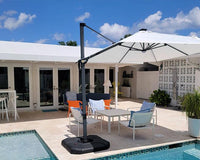
| Offset/cantilever | Separate base sits beside the table, not through it | Base can occupy the only clear floor zone if placed carelessly | Shade needs to sit beside rather than directly over the table, and the base fits outside the walkway |
A table umbrella with a fillable base is available in several canopy sizes, from 7.5-foot round up to 6.5-by-10-foot rectangular, with a 30-degree tilt, so you can match canopy size to how much of the table needs coverage without moving the support off the tabletop. If you'd rather keep the tabletop open and move shade beside the dining area, a cantilever umbrella base is offered in three sizes, with footprints from about 32.67 by 32.28 inches up to 39.83 by 39.83 inches depending on the model and its matching canopy size. Neither type is universally better: the base and support footprint that stays clear of your door and walkway is the one that works for your layout.
Verify Door, Railing-Walkway, and Umbrella Operation
A layout that measures out on paper still needs a live test. The door must open through its full range, the walkway must stay clear with furniture in place, and the umbrella must be one you can secure and close.
Run the door and walkway test
- Open the door through its complete swing with the table and chairs positioned as planned.
- Walk the required railing-side route from end to end.
- Check every chair in its pulled-out position, not just chairs currently pushed in, since a tucked-in chair can hide a collision that only appears when someone sits down.
Stop and reposition the furniture if the door can't open fully or the route is blocked by the table, a chair, or the umbrella base at any point in this test. The Access Board's guidance on continuous circulation paths uses a 36-inch clear width as a conservative planning reference for accessible routes; it's not a private-balcony furniture code, but keeping your walkway that open is a reasonable target if your railing-side path allows it.
Check umbrella setup and wind operation
Confirm the base you're using is listed as compatible with your umbrella's canopy size, and follow the manufacturer's setup and anchoring instructions exactly. The Consumer Product Safety Commission advises that you always secure the umbrella and anchor it as directed, and close the canopy immediately if it becomes unstable in wind. That instruction applies regardless of how well the umbrella fit your footprint on paper. For more on keeping a canopy from shifting once it's set up, see our notes on umbrella base matching.
If the Layout Fails, Change One Footprint Variable First
If your preferred dining arrangement fails, pinpoint the exact point of interference before altering the setup. Change only one variable at a time, such as picking a different table shape or swapping umbrella types, so you know which adjustment resolved the conflict.

Once that single variable is modified, rerun the full footprint and operation check from start to finish. Never accept a revised layout that still clips a door swing, constricts the railing passage, or traps a pulled-out chair.
FAQs
Can I use the same umbrella base for a different canopy size?
Not automatically. Base and canopy compatibility depends on the specific model, not a universal rule. As an example, our cantilever base line lists pairings by capacity: the 220-pound-capacity version is listed for 9-by-9-foot and 10-by-10-foot canopies, the 280-pound version for 9-by-12-foot and 11-by-11-foot canopies, and the 330-pound version for 10-by-13-foot and 12-by-12-foot canopies. Before filling or positioning any base, confirm the current pairing listed for your selected model rather than assuming it matches a different umbrella you already own.
Is there a standard balcony table size for four people?
No universal four-person minimum exists because chair depth, frame geometry, and balcony boundaries vary. A setup passes only when your table's outer dimensions and all four pulled-out chair positions fit comfortably within your measured usable rectangle.
When should I choose a center-pole umbrella over an offset model?
Choose a center-pole umbrella if your dining table includes a matching opening and the pole and base stay safely contained within the table footprint. Opt for an offset umbrella only when you require an unobstructed tabletop and have floor area outside your walkway for its larger freestanding base.