A lit patio umbrella is easiest to justify when you want shade plus localized evening ambience and the solar panel will receive usable daylight. A partially shaded site can work, but shade and obstructions may reduce available charging energy. If you need dependable light for reading, serving, or detailed dining tasks, require product-specific brightness and coverage information rather than treating LED presence as proof of task lighting.

Start by identifying the lighting job, observing daylight at the panel location, and comparing your planned event with the exact model's documented runtime. Then review the control routine, LED placement, canopy movement, replacement options, and storage instructions.

Choose a Lit Patio Umbrella by Evening Use and Sun Exposure
The right choice depends first on the job the light must perform and then on how much usable daylight reaches the panel. Use this split before comparing features:
| Evening job | Charging site and buying decision |
|---|---|
| Shade plus ambience in full sun | Strongest fit for integrated solar lighting when the panel receives direct daylight. Match the event duration to the model's documented runtime. |
| Shade plus ambience in partial shade | Conditional fit. Trees, buildings, and seasonal shade can reduce available charging energy, so observe the panel location and follow the exact product's charging instructions. |
| Functional light for serving, reading, or detailed dining | Treat the umbrella as unproven until the exact model documents brightness and usable coverage. LED presence alone does not establish task-light performance. |
| Seasonal outdoor dining | Choose only when you have a clear shutdown, drying, protected-storage, and service plan for the exact model. |
The panel's exposure matters more than whether the seating area looks bright. A patio can feel sunny while a tree, wall, canopy position, or changing seasonal angle shades the panel. For a solar LED patio umbrella, keep the purchase conditional when those factors are difficult to observe or the product does not document charging conditions.
Check Whether the Solar Panel Can Support Your Evening Runtime
Solar lighting depends on stored daytime energy for nighttime use, so panel exposure, battery storage, and evening demand need to be considered together. Solar energy storage basics explain the general relationship between stored daytime energy and later use. Compare the actual event duration with the exact model's documented runtime. If the product does not state charging conditions or runtime, the supportable conclusion is that it may provide ambience, but a full-evening result is not established.
Match the Panel to the Patio's Sun
Use this three-step site check before choosing a model:
- Observe direct daylight where the solar panel will sit during the hours when it is expected to charge. Account for trees, buildings, rooflines, and other obstructions. Shade and obstructions can reduce solar output.
- Consider whether opening, rotating, tilting, or closing the canopy changes the panel's exposure. The panel may not receive the same amount of light throughout the day.
- Follow the exact product's initial charging, indicator, and setup instructions. General solar principles cannot provide a missing umbrella-specific charging time.
A top-of-pole panel and a top-canopy panel also create different exposure questions. Judge the panel's location with the umbrella in its normal operating position, not only while the package is being assembled.
Turn the Event Into a Runtime Requirement
Write down the planned lighting duration, then compare it with the runtime stated for the exact model and setting. For example, the current PURPLE LEAF square model states up to 5 hours of illumination on a full charge and supports solar and USB charging. That is a stated maximum for that model under unspecified conditions, not a universal expectation for every solar LED patio umbrella. See the square model's stated runtime.
The measurable selection condition is simple: choose a model only when its documented runtime covers your planned event under its documented charging and operating conditions. When those conditions are absent, select based on shade and ambience rather than promising uninterrupted evening light.
Compare Controls and Light Placement for Nighttime Use
Nighttime usability comes from two separate details: whether you can operate the system easily after dark and whether the documented LED layout suits the area you want to accent. Neither control convenience nor LED placement proves brightness, coverage, or weather performance.
Test the Control Routine
Before buying, answer three practical questions:
- Where is the control with the canopy open, and can someone seated or serving reach it?
- What are the documented on, off, and mode steps, including behavior after low charge or storage if the instructions describe it?
- Does the routine suit repeated evening use, or would operating the light require moving around the umbrella each time?
The supplied information does not document the exact control type and mode sequence for every current model. Treat those details as product-specific questions instead of inferring them from the words "solar LED."
Read the LED Layout
Map the listed light location to the area you want to illuminate, while keeping the expected result modest:
| Documented LED detail | Buyer-visible effect to verify |
|---|---|
| Rib-mounted strips | Whether the light creates the desired canopy ambience around the seating area. |
| Center fixture | Whether the central position adds the visual focus you want without assuming a brightness level. |
| Listed color temperature | Whether the documented color option matches your preferred warm or neutral appearance. |
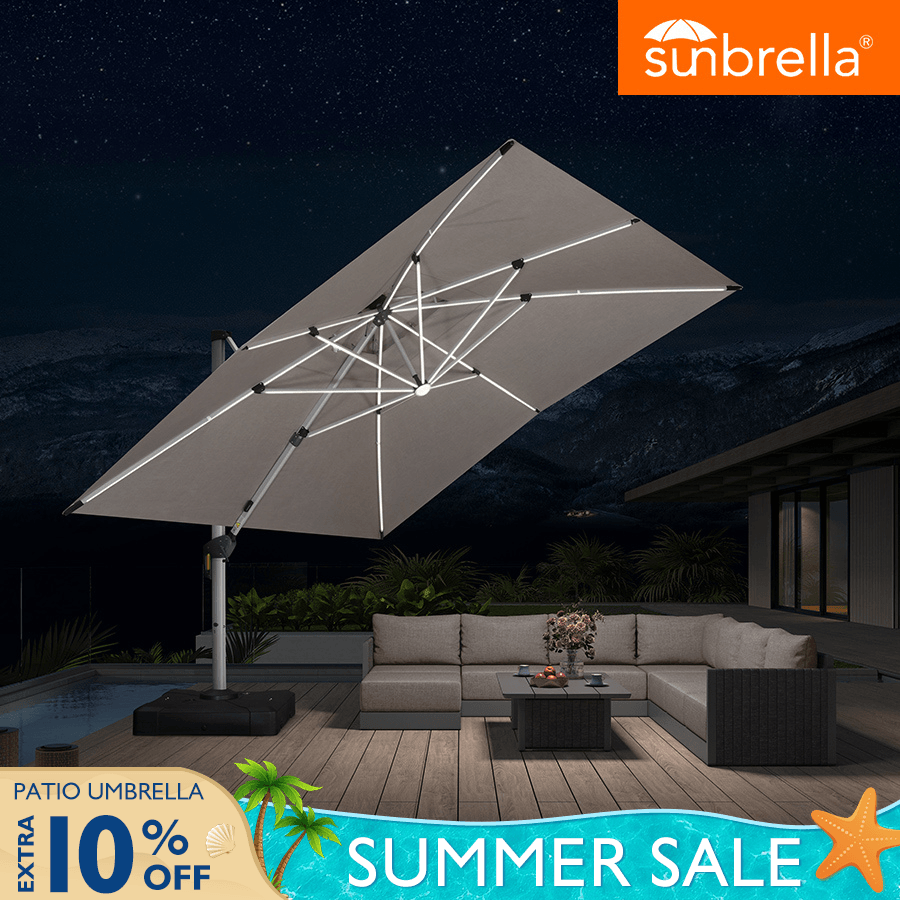
For example, the SUNBRELLA solar umbrella documents seven rib light strips, a center light, and 3200K and 4200K color-temperature options. Those facts support a placement and color comparison. They do not establish brightness, coverage, or suitability as a primary task light.
See How the Available Solar-LED Umbrellas Differ
These available options have useful documented differences in panel location, light layout, canopy movement, and materials. The evidence does not support ranking them by runtime, brightness, weather performance, or serviceability, so use the table to narrow the questions for the exact model.
| Available option | Supplied distinguishing detail and buyer relevance | Decisive fact still required |
|---|---|---|
| SUNBRELLA solar umbrella | Top-canopy solar panels, seven rib light strips, a center light, 3200K and 4200K options, 360-degree rotation, and six height adjustments. The page lists 100% SUNBRELLA fabric and a 5-year fabric warranty plus 1-year component warranty for this model. | Control sequence, runtime conditions, brightness, coverage, weather-use instructions, and battery or LED serviceability. |
| Rectangular LED umbrella | Top-of-pole solar panel, double-canopy rectangular design, 360-degree rotation, and six height and angle adjustments. | Runtime, brightness, control behavior, coverage, and component replacement terms. |
| 10-foot LED umbrella | Top solar panel, solar LED lighting, 360-degree rotation, left or right canopy tilt, crank operation, and LED+Swivel or LED Tube style variants. | Runtime, charging conditions, brightness, control behavior, weather instructions, and serviceable parts. |
Choose among these models by matching the documented physical arrangement to your patio first. A panel position that works on your site, a light layout that suits your ambience needs, and movement that fits your seating area are more defensible selection signals than an unsupported "brightest" or "best" label.
Confirm the Canopy Still Works Smoothly With Integrated Lights
Treat the lighting hardware as part of the operating routine, not as an isolated feature. Before installation, review the exact model's movement, clearance, and normal-use position.
- Movement: Verify the documented crank, lift, tilt, rotation, and locking steps with the canopy open. The rectangular model, for example, documents 360-degree rotation and six height and angle adjustments, but those features belong to that model only. The 10-foot model separately documents 360-degree rotation, left or right tilt, and crank operation.
- Component clearance: Look around the solar panel, wiring path, rib strips, and center fixture. Make sure the opening and closing routine does not require pulling on or pressing against lighting hardware.
- Operating position: Check whether the position used for shade also leaves the panel exposed and keeps the control reachable. A canopy adjustment can change both the light's visual direction and its charging exposure.
This check is especially useful for a lit patio umbrella beside a dining table or pool seating. The canopy should be practical to position before the lights are treated as an evening benefit.
Plan Parts, Service, and Off-Season Storage Before You Buy
Before buying, confirm the exact model's parts and support path. A standalone solar light needs stored energy to operate after dark, which makes the battery, charging path, controller, and load relevant to service questions. Let the exact product documentation determine what can be replaced or stored rather than making assumptions based on the word "solar."
Check the Service Path
Use this service checklist before placing the order:
- Identify whether the solar panel, battery, LED assembly, wiring, canopy, and ribs are separately serviceable or sealed for the exact model.
- Keep the model name, SKU, and order information available when asking about a replacement component. The replacement solar panel listing states that compatibility is model-specific and directs shoppers to customer service when the umbrella model is uncertain.
- Treat an accessories page as a discovery route, not proof that a part fits your umbrella. Match any component through exact model information.
The supplied information does not establish universal battery, LED, or wiring replacement for these models. Support access and model identification are therefore part of the buying decision.
Store the Umbrella Between Seasons
Use a conservative sequence for extended storage:
- Turn off the system and follow the exact model's instructions for charging, disconnecting, or removing batteries before storage.
- Inspect the canopy, frame, solar panel, light components, and visible wiring. Clean and fully dry the fabric and components before packing.
- Store the umbrella in the manufacturer-approved protected configuration, then inspect it again before reopening it for the next season. This general inspect, clean, dry, repair, and protect approach is also covered in off-season umbrella care.
Before you buy, match the exact model's documented service and storage instructions to your site, then choose it only if its runtime and support path fit your planned use.
Frequently Asked Questions
These questions focus on matching solar charging, light output, service, and storage to the exact umbrella model.
Are Solar Patio Umbrella Lights Worth It for Evening Entertaining?
They can be worth it when the goal is shade plus localized ambience, the panel receives usable daylight, and the exact model's documented runtime fits the event. If you need dependable light for reading or serving, require brightness and coverage evidence or plan a separate light source.
How Does the Solar Panel Location Affect Patio Umbrella Charging?
The panel's actual exposure matters more than the general brightness of the patio. Trees, buildings, canopy movement, and seasonal sun can change available charging energy, so observe the panel in its normal position and follow the exact setup instructions before relying on nighttime operation.
How Long Do Solar Umbrella Lights Last?
There is no universal runtime. For the exact square model cited here, the product page states up to 5 hours on a full charge, but the conditions are unspecified and that figure does not transfer to every model. Use the documented runtime for the model and setting you intend to buy.
Can You Replace the Battery or LED Lights in a Solar Patio Umbrella?
Do not assume they are replaceable. Ask support about the exact model and order information. Replacement-panel compatibility is model-specific, and the supplied product information does not establish universal battery or LED replacement.
How Should I Store a Solar-Lit Patio Umbrella for Winter?
Turn off the system, follow the exact model's battery and electronics instructions, clean and fully dry the canopy and components, and store the umbrella in the manufacturer-approved protected configuration. Inspect the solar, lighting, frame, and canopy before putting it back into service.